
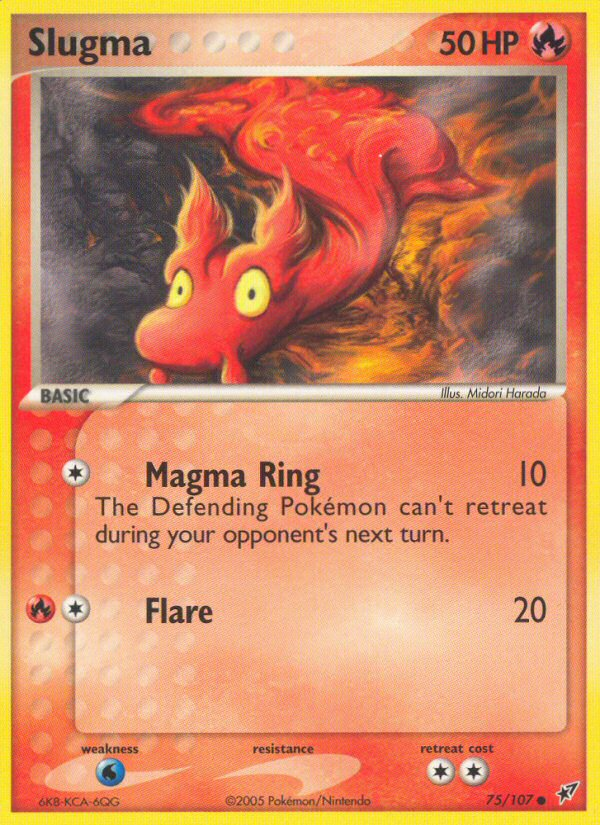
Image courtesy of TCGdex.net
Slugma and the Subtle Science of Grading: Why PSA and BGS Value Differently
For Pokémon TCG collectors chasing the right holo glow and the right price tag, the grade on a card can swing the perceived value as dramatically as the card’s power in a heated match. Slugma, a humble Fire-type Basic from the Deoxys era (ex8), offers a perfect case study. With 50 HP, two modest attacks—Magma Ring for 10 and the flame-kissed Flare for 20—and a vulnerability to Water, this little blazeball isn’t a tournament monster. Yet in the graded market, condition can turn ordinary into treasure. The PSA vs. BGS conversation isn’t about “which is better” so much as “which fits your goals.” Let’s dive into how these two grading powerhouses translate into value for a card like Slugma ex8-75, including its rare holo variant, and how collectors navigate the marketplace today. 🔥🎴
What makes Slugma special in this set?
- Card data snapshot: Slugma is a Basic Fire-type with 50 HP, hailing from the Deoxys (ex8) set. Its first attack, Magma Ring, costs a Colorless energy and prevents the Defending Pokémon from retreating on the opponent’s next turn, a handy lock for tempo games. The second attack, Flare, costs Fire plus Colorless and deals 20 damage. Its sole weakness is Water, which doubles the damage it takes. Midori Harada provided the artwork for this era, capturing the little magma sprite with a bright, nostalgic glow. The holo variant—featuring the set logo stamp—adds extra fanfare for collectors chasing shine.
- Rarity and evolution: Classified as Common, Slugma’s value in graded form hinges more on condition, holo presence, and population than raw power. It’s a great example of how rare variants (like holo vs normal) shift pricing curves even when base stats stay modest.
- Current pricing context: Market data shows a clear split between ungraded or non-holo copies and holo versions. Cardmarket prices hover with an average around EUR 0.41 for typical copies, but the holo market paints a brighter picture—average holo values sit higher, with notable spikes in pristine examples. On TCGPlayer, normal copies trend around low prices (~$0.18) to mid-range around $0.40, while holo copies frequently command higher market prices, sometimes climbing into the double-digit territory depending on grade and pop. This price desynchronization between holo and non-holo is a key battlefield for PSA vs. BGS strategies.
PSA vs. BGS: how their grading philosophies impact value
At a high level, both PSA and BGS aim to capture a card’s condition, but they do so with different methodologies that influence perceived value and eventual sale price. Here’s how it breaks down for a Slugma ex8-75—especially when you’re weighing a holo versus a non-holo copy.
- Grading approach: PSA uses a single numerical grade from 1 to 10 that sums a card’s overall condition into one snapshot. BGS, by contrast, offers a quartet of subgrades (Centering, Edges, Corners, Surface), each rated 1–10, and a separate overall label often expressed as a combination (e.g., BGS 9 with subgrades 9/9/9/9 or 9.5/9/9/9.5). Those subgrades provide a more granular read on where a card shines or falters. For a practical holo like Slugma, a pristine surface and clean centering can push a BGS subgrade score up, which in turn can lift the overall price more than a simple PSA 9 would. ⚡
- Subgrades and buyer confidence: BGS’s visible subgrades give buyers a quick technical read—any surface flaws or center misalignment are spelled out. In markets where collectors obsess over corners or gloss, BGS can signal a higher level of confidence when the surface and centering are strong. PSA’s single grade is simpler to digest, which can appeal to a wider audience but may obscure underlying weaknesses, potentially reducing the premium for borderline cards. 💎
- Population and demand: Population reports—the counts of how many copies have been graded at particular grades—drive scarcity signals. A holo Slugma ex8-75 with a flawless BGS 9.5/10 might sit in a tighter pool than a PSA 9, influencing price. Conversely, some buyers trust PSA’s long-standing market acceptance for vintage and mid-era cards; a PSA 10 on a holo can still carry a premium, but the supply dynamics vary by set and print run. The rarity label (Common) doesn’t vanish in graded markets, but the potential uplift from a pristine holo can be substantial when a card is scarce in top grades. 🔍
- Aesthetics and holder considerations: Many collectors prefer the look and feel of BGS slabs with crisp subgrades and black-core holders; others prefer PSA’s familiar, transparent case and simple labeling. The preference can tilt price expectations, especially among buyers who value a clean holo presentation—the way the light catches a Slugma’s molten sheen can be a big deal in photos and scans. 🎨
Putting it together: what this means for a Slugma ex8-75
Because Slugma is a Common card in the Deoxys set with a holo variant, the grading decision often hinges on the card’s surface gloss and centering. A holo Slugma with near-perfect centering and sharp corners will attract attention from both PSA and BGS buyers, but the path to premium pricing differs. A BGS 9.5 with strong surface and centering subgrades can fetch a heftier premium than a PSA 9, particularly if the population for holo copies at those grades is small. On the other hand, a PSA 10—while rarer for holo-era cards—still commands a strong premium and broad market acceptance, especially for collectors who want a single, clean grade without parsing subcategories. In practice, expect holo copies to push price more aggressively in the higher grades, and expect non-holo copies to sit at a more modest plateau unless they’re pristine in condition. 🔥
Market signals you can ride today
For collectors evaluating value, Slugma ex8-75 provides a teachable moment. The market clearly differentiates holo from non-holo—even more pronounced when grading enters the mix. Consider these practical takeaways:
- If you’re targeting a high-end resale or display piece, a holo copy in a top-graded slab (PSA 9.5/10 or BGS 9.5/10 with strong subgrades) will likely outpace a non-holo in the same grade bracket.
- Non-holo copies in top grades still perform well, but the premium tends to be tighter due to the abundance of holo examples in the vintage era.
- Be mindful of population data and current pricing curves from Cardmarket and TCGPlayer. The holo market often shows a broader swing in price tied to grade, while non-holo values are steadier but lower overall.
- When listing, highlight the card’s details—Midori Harada’s artwork, the Magma Ring locking mechanic, and the rarity nuance of Common with holo variants—to attract both gameplay-minded buyers and art-loving collectors. ⚡
Art, lore, and the value of nostalgia
This Slugma carries more than numbers on a grading label. Midori Harada’s art captures the tiny flame creature’s charm—a reminder that Pokémon cards are memories as much as they are investments. The Deoxys-era ex8 set sits at a potent crossroads of nostalgia and market realities, whereFans chase the glow of holo finishes and the crispness of high-grade condition. Grading differences illuminate those choices: PSA gives you a broad, easily comparable score, while BGS offers a richer diagnostic tapestry that can unlock premium pricing when the card’s four facets align perfectly. In the end, both paths lead back to the thrill of building a roster that looks as good as it plays—whether on a display shelf or in a competition binder. 🎨🎮
Phone Case with Card Holder MagSafe Polycarbonate Glossy MatteMore from our network
- https://crypto-acolytes.xyz/blog/post/giantsolmail-solmail-id-nft-stats/
- https://rusty-articles.xyz/tmppuvuc_83/shockproof-pc-tpu-armor-phone-case-with-wireless-charging.html
- https://crypto-acolytes.xyz/blog/post/nft-stats-solgod-3052-from-solgods-collection/
- https://blog.rusty-articles.xyz/blog/post/how-nihilego-gx-decks-foster-player-connection-in-tcg/
- https://wiki.digital-vault.xyz/wiki/post/pokemon-tcg-stats-luxio-card-id-sv02-070/
Slugma
Set: Deoxys | Card ID: ex8-75
Card Overview
- Category: Pokemon
- HP: 50
- Type: Fire
- Stage: Basic
- Dex ID: 218
- Rarity: Common
- Regulation Mark: —
- Retreat Cost:
- Legal (Standard): No
- Legal (Expanded): No
Description
Attacks
| Name | Cost | Damage |
|---|---|---|
| Magma Ring | Colorless | 10 |
| Flare | Fire, Colorless | 20 |
Pricing (Cardmarket)
- Average: €0.41
- Low: €0.05
- Trend: €0.32
- 7-Day Avg: €0.45
- 30-Day Avg: €0.72
Support Our Decentralized Network
Donate 💠More from our network
- https://crypto-acolytes.xyz/blog/post/giantsolmail-solmail-id-nft-stats/
- https://rusty-articles.xyz/tmppuvuc_83/shockproof-pc-tpu-armor-phone-case-with-wireless-charging.html
- https://crypto-acolytes.xyz/blog/post/nft-stats-solgod-3052-from-solgods-collection/
- https://blog.rusty-articles.xyz/blog/post/how-nihilego-gx-decks-foster-player-connection-in-tcg/
- https://wiki.digital-vault.xyz/wiki/post/pokemon-tcg-stats-luxio-card-id-sv02-070/