

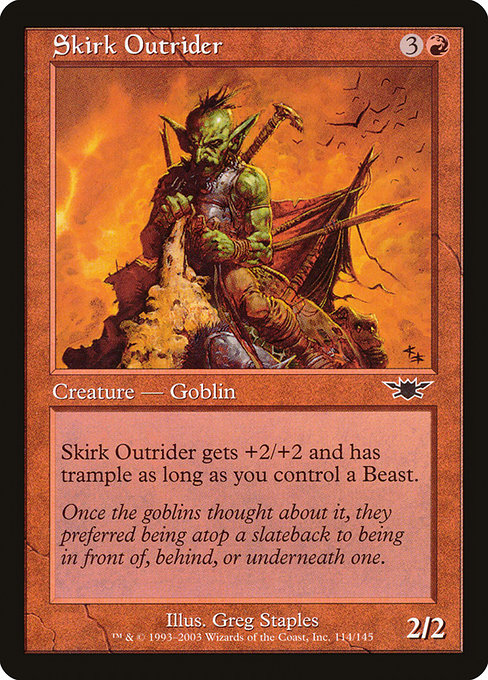
Image courtesy of Scryfall.com
Skirk Outrider: The Design Language of Rarity Indicators
Rarity in Magic: The Gathering isn’t just a static badge slapped on a card; it’s a carefully woven signal woven into art, flavor, and mechanics. From the boldness of a card’s mana cost to the subtle shimmer of a foil finish, rarity indicators whisper expectations about how a card will age in your collection and how it will perform on the battlefield 🧙♂️. Skirk Outrider, a creature from the Legions expansion (the 2003 era of chaotic goblin energy), is a textbook example of how design language uses rarity cues to shape both casual vibes and competitive nuance 🔥.
Meet the card, with its era-appropriate swagger
Legions introduced a new flavor of goblin mischief in a world where red chaos often crashed into tribal complexity. Skirk Outrider is a Goblin creature with a mana cost of {3}{R}, placing it in the tough-but-lightly-costed range that screams “play me if you’re racing to a big board.” It’s a 2/2 on the baseline, which feels modest until you factor in its condition: if you control a Beast, Skirk Outrider becomes a 4/4 with trample. That +2/+2 swing isn’t just numbers; it’s a design nudge that rewards a Beast-heavy board presence, a nod to tribal synergy that Wizards has stitched through countless sets 🧭⚔️.
The card’s rarity is listed as common, a designation echoed in its print runs and its foil vs. nonfoil finishes. The art, painted by Greg Staples, carries a black-border aesthetic that many players associate with early-2000s MTG design—no glittery watermark, just a sharp line between goblin chaos and a battlefield that’s about to break open. The flavor text adds a wink to goblin priorities, hinting that slatebacks—giant beasts you can ride into a skirmish—were preferable to the more chaotic positions goblins often find themselves in. This blend of mechanical amplification with flavorful context is exactly what rarity indicators are designed to communicate: value, risk, and a little lore all wrapped into one package 🧙♂️.
Rarity indicators as design language
On a card like Skirk Outrider, rarity manifests through several linked cues. The fact that it’s a common creature with a strong conditional ability is a deliberate tangle of power and accessibility: you can reliably include it in a deck without needing a fetch-heavy mana base, yet its effectiveness hinges on an additional board state (the presence of a Beast). The set Legions itself also frames rarity through its print approach, foils, and distribution typical of that era. The card’s foil print, priced modestly higher in collectibility terms (foil around $0.34 vs. nonfoil around $0.04 in USD), signals the collector appeal that accompanies even “everyday” cards when they’re foil-shocked into a 2003-era core idea. These structural choices—the mana curve, the conditional boost, the foil premium—are all part of the design language that communicates a card’s expected role in a casual game and its potential upside in a longer collector lifecycle 💎.
Design takeaways for deckbuilding and strategy
Skirk Outrider shines in Beast-friendly environments, but it also teaches a broader lesson about rarity-driven design. A common creature that can threaten as a 4/4 with trample when a Beast is on the board demonstrates how a card’s value isn’t only about raw power; it’s about timing, state, and synergy. In a red-dominant shell, you might run a Beasts subtheme or lean into even more aggressive, creature-rich decks where beasts are either your friends or your foes—either way, Outrider helps tilt the battlefield in your favor when the right pieces align 🧙♂️🔥.
For players chasing value, the foil version of Skirk Outrider offers a tactile, collectible payoff that mirrors the card’s rarity narrative. The card’s straightforward casting cost and swap-ready power make it a useful drop in various red-based strategies—particularly those that lean into thematic Beast interactions or a wider Goblin swarm that uses beasty supports as a force multiplier. The legend of rarity here isn’t just a sticker on a card; it’s a whisper about how often you’ll see it in your deck, how often you’ll want to flip it into play, and how much joy you’ll get dropping a 4/4 trampler on turn four in the heat of a chaotic board state 🎨.
Collectibility meets gameplay in a single glance
The Legions era is often remembered for its bold art direction and ambitious tribal ambitions, and Skirk Outrider embodies that spirit. The card sits comfortably in the “common” tier, yet its practical impact can loom large in the right moment. The dual finish, the vibrant red mana, and the Beast-dependent buff together form a microcosm of rarity design: choose power thoughtfully, reveal it at the right moment, and amplify it with a foil sheen if you want to chase that extra sparkle ⚔️.
Phone Click on Grip Kickstand Back Holder StandMore from our network
- https://blog.digital-vault.xyz/bolg/category/gaming/
- https://blog.crypto-articles.xyz/blog/post/nft-data-solle-105-from-solle-collection-on-magiceden/
- https://articles.zero-static.xyz/blog/post/exposed-copper-bulb-redstone-sensor-for-base-defense/
- https://wiki.digital-vault.xyz/wiki/post/pokemon-tcg-stats-espurr-card-id-sm6-44/
- https://crypto-acolytes.xyz/blog/post/nft-stats-doodle-bonk-23-from-doodle-bonk-collection/
Skirk Outrider
As long as you control a Beast, this creature gets +2/+2 and has trample.
ID: 416de0f4-1540-4286-a1ac-4f57301c54e9
Oracle ID: 40e52554-74e9-4d15-9a38-fc945f7d7ab8
Multiverse IDs: 42082
TCGPlayer ID: 10791
Cardmarket ID: 2095
Colors: R
Color Identity: R
Keywords:
Rarity: Common
Released: 2003-02-03
Artist: Greg Staples
Frame: 1997
Border: black
EDHRec Rank: 30005
Set: Legions (lgn)
Collector #: 114
Legalities
- Standard — not_legal
- Future — not_legal
- Historic — not_legal
- Timeless — not_legal
- Gladiator — not_legal
- Pioneer — not_legal
- Modern — not_legal
- Legacy — legal
- Pauper — legal
- Vintage — legal
- Penny — not_legal
- Commander — legal
- Oathbreaker — legal
- Standardbrawl — not_legal
- Brawl — not_legal
- Alchemy — not_legal
- Paupercommander — legal
- Duel — legal
- Oldschool — not_legal
- Premodern — legal
- Predh — legal
Prices
- USD: 0.04
- USD_FOIL: 0.34
- EUR: 0.08
- EUR_FOIL: 0.75
- TIX: 0.06
More from our network
- https://blog.digital-vault.xyz/blog/post/ledian-rom-hacks-reimagined-forms-moves-and-mods/
- https://blog.digital-vault.xyz/blog/post/tracing-handmade-paper-into-modern-texture-design/
- https://blog.digital-vault.xyz/blog/post/brick-stairs-in-the-end-for-creative-builds-120-tips/
- https://articles.zero-static.xyz/blog/post/mastering-clash-of-clans-through-advanced-combat-strategies/
- https://blog.crypto-articles.xyz/blog/post/nft-data-planet-kaiju-5670-from-planet-kaiju-collection-on-magiceden/