
Image courtesy of Scryfall.com
Shifting Tempo: How a Black Elf Cleric Changes Mid-Game Momentum
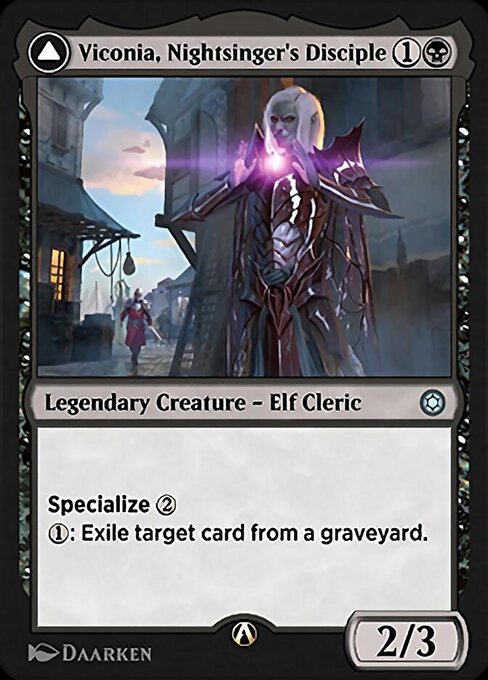
Magic: The Gathering has always rewarded players who read the room—the tempo connoisseurs who squeeze maximum value from every swing, every exile, and every carefully timed attack. In the realm of black-leaning engines, a single card can tilt the pace of a match from a quiet grind to a sudden, decisive shift. Viconia, Nightsinger's Disciple is one such card, a two-mana rarity of cunning that embodies the old adage: the best defense is a faster offense. 🧙♂️🔥 This legendary Elf Cleric from Alchemy Horizons: Baldur’s Gate brings not just a body on the battlefield but a toolbox of tempo-denial and disruption that sneaks up in mid-game when your opponent least expects it.
With a mana cost of {1}{B} and a sturdy 2/3 profile, Viconia is built to be a reliable early drop that doesn’t fade as the game unfolds. Her Specialize ability—costing {2} to activate—hands you a dynamic, upgrade-ready option as the board develops. The card’s true tempo hinge, however, is the triggered effect: {1}: Exile target card from a graveyard. In a world where the graveyard has become a bustling resource for graveyard-shift strategies, exiling a key threat or enabler at the moment you need it most can be the difference between a blown tempo and a clean, surgical swing. ⚔️
Let’s talk flavor and function side by side. In Black, tempo is often about control—removing obstacles, denying resources, and imposing a slower, more efficient plan on the opponent’s creature-driven offense. Viconia embodies that ethos with funeral-sack precision. Her ability to exile from a graveyard is not just removal; it’s graveyard hate with tempo. When you disrupt the opponent’s plan mid-game, you’re not merely buying a turn—you’re reshaping the decision space for both players. That’s how the card earns its keep in actual play: a resilient pivot that can stifle an opponent’s reanimation, graveyard-based card draw, or value engines while you maintain pressure on the battlefield. 🕯️💎
Consider the set’s broader flavor—the Nightsinger moniker conjures a window into the darker corners of the Baldur’s Gate mythos. Viconia’s cleric lineage adds a layer of inevitability: she’s not a runaway threat, but a measured, calculated one, the kind of strategist who knows when to pull the trigger. The card art by Daarken captures that calculating, midnight-tone mood, a fitting visual cue for players who love to ride the subtle wave of tempo shifts. The design encourages a mid-range plan: you’re often content to trade and stabilize, then spring a timely exile or a Specialize upgrade to turn the game in your favor. 🎨🧙♂️
Tempo levers and how to pull them
- Early drop, mid-game pressure: Viconia arrives on a solid body (2/3) for two mana, establishing a baseline of influence while you assemble your longer-term plan. The back-pocket exile ability gives you a reliable weapon against graveyard-centric decks that would otherwise outpace you with recursion and value. 🔥
- Specialize as tempo insurance: The Specialize cost invites you to invest into a flexible upgrade at the right moment. In practice, this means you can keep the board stable while you tune Viconia to a state that better suits the matchup—whether you need more resilience, additional disruption, or a more precise tempo window. The decision to Specialize often comes when you foresee a critical turn where a second, upgraded mode would swing your parity back into your favor.
- Graveyard exile as resource denial: Exiling a graveyard card doesn't just remove a threat; it denies the opponent a potential engine. Against reanimator builds, this is a direct tempo gain—your opponent’s plan stalls while you reestablish control of the board. 🧙♂️
- Synergy with the Viconia family: The card data hints at a broader arc: Viconia, Disciple of Arcana and the other Disciple lines—each offering their own flavor and utility. Building around this cycle can create a layered tempo strategy where you transition between variants as the game evolves, forcing your opponent to play reactively rather than executing a single, clean plan. While not all cycles are legal in every format, the design language signals a deliberate tempo-centric approach that can inform deck choices even outside of Arena play. ⚔️
In practical terms, you’ll want to lean into a deck that can sustain pressure while keeping a back-pocket exile option available for mid-game disruptions. Pair Viconia with removal and card advantage so you’re not just trading bodies, but curating a hand that keeps options open while your opponent’s graveyard strategies stall. Aesthetically and mechanically, this is the kind of card that shines when you can read the table: you don’t need a flashy endgame collapse if you’ve already made it uncomfortable for your opponent to execute their plan. 💎
Deck-building notes and playstyle guidance
For players who love mid-range, tempo-rich games, Viconia slots nicely into black-centric shells that prize efficiency and disruption. A few practical considerations:
- Tempo vs. value balance: Because Viconia is a two-drop with a decent body, you can stabilize the early game and still have mana to spare for Exile effects and Specialize maneuvers. Don’t overcommit to a race; instead, leverage Viconia’s resilience to weather early trades while you prepare the late-game plan. 🧙♂️
- Graveyard management: The exile ability is a gatekeeper against graveyard recursion. When you anticipate a reanimation or value engine, timing your exile to deny a crucial piece is often more impactful than removing a threat outright. This keeps the tempo on your side without overextending your resources. 🔥
- Pairings and orbiting cards: Look for synergistic cards that reward you for controlling the graveyard or that help you pivot after a Specialize upgrade. The flavor of the Alchemy Horizons set leans into flexible, evolving boards—the very space where Viconia can shine. 🎲
While Arena-era legality and the Alchemy Horizons environment shape how you’ll actually slot Viconia into a deck, the core principle remains: tempo is won by the quality of your exchanges and the timing of your graveyard disruption. If you relish mid-game pivots, Viconia provides a tactile and flavorful instrument to conduct the tempo orchestra. The card’s art, its lineage of Disciple variants, and its flexible Specialize mechanic all contribute to a play pattern that rewards patience, precision, and a dash of boldness. ⚔️
As with any MTG deck-building exploration, the joy lies in trying, failing, and refining your tempo calculus. The Night-sky quiet of black mana, the surgical exile of a graveyard card, and the upgrade-ready pulse of Specialize create a rhythm that’s as satisfying to play as it is to watch unfold on the battlefield. And when you land that decisive tempo swing, you’ll hear the crowd in your own head whisper, “That’s the moment.” 🧙♂️🎲
Phone Click On Grip Back Holder KickstandMore from our network
- https://wiki.digital-vault.xyz/wiki/post/pokemon-tcg-stats-togekiss-ex-card-id-xy9-83/
- https://wiki.digital-vault.xyz/wiki/post/pokemon-tcg-stats-arceus-lv-x-card-id-pl4-96/
- https://blog.digital-vault.xyz/blog/post/building-ai-powered-design-tools-for-creators/
- https://transparent-paper.shop/blog/post/how-to-create-profitable-photoshop-action-bundles-for-sale/
- https://blog.zero-static.xyz/blog/post/pikmin-4-community-wishlist-roundup-fans-ask-for-features/
Viconia, Nightsinger's Disciple
Specialize {2}
{1}: Exile target card from a graveyard.
ID: b965f765-35a8-471b-b9e1-d7d539b9ae1a
Oracle ID: bfd05128-6a04-49e9-8744-e044099358e3
Colors: B
Color Identity: B
Keywords: Specialize
Rarity: Uncommon
Released: 2022-07-07
Artist: Daarken
Frame: 2015
Border: black
Set: Alchemy Horizons: Baldur's Gate (hbg)
Collector #: 11
Legalities
- Standard — not_legal
- Future — not_legal
- Historic — legal
- Timeless — legal
- Gladiator — legal
- Pioneer — not_legal
- Modern — not_legal
- Legacy — not_legal
- Pauper — not_legal
- Vintage — not_legal
- Penny — not_legal
- Commander — not_legal
- Oathbreaker — not_legal
- Standardbrawl — not_legal
- Brawl — legal
- Alchemy — not_legal
- Paupercommander — not_legal
- Duel — not_legal
- Oldschool — not_legal
- Premodern — not_legal
- Predh — not_legal
Prices
More from our network
- https://crypto-acolytes.xyz/blog/post/nft-stats-poketardio-2109-from-poketardio-collection/
- https://wiki.digital-vault.xyz/wiki/post/pokemon-tcg-stats-dunsparce-card-id-ex2-60/
- https://blog.crypto-articles.xyz/blog/post/nft-data-llap-21-from-dhealth-live-long-and-prosper-series-collection-on-magiceden/
- https://articles.digital-vault.xyz/blog/post/pikmin-4-early-game-weapon-picks-guide-for-beginners/
- https://crypto-acolytes.xyz/blog/post/nft-stats-nuddies-1387-from-nuddies-collection/