

Image courtesy of Scryfall.com
Why Serpent Dancers Matter in MTG Canon
When you spot Serpent Dancers on the battlefield, you’re witnessing a moment that crystallizes how MTG canon can hinge on a single, deceptively simple creature. This token entry—creature type Human Reveler with a zero mana cost—reminds us that the story behind a card isn’t only about big dragons and legendary generals. It’s also about how a small, stubborn piece can tilt conversation, strategy, and even table dynamics in ways that echo through the multiverse 🧙♂️🔥.
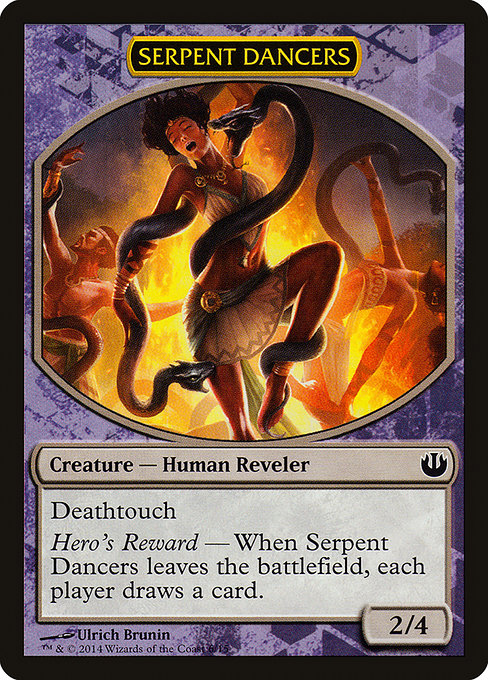
Mechanically, Serpent Dancers is unusual in the best way: a colorless, 0-CMC body with solid staying power (2 power, 4 toughness) and a fearsome ability. The card wields Deathtouch as a killer instinct—any damage from this diminutive dancer can wipe out larger threats with surgical precision. Its flavor supports a serpentine reverie: a troupe of performers dancing on the edge, where danger is part of the spectacle. The real hook, though, is the built-in social mechanic: Hero's Reward — When Serpent Dancers leaves the battlefield, each player draws a card. In a multiplayer setting, that line guarantees that every time this dancer exits stage left, the entire table gains a fresh handful of options, often reshaping the balance of power and negotiation in the flash of a single moment 🧩🎲.
“A 0-cost threat that forces a card draw for everyone is less about who wins the exchange and more about who can steer the narrative after the fact.”
Take a breath and consider the lore context: Serpent Dancers appears in the Defeat a God memorabilia set from 2014, crafted as a memorabilia insert rather than a standard-legal release. Its colorless identity makes it accessible across decks, while its common rarity ensures it’s not just a collector’s curiosity but a practical curiosity for players exploring risk-versus-reward table dynamics. The artwork by Ulrich Brunin emphasizes the ceremonial, almost mythic aura of a troupe that dances on the edge of peril—an aesthetic that MTG fans often associate with serpentine cunning and high-stakes masquerades 🎨💎.
From a design perspective, the card is a microcosm of MTG’s sandbox mentality. A token with real utility, it grows beyond a one-shot trick: its presence invites careful timing. If you can force tempo and tempo aside, you can use the “leave battlefield” trigger to yank a strategic card draw into play at a critical moment. In EDH (Commander) circles, where everyone brings deliberate card advantage to the table, Serpent Dancers can become a catalyst for late-game pivots, frantic comebacks, or dramatic standoffs ⚔️. Its fact that it’s not tied to a specific color means it slips into many color palettes—an understated but meaningful nod to MTG’s flexible design philosophy 🧙♂️.
Collectors and lore-crazed fans also relish Serpent Dancers as a symbol of MTG’s broader canon: mortals challenging the divine within a structured game of wits, risk, and strategy. The card’s set type, memorabilia, hints at moments that matter beyond the standard play experience—the kind of card that resonates with players who love the stories around the table as much as the mechanics on the page. The imagery of dancers, danger, and a moth-to-flame draw engine makes it a small but resonant piece of the MTG mosaic, a reminder that canon isn’t only about the most powerful combos but about the texture of play and the stories created in a match 🧭🔥.
For players who value synergy, Serpent Dancers encourages a style of play that blends tempo, threat density, and card advantage in a single breath. If your board is crowded, the “leave battlefield” draw can become a social equalizer or a tension-builder—depending on who’s holding the loom at that moment. It’s a card that rewards attention to table dynamics and a willingness to let the game breathe, letting a single moment unfold into a broader narrative. In other words, Serpent Dancers isn’t just a creature; it’s a narrative device that makes every disappearance feel momentous 🧙♂️🎲.
As a piece of MTG history, Serpent Dancers is also a reminder of the creativity that flourished in the 2010s. Its zero-cost design, coupled with a non-color mana identity, shows how designers and artists experimented with new textures for the collectible card game. It’s not the flashiest marquee card, but it embodies a certain charm—the quiet, cunning courage of a card that can swing a table’s mood just by leaving the battlefield. And that, in the grand Canon, is precisely the magic that makes MTG special ⚔️🎨.
- Zero-cost presence combined with Deathtouch makes Serpent Dancers a credible early drop that can threaten bigger bodies while remaining difficult to ignore.
- Hero’s Reward creates a unique social dynamic, turning a battlefield event into a shared card draw that reshapes planning and negotiation.
- Memorabilia design from the Defeat a God set highlights MTG’s willingness to explore story-rich, collector-friendly formats outside standard play.
- Flavor meets function in a token whose serpentine aesthetic and reveler identity tie into broader mythic themes across the Multiverse.
- Edition and accessibility—as a common, colorless token, it’s approachable for new players and nostalgic for longtime fans alike.
In the end, Serpent Dancers matter because they prove that in Magic, a card’s weight isn’t always measured by mana cost or combat stats. It’s about the conversations it starts, the table dynamics it reshapes, and the way it threads into the larger tapestry of MTG canon. It’s a reminder that sometimes the most memorable moments come from a single, elegant trigger that compels everyone to draw a card—and suddenly the game remembers who’s really in the driver’s seat 🧙♂️💎.
Neon Gaming Mouse Pad - Custom 9x7 Neoprene with Stitched EdgesMore from our network
- https://blog.rusty-articles.xyz/blog/post/daghatar-the-adamant-multiverse-event-catalyst/
- https://articles.zero-static.xyz/blog/post/mastering-redstone-wire-for-efficient-storage-systems/
- https://blog.rusty-articles.xyz/blog/post/top-heliolisk-cards-highlighted-by-this-artist-in-pokemon-tcg/
- https://crypto-acolytes.xyz/blog/post/nft-stats-hero-614-from-soul-gate-heroes-collection/
- https://crypto-acolytes.xyz/blog/post/nft-stats-vegeta-464-from-vegeta-nft-collection/

Serpent Dancers
Deathtouch
Hero's Reward — When Serpent Dancers leaves the battlefield, each player draws a card.
ID: f4210dae-7248-4a7b-9646-99683c0dce17
Oracle ID: cfe14f30-a413-41dc-82e6-48eef2e92fa8
Colors:
Color Identity:
Keywords: Hero's Reward, Deathtouch
Rarity: Common
Released: 2014-05-25
Artist: Ulrich Brunin
Frame: 2003
Border: black
Set: Defeat a God (tdag)
Collector #: 6
Legalities
- Standard — not_legal
- Future — not_legal
- Historic — not_legal
- Timeless — not_legal
- Gladiator — not_legal
- Pioneer — not_legal
- Modern — not_legal
- Legacy — not_legal
- Pauper — not_legal
- Vintage — not_legal
- Penny — not_legal
- Commander — not_legal
- Oathbreaker — not_legal
- Standardbrawl — not_legal
- Brawl — not_legal
- Alchemy — not_legal
- Paupercommander — not_legal
- Duel — not_legal
- Oldschool — not_legal
- Premodern — not_legal
- Predh — not_legal
Prices
More from our network
- https://blog.digital-vault.xyz/blog/post/mind-whips-flavor-cycle-hidden-lore-revealed/
- https://crypto-acolytes.xyz/blog/post/nft-stats-lil-chiller-939-from-lil-chillers-collection/
- https://wiki.digital-vault.xyz/wiki/post/pokemon-tcg-stats-team-rockets-persian-ex-card-id-sv10-150/
- https://crypto-acolytes.xyz/blog/post/nft-stats-jellylore-club847-from-jellylore-club-collection/
- https://wiki.digital-vault.xyz/wiki/post/pokemon-tcg-stats-unown-l-card-id-neo4-86/