
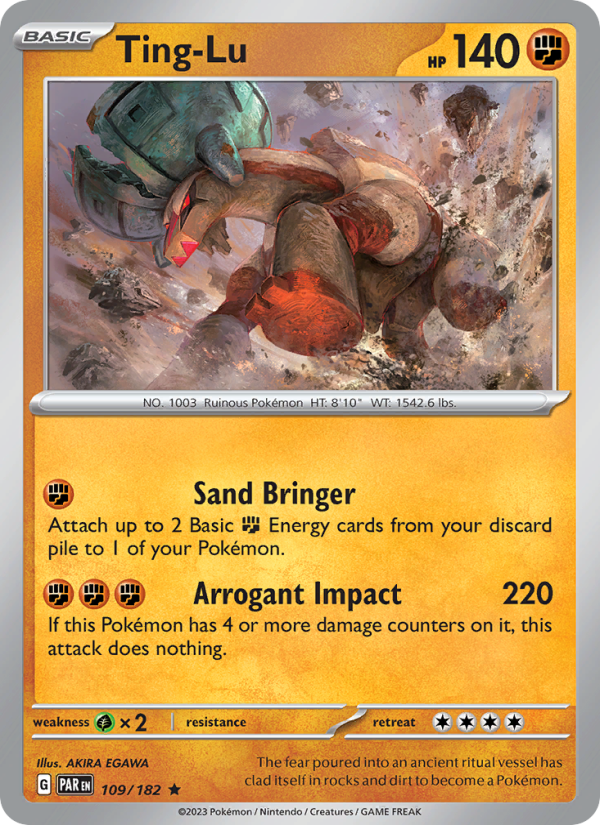
Image courtesy of TCGdex.net
Rotation Shifts Ting-Lu's Role in Standard Deck Builds
As the Pokémon TCG ecosystem continues to evolve with every rotation, big, heavy-hitting contenders like Ting-Lu find themselves redefined by the shift in available tools and archetypes. Ting-Lu, a Basic Fighting-type with 140 HP from the Paradox Rift subset (SV04), arrives on the battlefield with two potent options that shape its place in Standard decks. Illustrated by AKIRA EGAWA, Ting-Lu carries a compelling mix of energy acceleration and explosive finishing power, tempered by a self-imposed risk that players must navigate when the field tightens around them ⚡🔥. In this rotation-focused landscape, Ting-Lu’s Sand Bringer and Arrogant Impact are not just attacks—they are statements about tempo, resource management, and timing.
Why Ting-Lu fits into a post-rotation tempo game
Rotation typically whittles the pool of available support and energy acceleration, nudging players toward leaner, more directed lines. Ting-Lu’s Sand Bringer is a prime example of a card that gains value as the metagame emphasizes efficient energy management. For one Fighting energy, Sand Bringer lets you attach up to two Basic Fighting Energy cards from your discard pile to a single Pokémon. This is not a simple fetch—it’s a reset-and-accelerate option that can push Ting-Lu ahead on turns where you’ve weathered early hits and need to surge into a powerful late-game push. In a Standard deck, this can translate to a smoother trajectory from mid-game board presence to game-ending pressure, especially when other parts of your lineup support sustain and protection.
Meanwhile, the field-wide shift in rotation often reduces the number of ways to repeatedly refill energy from the deck itself. Sand Bringer bypasses some of that vulnerability by tapping the discard for fuel, letting Ting-Lu become a reliable anchor while you set up other attackers or heal-juggling lines. As you weave through the post-rotation sandbox, you’ll appreciate a card that can keep momentum in check—neither overextending you nor leaving you stranded when the prize attack arrives. Ting-Lu’s ability to push energy forward with intent makes it a natural partner to bench strategies that prize control and continuous pressure.
Arrogant Impact: timing the eruption, not just the damage
The other side of Ting-Lu’s power curve is Arrogant Impact, a formidable 220-damage strike that costs three Fighting Energy. It’s a heavy hit with a built-in caveat: if Ting-Lu has four or more damage counters on it, this attack does nothing. In rotation-sculpted formats, where fewer hard-hitting options exist to patch a damaged Ting-Lu quickly, this clause becomes a critical puzzle piece. It invites players to optimize the moment of the finisher—strike when Ting-Lu is sufficiently supported, either by healing infrastructure, protection lines, or a carefully timed retreat to a primed backline attacker. The net effect is a kit that rewards precise tempo, careful damage management, and the ability to sustain Ting-Lu long enough to deliver a decisive blow—without tipping into a state where Arrogant Impact is nullified by a mis-timed hit.
From a strategic standpoint, rotation nudges you toward combining Sand Bringer’s energy recycling with defensive or healing assets that keep Ting-Lu from tipping into the four-damage-counter threshold before you can land Arrogant Impact. It also encourages exploring matchups where you can threaten big tempo plays while your opponent’s removal options are constrained by the post-rotation card pool. In short, the big swing becomes a rhythm—build up momentum with energy acceleration, test the opponent’s defenses, and strike when the window is widest.
Deck-building implications in the post-rotation world
The Paradox Rift set, with Ting-Lu as a Rare Fighting-type, sits at a pivotal point for Standard players who value resilience and raw power. Ting-Lu’s basic status keeps it accessible on the bench, but the real juice lies in pairing it with support cards that stabilize the board and keep the damage counters in check. Rotations often prune out legacy accelerants, so Ting-Lu’s ability to pull energy from the discard becomes even more valuable when you need to rearm quickly after a big exchange. Strategists can lean into a build that emphasizes:
- Controlled energy cycling: use Sand Bringer to refill essential Energy while maintaining a defensive posture.
- Damaged-avoidance tools: healing or damage-prevention options that prevent Ting-Lu from tipping into the deadly four-counter threshold before you can unleash Arrogant Impact.
- Mid-game to late-game pivots: Ting-Lu as a durable wall that transitions into a knockout when the board state is right.
As with any rotation, the art is in balancing the raw power of Arrogant Impact with the reality of a smaller card pool. You may find yourself fielding Ting-Lu as a primary attacker only after securing several turns of safe setup, or you might deploy it as a bold secondary finisher that capitalizes on an opponent overextend. Either way, the flavor of Ting-Lu—its imposing silhouette, its 140 HP, and its dual-attack versatility—remains a cultural touchstone for the Paradox Rift era 🔥💎.
“Ting-Lu embodies the big-pivot mindset: accelerate energy, stall when needed, and strike with precision.”
Note that Ting-Lu is a basic Pokémon with a retreat cost of 4, regulation mark G, and a role that shines when the line-up around it is tuned to survive the mid-game barrage. Its artwork by AKIRA EGAWA adds a sense of weight and inevitability to its presence on the table, a reminder that, even as rotation reshuffles the landscape, some Pokémon carry a timeless aura of impact 🎴🎨.
Final thoughts for players chasing the rotation-driven meta
Rotation shifts the framework, but it also reveals the perennial truth of the Pokémon TCG: energy management, board control, and death-by-a-thunderous-hit all weave together to decide the winner. Ting-Lu offers a compelling combination of energy acceleration, a high-damage finishing option, and a set of constraints that reward careful play and adaptive deck-building. In Standard, its value comes from being a steady mid-to-late-game threat that can surge ahead when the sequence of plays is executed with discipline. For collectors and players alike, Ting-Lu from Paradox Rift is a card that not only performs on the table but also captures a moment in time when rotation reshapes strategy and storytelling in equal measure ⚡🎴.
Gaming Mouse Pad 9x7 Neoprene with Custom PrintMore from our network
- https://wiki.digital-vault.xyz/wiki/post/pokemon-tcg-stats-shaymin-card-id-sm5-15/
- https://articles.digital-vault.xyz/blog/post/black-carpet-texture-history-across-minecraft-versions/
- https://crypto-acolytes.xyz/blog/post/pullo-3093-pullo-nft-stats/
- https://wiki.digital-vault.xyz/wiki/post/servine-pokemon-tcg/
- https://blog.crypto-articles.xyz/blog/post/underwater-base-decor-potted-red-mushroom-ideas/
Ting-Lu
Set: Paradox Rift | Card ID: sv04-109
Card Overview
- Category: Pokemon
- HP: 140
- Type: Fighting
- Stage: Basic
- Dex ID: 1003
- Rarity: Rare
- Regulation Mark: G
- Retreat Cost: 4
- Legal (Standard): Yes
- Legal (Expanded): Yes
Description
Attacks
| Name | Cost | Damage |
|---|---|---|
| Sand Bringer | Fighting | |
| Arrogant Impact | Fighting, Fighting, Fighting | 220 |
Pricing (Cardmarket)
- Average: €0.07
- Low: €0.02
- Trend: €0.12
- 7-Day Avg: €0.09
- 30-Day Avg: €0.07
Support Our Decentralized Network
Donate 💠More from our network
- https://wiki.digital-vault.xyz/wiki/post/pokemon-tcg-stats-shaymin-card-id-sm5-15/
- https://articles.digital-vault.xyz/blog/post/black-carpet-texture-history-across-minecraft-versions/
- https://crypto-acolytes.xyz/blog/post/pullo-3093-pullo-nft-stats/
- https://wiki.digital-vault.xyz/wiki/post/servine-pokemon-tcg/
- https://blog.crypto-articles.xyz/blog/post/underwater-base-decor-potted-red-mushroom-ideas/