
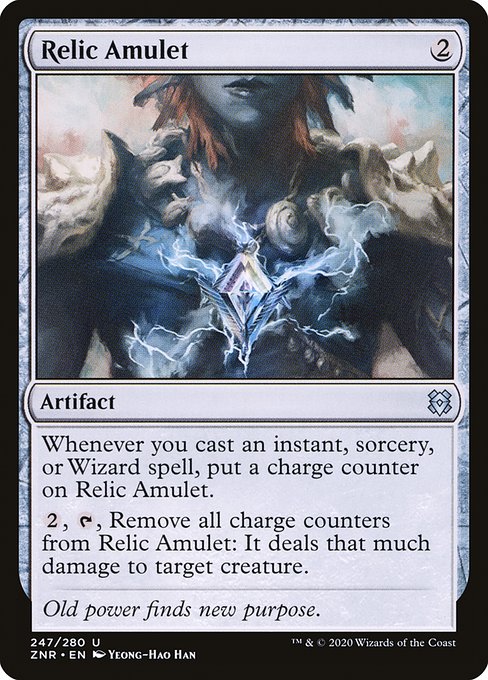
Image courtesy of Scryfall.com
Relic Amulet: Two-Color Mana Fixing Strategies
Two-color mana is the heartbeat of countless MTG decks, especially in Commander where you balance economy, tempo, and inevitability. Zendikar Rising gave us Relic Amulet, a humble artifact that doesn’t color-fix in the traditional sense, but it does something subtler and far from useless: it rewards you for casting instant, sorcery, and Wizard spells by piling charge counters on itself. As you cast more cheap cantrips and efficient spells to fuel the amulet, you unlock a late-game outlet that can pressure creatures or close the game. The art and flavor tell a quiet story: old power, reimagined through a modern spell-slinging lens 🧙♂️🔥. This is the kind of design that makes players grin when a mundane mana rock suddenly becomes a lever for real pressure 💎.
Let’s unpack how this colorless sturdy bit of metal fits into a two-color strategy. The amulet’s unconditional nature makes it a flexible companion for shells that rely on a rich density of instants and sorceries. It doesn’t care which two colors you’re pairing; it cares that you’re casting enough spells to feed its counters. In practice, this creates a continuum: you spend early turns building your mana base with dual lands or fetches, you pepper in cheap draw and removal, and you watch the amulet accumulate charge counters. When you finally decide to torque up, you tap ({2}, {T}) and remove all counters to deal that much damage to a target creature. It’s a neat, spell-slinger’s arc that can surprise blockers and keep attrition games honest 🎲.
Old power finds new purpose.
Strategic pillars for the two-color plan
- Spell density over raw fix: Prioritize inexpensive cantrips, efficient removal, and Wizard-themed spells to feed the amulet. The more spells you cast, the more counters you accrue, and the bigger your synthetic reach becomes. This works best when your mana base reliably hits both colors while you stay aggressive on the board 🧙♂️.
- Wizard inclusion as a catalyst: The trigger explicitly includes Wizard spells. If your two-color pair leans on a few Wizards (even as a splash), the amulet accelerates faster. This isn’t just about red or blue spell-power; it’s about turning a quiet artifact into a tempo engine that punishes stalled boards ⚔️.
- Complementary mana-fixers: Relic Amulet isn’t a mana-doubler; it’s a spell-density accelerant. Pair it with traditional color-fixers—dual lands, fetch lands, mana rocks, and signets—that keep your early turns packed with action. The colorless cost of charging is a relief when your curve includes multiple colors; you’re not fighting for color, you’re harnessing volume 🔧💎.
- Decision points for the late game: With a handful of counters amassed, you can leverage the amulet as a reach tool. If your opponent finally stabilizes, the optional removal can push through a key attacker or clear a troublesome blocker. It’s not always a one-turn win, but it’s a reliable bridge to your larger game plan 🧭🎲.
From a design perspective, Relic Amulet embodies how colorless value can interplay with colored strategies. It invites players to think not just in terms of mana costs and color requirements, but in terms of tempo, resource density, and spell-craft. In two-color shells, this means asking: which two colors support a high spell count, which spells help you curve, and which matchups will you tax with the amulet’s closing power? The result is a flexible, flavorful dynamic that rewards careful sequencing and creative deck building 🔥💎.
For practical deck-building, here are a few concrete ideas you can steal for your next two-color build. If you’re chasing Izzet flair (Blue-Red), you’ll lean into cheap cantrips like Opt and Serum Visions, removal like Shock or Lightning Bolt, and Wizards that love spell-based play. In an Azorius-leaning tempo shell (Blue-White), you’ll balance countermagic with cantrips and a few Wizard spells to juice the amulet without losing your control edge. If you’re exploring Simic-linked synergy (Blue-Green) or a more hybrid approach, the amulet still rewards you for casting spells while you sculpt a strong mana base that smooths two colors together. The key is to keep your spell density high enough to trigger consistently while maintaining enough sources to cast both colors on each turn 🧙♂️🎨.
As with any Zendikar Rising relic, the flavor invites a moment of reverence for the “old power” that refuses to stay quiet. The artwork by Yeong-Hao Han captures the artifact’s steady, patient potential, and the card’s flavor text nods to evolving purpose, a theme that resonates with many two-color commanders who bend old tools into new tempo engines. It’s a reminder that in MTG, even an artifact that looks simple on its face can be a linchpin for strategy, memory, and a few well-timed detonations of damage ⚔️💎.
Practical tips at the table
- Keep your mana rocks and dual lands in the mix, but don’t over-invest in a single color shard. You want consistent access to both colors while you feed the amulet’s counters 🧙♂️.
- Count on your cheap instants and cantrips to push through a trigger-heavy turn where the amulet starts to shine. A single turn of three or four spells can establish a strong trajectory for the rest of the game 🎲.
- Use the amulet as a late-game finisher or a tempo swing, not only as a damage outlet. If your board position is fragile, the amulet’s presence might deter a major attack or force a suboptimal block from your opponent 🔥.
More from our network
- https://articles.zero-static.xyz/blog/post/how-the-shadow-of-mordor-soundtrack-shapes-its-tone/
- https://articles.digital-vault.xyz/blog/post/sail-fossil-booster-openings-the-joy-of-discovery/
- https://crypto-acolytes.xyz/blog/post/nft-stats-nuddies-891-from-nuddies-collection/
- https://rusty-articles.zero-static.xyz/e98266f0.html
- https://blog.digital-vault.xyz/blog/post/vermin-gorger-deck-tech-mtg-influencers-weigh-in/
Relic Amulet
Whenever you cast an instant, sorcery, or Wizard spell, put a charge counter on this artifact.
{2}, {T}, Remove all charge counters from this artifact: It deals that much damage to target creature.
ID: 0ab97a84-fe8c-4986-afd8-3abdcc029f7f
Oracle ID: b3998d9c-56b1-486c-818c-a6882e999d54
Multiverse IDs: 491898
TCGPlayer ID: 222197
Cardmarket ID: 496830
Colors:
Color Identity:
Keywords:
Rarity: Uncommon
Released: 2020-09-25
Artist: Yeong-Hao Han
Frame: 2015
Border: black
EDHRec Rank: 18214
Penny Rank: 11463
Set: Zendikar Rising (znr)
Collector #: 247
Legalities
- Standard — not_legal
- Future — not_legal
- Historic — legal
- Timeless — legal
- Gladiator — legal
- Pioneer — legal
- Modern — legal
- Legacy — legal
- Pauper — not_legal
- Vintage — legal
- Penny — not_legal
- Commander — legal
- Oathbreaker — legal
- Standardbrawl — not_legal
- Brawl — legal
- Alchemy — not_legal
- Paupercommander — not_legal
- Duel — legal
- Oldschool — not_legal
- Premodern — not_legal
- Predh — not_legal
Prices
- USD: 0.09
- USD_FOIL: 0.21
- EUR: 0.05
- EUR_FOIL: 0.22
- TIX: 0.03
More from our network
- https://crypto-acolytes.xyz/blog/post/from-pixels-to-realism-the-evolution-of-3d-game-graphics/
- https://blog.zero-static.xyz/blog/post/how-tropico-6-devs-shaped-its-sandbox-with-key-choices/
- https://blog.digital-vault.xyz/blog/post/red-bp-rp-signature-reveals-a-hot-distant-giant-at-28-kpc/
- https://crypto-acolytes.xyz/blog/post/nft-stats-meta-muse-753-from-meta-muses-collection/
- https://blog.digital-vault.xyz/blog/post/photometry-opens-a-window-into-stellar-atmospheres-of-a-distant-blue-star/