
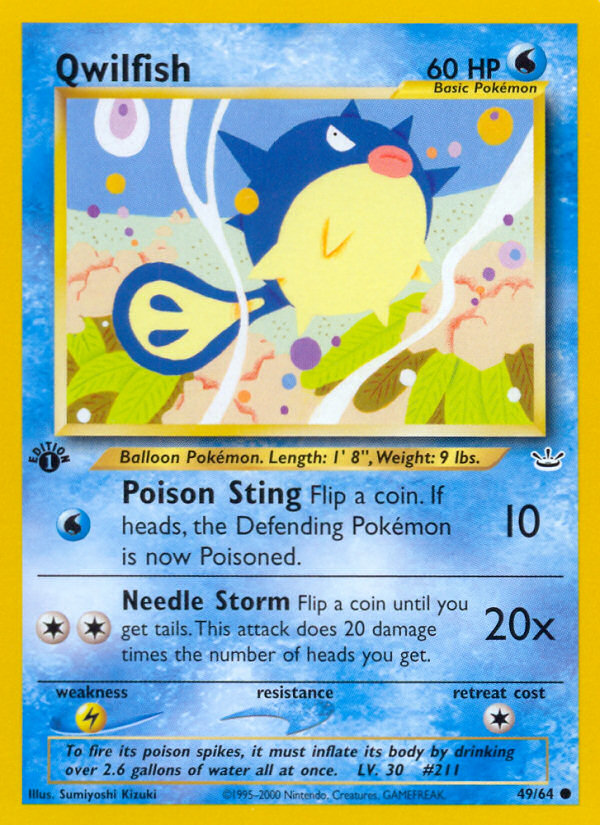
Image courtesy of TCGdex.net
Nostalgia in the Neo Revelation Era: Qwilfish and the Quiet Evolution of TCG Play
Long before alternating between VMAX shenanigans and tag-team boss battles, the Pokémon Trading Card Game lived in a simpler, coin-flip-fueled glow. The Neo Revelation era, represented by the Neo3 set, arrived with a draw-drop of classic watercolors, stamp foils, and the thrill of exploring a new generation’s mechanic palette. Among the water-leaning basics, Qwilfish stands out not for fireworks in big combos, but for the quiet nostalgia it evokes: a basic Water-type with a stubbornly stubborn defense, a couple of reliable attacks, and art that harks back to an era when deckbuilding centered on fundamentals and the joy of discovering a card’s potential in play rather than chasing the latest gimmick.
Qwilfish here is a Basic Pokémon with 60 HP, a modest footprint in the evolving meta, and a design by Sumiyoshi Kizuki that captures the spiky, water-drenched charm of late-90s Pokémon. The Neo Revelation set (neo3) carries the set symbol that many collectors memorize—the little badge that says you’re holding a piece of a pivotal transitional era. This card’s rarity is Common, making it accessible to players and collectors who want a tangible link to the game’s early days without spending fortunes. Its first-edition variant, stamped and cherished by those who chase the aura of early print runs, is a reminder that nostalgia isn’t just about the card’s power; it’s about the memory of opening a pack and finding something that felt like a whisper from a different youth.
Two Attacks, Two Flavors of Nostalgia
Qwilfish’s two attacks crystallize the generation-agnostic rhythm of early TCG gameplay. Its first attack, Poison Sting, costs a single Water Energy and deals 10 damage with a chance to poison the Defending Pokémon. It’s simple, reliable, and evokes the era when status conditions mattered as much as raw damage—an invitation to plan around poison counters and the tempo of a match. The second option, Needle Storm, costs two Colorless energies and delivers a big variable payoff: 20 damage times the number of heads you flip before tails, with the flips continuing until tails appear. That mechanic—an ongoing coin-flip gamble that could swing the game—feels like a callback to a time when players embraced risk as a core part of strategy, not a byproduct of complex combos.
Weakness is a blunt but telling detail: Qwilfish mats up against Lightning, taking ×2 damage from that type. In the Neo Revelation landscape, that wasn’t just a stat line—it shaped how players built decks and navigated the meta’s evolving type matchups. The card’s Water typing and the coin-flip nature of Needle Storm gave players a tactile, memory-rich way to approach risk and calculation: how many hits to press, how long to rely on the luck of the draw, and which energy lines to balance for maximum effect.
Art, Set, and the Collector’s Eye
Sumiyoshi Kizuki’s illustration for Qwilfish captures the era’s aesthetic: crisp lines, bold color boundaries, and a sense of motion that makes the spiny Water Pokémon feel ready to pounce or deflect with a flick of the tail. The Neo Revelation set itself is a gateway to the early days of the expansion cycle—64 cards officially in the set (with a total of 66 in print runs), and a symbol that nostalgically signals a slot in a larger narrative of discovery. The “1st-edition” stamp—present on some printings—adds an extra layer of collectibility for fans who seek the tactile memory of hunting down the first wave of prints from this era.
From a collector’s viewpoint, Qwilfish stands as a prime example of how “common” can still feel special. It isn’t a powerhouse in today’s competitive sense, but its charm lies in accessibility and the story it shares with players who started their journey in the late 1990s and early 2000s. When you pair the card’s status as a common staple with its distinctive Neo Revelation artwork, you get a piece that’s both playable in nostalgia-driven casual setups and desirable for a focused, period-specific collection.
Market Pulse: Value, Rarity, and What It Means to Collect
For modern collectors eyeing Neo Revelation staples, Qwilfish offers a compelling lens into market dynamics. The price meta reflects its status as a Common card with limited playability today but significant nostalgia. Cardmarket data (updated 2025-11-20) shows an average around €0.55 with a wide swing from as low as €0.02, hinting at the card’s role as an affordable entry point for Neo Revelation enthusiasts. The pricing trend is modestly positive, signaling steady, collectible interest rather than explosive growth—precisely the mood for a set that thrums with memory more than with meteoric market spikes.
TCGPlayer’s figures (updated 2025-11-19) illustrate a similar story. For 1st-edition copies, low prices hover near $0.51, with mid prices around $1.15 and highs around $2.20. Unlimited copies show even broader ranges, with low prices near $0.19 and market prices around $0.51, peaking at nearly $4.99 for rarer examples. This spread confirms what many vintage lovers already know: the Neo Revelation era rewards patient hunting and the joy of completing a line more than chasing a high-dollar trophy. For a card like Qwilfish, the value isn’t just in the damage it can dish out; it’s in the doorway it opens to the memory of your first pulls and your first pivotal coin-flip moments in a game that felt smaller, purer, and wonderfully tactile.
Deckbuilding Nostalgia and Practical Play Today
While Qwilfish may not see tournament staple status in the current standard or expanded formats, it still offers a delightful exercise in retro deck design. A nostalgic mono-Water build can center around basic attackers and status effects, pairing Qwilfish with other Water-types from the era to create a tempo-based match where poison and calculated gambles determine the pace. The simplicity of the attacks invites experimentation with energy acceleration, trainer support from the Neo era, and the charm of coin-flip resolutions that felt like a coin-toss fate deciding the match’s arc.
For modern collectors who want a tactile bridge to past playgrounds, this card’s unassuming power is part of its allure. It’s a conversation starter—an artifact that invites players to reminisce about the days when opening a booster could feel like unsealing a small piece of history. The Neo Revelation line, including Qwilfish, reminds us that nostalgia in the Pokémon TCG often rests not in the most formidable cards, but in the shared experiences of a community that grew up with these images, coins, and the thrill of a well-timed Needle Storm.
Round Rectangular Vegan PU Leather Mouse Pad CustomizableMore from our network
Qwilfish
Set: Neo Revelation | Card ID: neo3-49
Card Overview
- Category: Pokemon
- HP: 60
- Type: Water
- Stage: Basic
- Dex ID: 211
- Rarity: Common
- Regulation Mark: —
- Retreat Cost:
- Legal (Standard): No
- Legal (Expanded): No
Description
Attacks
| Name | Cost | Damage |
|---|---|---|
| Poison Sting | Water | 10 |
| Needle Storm | Colorless, Colorless | 20x |
Pricing (Cardmarket)
- Average: €0.55
- Low: €0.02
- Trend: €0.56
- 7-Day Avg: €0.33
- 30-Day Avg: €0.52
Support Our Decentralized Network
Donate 💠More from our network
- https://wiki.digital-vault.xyz/wiki/post/pokemon-tcg-stats-seel-card-id-swsh11-033/
- https://transparent-paper.shop/blog/post/stable-diffusion-xl-prompt-retro-futurism-noir-sci-fi-crosshatch-texture-neon-glow-midnight-palette-poster-art/
- https://blog.rusty-articles.xyz/blog/post/regional-variants-in-scarlet-violet-and-energy-loto-explained/
- https://blog.zero-static.xyz/blog/post/which-legendary-recurring-characters-tie-to-irrefutable-evidence/
- https://blog.crypto-articles.xyz/blog/post/nft-data-chubby-ape-gen2-1790-from-chubby-ape-gen2-collection-on-magiceden/