

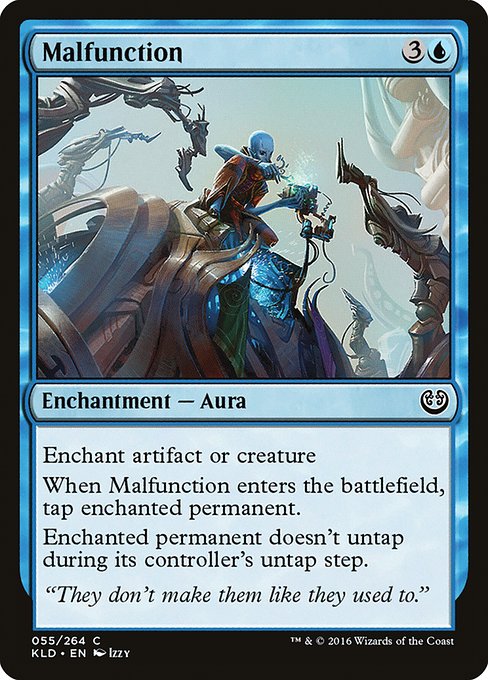
Image courtesy of Scryfall.com
Rarity Scaling and Set Balance for Malfunction in MTG
In the swift, copper-and-gold world of Kaladesh, blue magic often wears a mask of precision and tempo. Malfunction arrives as a blue Aura with a humble mana cost of {3}{U}, a common rarity in a set that worships artifact synergy and the art of controlled stoppage. Its simple truth—“Enchant artifact or creature; When this Aura enters, tap enchanted permanent; Enchanted permanent doesn’t untap during its controller’s untap step.”—is a masterclass in twitchy, hiccup-in-the-outer-world card design. 🧙♂️🔥
“They don't make them like they used to.”
That flavor line sits at the crossroads of Kaladesh’s gleaming machines and blue’s patient, tinkering mind. Malfunction isn’t flashy. It doesn’t win the game by itself. What it does do is tilt the tempo, force an opponent into awkward decisions, and reward smart timing. In other words, it’s a quintessential tempo tool: not a knockout punch, but a precise jab that shapes the pace of the battlefield. ⚔️
Design and Mechanics: A Blue Spark in a Colorful Set
Malfunctions’ aura-locked target is a deliberate design choice. Enchanting an artifact or a creature means you can disrupt the opponent’s board presence whether they lean on a beefy beater or a key piece of their artifact-synergy strategy. The ETB tap is immediate pressure, and the rule that the enchanted permanent “doesn’t untap” adds a long tail of effect—potentially locking down a threat across a full turn cycle. In Kaladesh, where artifacts, vehicles, and clever tempo plays define many games, that small swing can ripple into larger advantages as the game progresses. 🧩💎
From a rarity scaling perspective, Malfunction is notable. In a set where rares and mythics often hoard big-board effects or multi-turn inevitabilities, a common aura that compresses a board state is unusually efficient at common-play levels. It rewards skilled timing, not raw mana investment, which makes it a natural fit for limited formats where the power curve is tight and space is precious. The card’s cube-like design—trade a temporary lock for tempo pressure—also resonates with blue’s identity as the color of exacting control and reversible plans. 🎨
Rarity Scaling and Set Balance: Why Common Auras Matter
Rarity scaling is the careful art of calibrating a card’s impact as a format evolves. In Kaladesh, Malfunction’s common status provides accessibility without overwhelming the board. If a similar effect were to migrate to a higher rarity in a future reprint or a different set, designers would weigh several factors: cadence with other tempo picks, the density of defending-permanent targets, and how often the aura could be packed into multiple copies in limited pools. The balance question isn’t merely “is it good?” but “does it era-match the other tools in blue’s arsenal and the artifact-heavy ethos of Kaladesh?” 🔬⚙️
In constructed contexts, Malfunction’s value shifts with the metagame. In formats where many players rely on untapped or recurring permanents, the aura’s tap-and-lock flavor can be a meaningful front-end interaction—especially against artifact-based decks that hinge on a critical permanent staying untapped. Yet, as a common-level piece from Kaladesh, it tends to be outpaced by more explosive or multi-effect spells in high-power environments. That’s precisely the intention: it remains a reliable pick for tempo decks without destabilizing the broader power balance. 🧭
Strategic Use: When to Deploy Malfunction
For a blue-control or tempo deck, Malfunction shines as a first-pivot answer to a key threat. You can drop it on an opposing creature that’s about to attack, or on a crucial artifact that enables big plays, and then push forward with your own plan while their board remains stifled. It’s particularly effective in Kaladesh’s environment, where artifacts and vehicles feature prominently, and many decks rely on a single multi-turn thread to win. The aura’s limited target (artifact or creature) also helps avoid over-reach in games littered with enchantments, a common hazard in artifact-heavy metagames. 🧙♂️🎲
Deck builders can pair Malfunction with untap-locked synergies, such as follow-up counterspells, bounce effects, or cheap evasive threats that pressure an opponent’s position while they’re stuck tap-dancing. The combination creates a classic blue tempo arc: slow down, buy time, and win with precise disruption. If you’re piloting a cube or a casual commander list with artifact-heavy themes, Malfunction can slot into color blue’s wheelhouse as a steady, repeatable disruption tool. 🔧🌀
Art, Lore, and Collector Value
Izzy’s art for Malfunction captures that gleaming, slightly mechanical aesthetic Kaladesh perfected. The card’s flavor text hints at a culture that admires innovation but respects the cost of a machine that misfires—a perfect mirror to blue’s love of mastery and caution. As a common with a foil option, Malfunction remains approachable for players chasing budget-friendly builds or those seeking a reliable sideboard gem in formats where a single aura can swing a match. The current price reflects its common status, but foils and print variants can still spark collector interest among players who appreciate Kaladesh’s clockwork charm. 💎
Practical Deck-Building Tips
- Prioritize early interaction. In the first few turns, Malfunction can set your opponent back enough to swing tempo in your favor.
- Pair with mana-efficient interaction. Since the aura costs {3}{U}, look for ways to accelerate or protect it with counterspells or cantrips to maximize its uptime.
- Maximize targets. In artifact-heavy metas, the option to enchant artifacts increases your hit-rate, especially when the opponent relies on critical equipment or vehicles.
- Be mindful of enchantment hate. If your metagame features mass removal or enchantment destruction, Malfunction can be a temporary buffer rather than a lasting lock—plan your sequence accordingly.
- For Commander players, consider commander synergy. A well-placed Malfunction can pause a key artifact-based strategy and open doors for game-winning plays later in the game. 🧙♂️⚔️
More from our network
- https://blog.digital-vault.xyz/blog/post/integrating-photography-with-digital-paper-design/
- https://crypto-acolytes.xyz/blog/post/catalog-fusion-reveals-hot-blue-white-giant-in-scorpius/
- https://crypto-acolytes.xyz/blog/post/nft-stats-nft-164-from-deb00tyclub-ii-collection/
- https://wiki.digital-vault.xyz/wiki/post/pokemon-tcg-stats-mantine-card-id-a3a-010/
- https://blog.zero-static.xyz/blog/post/razor-hippogriff-reveals-its-planes-culture/
Malfunction
Enchant artifact or creature
When this Aura enters, tap enchanted permanent.
Enchanted permanent doesn't untap during its controller's untap step.
ID: c41f907f-4512-4c5d-827b-fef04613d641
Oracle ID: d2f98983-f395-4166-aa5a-309b4769baab
Multiverse IDs: 417628
TCGPlayer ID: 123142
Cardmarket ID: 292812
Colors: U
Color Identity: U
Keywords: Enchant
Rarity: Common
Released: 2016-09-30
Artist: Izzy
Frame: 2015
Border: black
EDHRec Rank: 25157
Penny Rank: 16309
Set: Kaladesh (kld)
Collector #: 55
Legalities
- Standard — not_legal
- Future — not_legal
- Historic — legal
- Timeless — legal
- Gladiator — legal
- Pioneer — legal
- Modern — legal
- Legacy — legal
- Pauper — legal
- Vintage — legal
- Penny — legal
- Commander — legal
- Oathbreaker — legal
- Standardbrawl — not_legal
- Brawl — legal
- Alchemy — not_legal
- Paupercommander — legal
- Duel — legal
- Oldschool — not_legal
- Premodern — not_legal
- Predh — not_legal
Prices
- USD: 0.05
- EUR: 0.04
- EUR_FOIL: 0.17
- TIX: 0.04
More from our network
- https://crypto-acolytes.xyz/blog/post/nft-stats-bpw-585-from-bonk-puppets-collection/
- https://crypto-acolytes.xyz/blog/post/nft-stats-zmb3y-5135-from-zmb3ys-collection/
- https://wiki.digital-vault.xyz/wiki/post/pokemon-tcg-stats-paras-card-id-swsh11-004/
- https://blog.zero-static.xyz/blog/post/zephyrim-signed-copies-mtg-auction-trends-and-value/
- https://wiki.digital-vault.xyz/wiki/post/pokemon-tcg-stats-froakie-card-id-b1-071/