
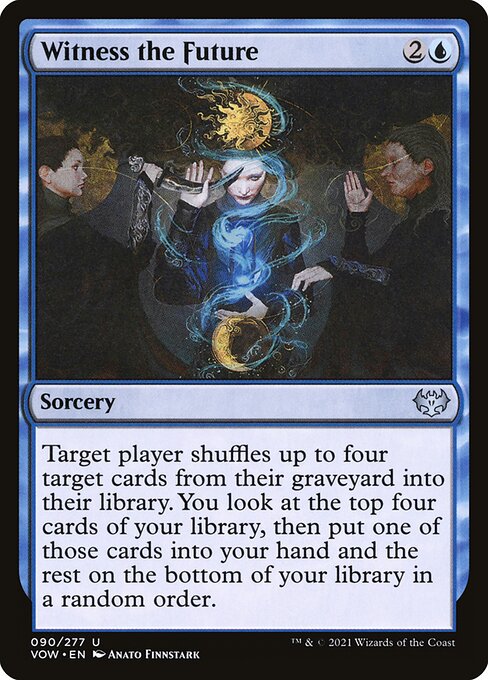
Image courtesy of Scryfall.com
Reading the rarity signals: how MTG communicates value at a glance
Magic: The Gathering isn’t just about clever combos and flashy battles; it’s also a living library of design language. Rarity indicators—those tiny cues tucked into every card’s frame—are a compact guide to expectations, reprint history, and even price habits. When you study a blue Sorcery like Witness the Future from Innistrad: Crimson Vow, you can see how rarity nudges the eye and the mind, signaling not just how strong a card might feel in play, but how often you’ll encounter it in booster packs or in trade piles 🧙♂️. The card’s blue mana cost, its uncommon status, and its strategic effect all dance together to offer a precise micro-lesson in design language 🔵.
How rarity is encoded in Innistrad: Crimson Vow
Rarity in MTG is traditionally conveyed through a few reliable design levers that players learn to read without pulling out a catalog. For Witness the Future, a few signals stand out:
- Set symbol color: The color of the expansion symbol (the mark near the bottom corner) is a quick clue. Common symbols tend to be darker, while Uncommons lean toward silver/gray, Rare cues glow gold, and Mythic Rares pop with an orange tone. This color cue travels with the card through foiling and reprints, creating a consistent shorthand across a sprawling multiverse 🪄.
- Foil and non-foil finishes: The presence of a foil treatment is itself a rarity signal. Foiled variants command higher attention and, often, price. Witness the Future is printed in both foil and non-foil, giving players a tactile sense of value depending on how the card lands in their collection ✨.
- Frame and border artistry: The 2015 frame associated with the Modern card pool carries a certain weight and silhouette that fans recognize. While the frame doesn’t declare rarity outright like the symbol does, it reinforces the set’s atmosphere and the card’s place within it. Innistrad: Crimson Vow’s Gothic motifs pair with its rarity signals to deliver a cohesive, collectible vibe 🎨.
Speaking specifically about Witness the Future, the card is an uncommon from Innistrad: Crimson Vow (VOW). Its mana cost of {2}{U} keeps it in a sweet spot for tempo and card selection, while its effect—shuffling up to four graveyard cards back into the library, then letting you peek and pick a card from the top four—offers built-in subtlety. It’s the kind of spell that rewards careful deck design and sequencing, not brute force. That alignment between power level and rarity is exactly what rarity indicators are meant to reinforce: you feel you’re getting something special, yet you know you can’t savagely spam it in every game. 🔎⚡
Design language at play: why rarity matters in play and value
From a gameplay perspective, uncommon cards like Witness the Future often strike a balance: they deliver meaningful value without eclipsing the more consistently available commons or the high-impact mythics. This balance helps keep formats diverse and dynamic. In practice, the card’s ability to manipulate a graveyard and library structure can enable resilient draws while nudging opponents into cautious play—an elegance that mirrors the elegance of a well-chosen rarity tier. The rarity indicator nudges players to consider how often they’ll see the card in booster packs, how it fits into price bands for casual collections, and how its foil form can stand out in a binder, a deck box, or a display case 🔥💎.
Collectors often notice how rarity interacts with printing and reprint cycles. An uncommon like Witness the Future may float around a modest price point, but foils can attract a premium due to their visual shimmer and demand among players who want to showcase their favorite blue control spells. The Scryfall price data—accessible, current snapshots show the card around a few cents in non-foil and a small uplift for foils—illustrates how rarity translates into market behavior. The nuance here is not just about raw power but about the story a card tells—how often you’ll reach for it, how it looks in your binder, and how it feels when you flip through a booster pack and glimpse that silver or gold symbol 🔍🧊.
As designers and players alike celebrate the joy of discovering new cards, the design language of rarity indicators remains a social contract. It says, in effect: “Here is something you can chase, but not something you can rely on appearing in every pick.” That tension fuels conversations, theorycraft, and even the way players curate their play spaces. And that sense of anticipation is part of what makes your next sealed event feel like a treasure hunt ⚔️🎲.
On a meta level, this is also where cross-promotional storytelling shines. If you’re a fan who loves the art, the lore, and the tactile feel of foil shining in a tournament hall, you’re already tuned into the broader MTG ecosystem—where rarity is the quiet conductor behind a thousand little decisions you make at the table 🧙♂️. That’s the magic of design language in motion: it nudges your choices without shouting, inviting you to explore more, collect a little more, and play a little smarter each time you shuffle up.
Slim Glossy Phone Case for iPhone 16 Lexan PCMore from our network
- https://crypto-acolytes.xyz/blog/post/nft-stats-topu-inc-537-from-topu-inc-collection/
- https://transparent-paper.shop/blog/post/distant-hot-blue-star-defies-parallax-assumptions/
- https://blog.digital-vault.xyz/blog/post/distant-blue-beacon-31173-k-temperature-from-teff_gspphot/
- https://crypto-acolytes.xyz/blog/post/nft-stats-rage-guy-711-from-rage-guys-collection/
- https://blog.crypto-articles.xyz/blog/post/what-jangmo-o-regional-variants-reveal-in-the-pokemon-tcg/
Witness the Future
Target player shuffles up to four target cards from their graveyard into their library. You look at the top four cards of your library, then put one of those cards into your hand and the rest on the bottom of your library in a random order.
ID: d0b3683f-a68b-458c-8f70-bba0f8779b8a
Oracle ID: fc7f00ad-7cc1-4be4-9924-16531e4fb829
Multiverse IDs: 540934
TCGPlayer ID: 253153
Cardmarket ID: 581901
Colors: U
Color Identity: U
Keywords:
Rarity: Uncommon
Released: 2021-11-19
Artist: Anato Finnstark
Frame: 2015
Border: black
EDHRec Rank: 16893
Penny Rank: 11953
Set: Innistrad: Crimson Vow (vow)
Collector #: 90
Legalities
- Standard — not_legal
- Future — not_legal
- Historic — legal
- Timeless — legal
- Gladiator — legal
- Pioneer — legal
- Modern — legal
- Legacy — legal
- Pauper — not_legal
- Vintage — legal
- Penny — not_legal
- Commander — legal
- Oathbreaker — legal
- Standardbrawl — not_legal
- Brawl — legal
- Alchemy — not_legal
- Paupercommander — not_legal
- Duel — legal
- Oldschool — not_legal
- Premodern — not_legal
- Predh — not_legal
Prices
- USD: 0.06
- USD_FOIL: 0.24
- EUR: 0.04
- EUR_FOIL: 0.21
- TIX: 0.03
More from our network
- https://crypto-acolytes.xyz/blog/post/nft-stats-pechi-810-from-pechi-nft-collection/
- https://blog.crypto-articles.xyz/blog/post/nft-data-lion-of-liquania-390-from-lions-of-liquania-collection-on-magiceden/
- https://crypto-acolytes.xyz/blog/post/nft-stats-cnp-red-kakera-12134-from-cnp-red-kakera-collection/
- https://crypto-acolytes.xyz/blog/post/nft-stats-debros-96-from-debros-collection/
- https://articles.zero-static.xyz/blog/post/how-reprints-impact-syncopates-card-prices/