
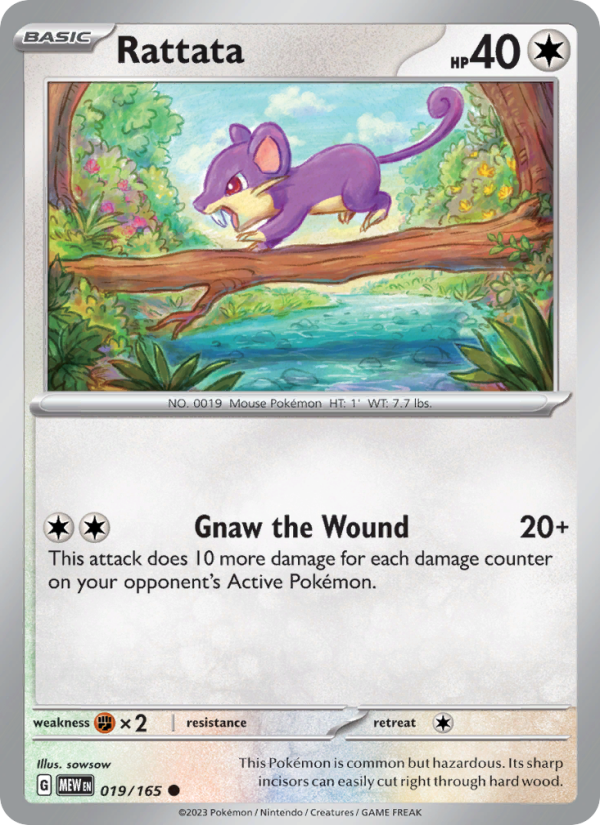
Image courtesy of TCGdex.net
PSA vs BGS Grading: Explaining Rattata Card Value
For Pokémon fans and collectors, the question of why PSA and BGS grades can yield different price tags is never far from the surface. When you’re eyeing a card like Rattata from the SV03.5 set “151” — a cute, easily overlooked Basic Colorless Pokémon with a simple but spicy attack — the grading debate becomes a fascinating lens on value, rarity, and market psychology. Let’s unpack how two major grading giants approach this little Rodent of Paldea, and what that means for the spotted price tag on a Common rarity card with a 40 HP bench presence.
Rattata at a glance: the card’s DNA
- Card name: Rattata
- Set: SV03.5 (151)
- Illustrator: sowsow
- HP: 40
- Type: Colorless
- Stage: Basic
- Rarity: Common
- Attack: Gnaw the Wound — costs Colorless ×2; deals 20+ damage and says, “This attack does 10 more damage for each damage counter on your opponent’s Active Pokémon.”
- Weaknesses: (not listed in the provided data; typical print conventions vary by set)
- Illustration quality: classic, approachable line work by sowsow
- Pricing snapshot: CardMarket shows an average around €0.04 for standard, non‑holo copies (low around €0.02), with holo variants historically higher (average around €0.14).
In practice, Rattata from this era is a prologue to battles rather than the main star—yet that unassuming role can amplify how grading impacts its value. The card’s small footprint, two-colorless energy requirement, and the way its “20+” can scale with damage counters invite a playful optimization puzzle for players, while collectors weigh the card’s grammar of condition and presentation when pricing graded copies.
Why grading differences matter for value
PSA and BGS assess cards through different lenses, and those lenses translate into price realities in several ways ⚡:
- Overall vs. subgrades: PSA assigns a single numerical grade (1–10) based on a holistic appraisal. BGS, by contrast, offers four subgrades (Centering, Edges, Corners, Surface) plus an overall letter-grade factor. A BGS 9.5 with top subgrades can fetch strong premiums, especially on cards with potential eye appeal or rare surface characteristics.
- Centering and edge quality: For a common Basic like Rattata, centering tends to be a common flaw source. A PSA 10 is incredibly rare for a card with typical print quality hurdles, while BGS 9.5/10 subgrades might reflect better surfaces or cleaner edges, which some buyers prize even on low-cost cards.
- Market preference: The market often gravitates toward PSA’s label and capture in tiered offerings, particularly for modern and widely collected sets. However, BGS can command premium in niches where collectors value four precise subgrades and the “GEM MT” aura that some buyers associate with pristine surface and corners.
- Subtle vs. visible flaws: A card with a tiny surface imperfection may survive an eye test but lose a boundary percentage of its BGS score due to surface grading. In PSA terms, that same card might land a solid 9 or even 9.5, depending on the evaluator’s emphasis at grading time.
While Rattata SV03.5-019 is a Common, its value dynamics shift with the grader’s recognition: a coveted PSA 10 for a nostalgic or scarce print can outpace a high-grade BGS 9.5 copy, even if MSRP feels modest for both.
Gamers and collectors alike often debate whether a PSA 9 is more or less valuable than a BGS 9.5. The answer isn’t purely numerical; it’s practical. PSA 9s can be easier to move in broad markets due to brand recognition. BGS 9.5s may attract premium in hobby circles that prize the multi-subgrade approach and the perception of higher integrity in surface and edge control. The Rattata example illustrates how the same physical card could land in different value corridors depending on the grading choice—and, crucially, depending on the buyers’ preferences.
Strategic angles for collectors and players
From a gameplay perspective, Rattata’s “Gnaw the Wound” can pressure opponents when stacked with the right energy and timing. But the carnation of value in graded form comes not from attack potential alone—it comes from the card’s condition, presentation, and the market’s appetite for this particular print. For collectors, the key is to balance nostalgia with a realistic grading plan:
- Condition-first approach: If you treasure this print, submit in top condition to maximize the subgrades. A well-centered, clean copy stands a better chance of achieving a high subgrade spread, increasing the overall value for BGS or the crowd-pleasing PSA 9/10 snapshot.
- Version awareness: The SV03.5 era includes normal and reverse variants. Your strategy should factor rarity, print run, and whether a holo or non-holo version exists in your target collection—these variations materially shift market appeal.
- Grade transparency: When selling, disclose the exact subgrades for BGS or the full PSA narrative. Buyers love clarity, and precise grading details reduce friction in trades and sales.
- Budget-conscious collecting: For a card with a low baseline price, the incremental cost of grading can be a larger percentage of the total value. Careful cost-benefit analysis can save hobbyists from overgrading a common card.
“The thrill of a graded card isn’t always about its battleground prowess; it’s about the story a pristine surface tells and the way a collector envisions it living in a display case and a binder alike.” ⚡
Market snapshot and practical takeaways
In practical terms, data from CardMarket shows a modest baseline for ungraded copies (average around €0.04) with a wide room for variation depending on condition and edition. Holo variants fetch notably higher prices, reflecting a broader market preference for shiny accents—even for a Common card like Rattata. If you’re weighing PSA vs BGS for this SV03.5-019 print, consider your goals:
- If you want broad market liquidity and easier resale, PSA 9 or PSA 10 can be a robust path, though a PSA 10 for a basic Common is rare.
- If you’re chasing collector prestige and you properly document subgrades, a BGS 9.5 with near-perfect surface/edge attributes may command premium in hobby circles.
- Keep an eye on the set’s ongoing print dynamics and market interest. The 151 imprint is beloved for its nostalgia, but price momentum swings with new printings and collector demand spikes.
Each grading decision shapes the value arc of Rattata in a small but meaningful way. The charm of this card lies in its simplicity and the warm, familiar art by sowsow — a reminder that every Pokémon, even a humble Basic Colorless Rattata, has a place in a well-curated collection and in the strategic dance of market value.
Foot Shape Neon Ergonomic Mouse Pad with Memory Foam Wrist RestMore from our network
- https://donation.digital-vault.xyz/donation/post/support-global-digital-independence-by-funding-an-open-internet/
- https://crypto-acolytes.xyz/blog/post/how-twitch-streamers-hype-meme-coins-to-go-viral/
- https://crypto-acolytes.xyz/blog/post/webkidz-traits-s1-solid-snake-webkidz-traits-nft-stats/
- https://wiki.digital-vault.xyz/wiki/post/pokemon-tcg-stats-tapu-koko-card-id-a3-068/
- https://transparent-paper.shop/blog/post/stable-diffusion-xl-prompt-neon-noir-liquid-light-cyberpunk-glamour-glowwaterfall-high-contrast-monochrome-with-neon-accents/
Rattata
Set: 151 | Card ID: sv03.5-019
Card Overview
- Category: Pokemon
- HP: 40
- Type: Colorless
- Stage: Basic
- Dex ID: 19
- Rarity: Common
- Regulation Mark: G
- Retreat Cost: 1
- Legal (Standard): Yes
- Legal (Expanded): Yes
Description
Attacks
| Name | Cost | Damage |
|---|---|---|
| Gnaw the Wound | Colorless, Colorless | 20+ |
Pricing (Cardmarket)
- Average: €0.04
- Low: €0.02
- Trend: €0.04
- 7-Day Avg: €0.04
- 30-Day Avg: €0.04
Support Our Decentralized Network
Donate 💠More from our network
- https://donation.digital-vault.xyz/donation/post/support-global-digital-independence-by-funding-an-open-internet/
- https://crypto-acolytes.xyz/blog/post/how-twitch-streamers-hype-meme-coins-to-go-viral/
- https://crypto-acolytes.xyz/blog/post/webkidz-traits-s1-solid-snake-webkidz-traits-nft-stats/
- https://wiki.digital-vault.xyz/wiki/post/pokemon-tcg-stats-tapu-koko-card-id-a3-068/
- https://transparent-paper.shop/blog/post/stable-diffusion-xl-prompt-neon-noir-liquid-light-cyberpunk-glamour-glowwaterfall-high-contrast-monochrome-with-neon-accents/