
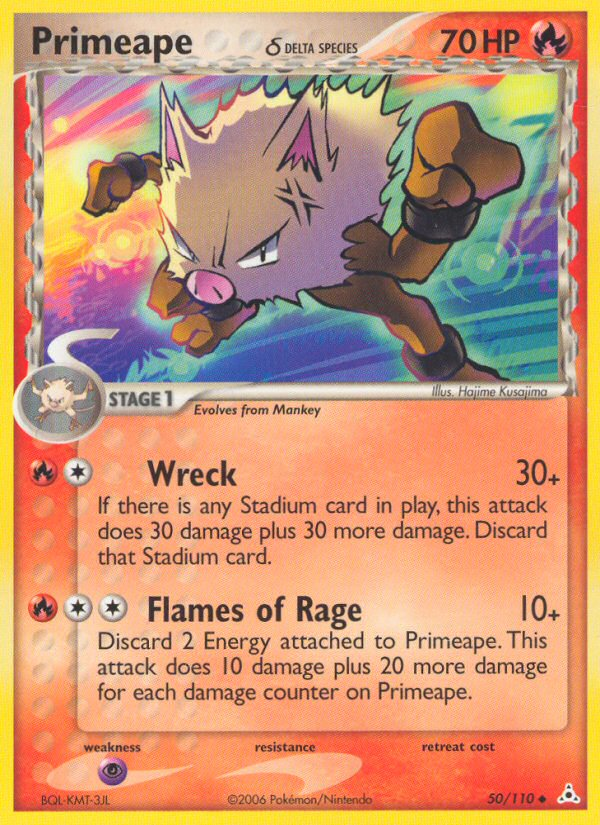
Image courtesy of TCGdex.net
Primeape δ and the Delta constraints that shaped its design
Delving into the Delta Species era, trainers met a unique challenge: cards that wore a different type than their familiar baselines. Primeape δ is a perfect case study in how constraints from Delta design influenced both the mechanics and the strategic identity of a familiar creature. As a Fire-type evolution of Mankey in the Holon Phantoms line, this Primeape didn’t just swap colors; it required a reconsideration of risk, tempo, and how a stage 1 creature could contribute meaningfully to a deck’s plan. The delta twist—a different type, altered weaknesses, and tailored attacks—demanded careful tuning to feel distinct yet balanced within the broader metagame. ⚡🔥
Shifting type as a deliberate constraint
In the Delta Species era, Pokemon could emerge with a type that differed from their traditional archetype. Primeape δ’s Fire typing—paired with its Stage 1 evolution from Mankey—had to slot into a world where Fire-type attackers competed for energy and space on the bench. The designer’s constraint was to ensure that a Fire Primeape didn’t steamroll through the field simply by existing in a different hue; it needed to fit a charging rhythm alongside other Delta variants and standard cards alike. The consequence is a creature whose weaknesses, like Psychic ×2, were chosen to keep it from becoming an overpowering anomaly while still granting interesting matchups against Water and Grass strategies that dominated the era. This deliberate type swap shaped the card’s play pattern: you’d often weigh when to commit to a Wreck that could rely on a Stadium to buff its damage, rather than rely on raw stats alone. 🎴
Attack design and the Stadium constraint
Primeape δ’s moves tell a crisp story about constraint-driven design. Its primary attack, Wreck, costs Fire and Colorless and delivers 30 damage, with a clever twist: if there is a Stadium card in play, it does 30 more damage and then discards that Stadium. That means the deck must actually plan to include a Stadium—either to amplify aggression at the right moment or to curate a tempo swing that forces an opponent to respond to a shifting battlefield. The requirement to discard the Stadium card after use is a double-edged constraint, ensuring that the increased power is not easily repeatable on successive turns without a steady Stadium cadence. In play, this translates into a meta where Stadiums become both a resource and a liability, pushing players to build around card draw, disruption, and timing windows rather than simple power spikes. This constraint also encouraged deck variety: you could craft a stadium-centric plan or pivot to other Delta options when the board called for it. ⚔️
Its secondary attack, Flames of Rage, costs Fire + Colorless + Colorless and requires discarding 2 Energy attachments. Its damage reads as 10 plus 20 per damage counter on Primeape. Here you see a design intent that rewards risk-taking and self-scarification: Primeape grows more dangerous as it gets banged up, but the player pays for that damage with a steeper energy commitment. The constraint here is balancing: a card that scales with its own injury could spiral out of control unless the energy costs and self-checks are kept in line with the rest of the format. The result is a dramatic, high-variance finisher that can swing the tide when the stadium is doing its job elsewhere, but won’t reliably threaten big targets without careful resource management. This self-referential dynamic captures the Delta spirit: a Pokémon altered by circumstance that must navigate new rules to remain viable. 🔥🎨
Evolution and risk-reward within a compact package
- Stage: Stage 1 — Primeape δ evolves from Mankey, placing it on the growth curve of a typical early-2000s Pokémon TCG power ladder. It has 70 HP, a moderate baseline that leaves room for tactical placement (protecting it with a Stadium in play, or healing to sustain the Wreck window).
- Rarity and format: Uncommon in the Holon Phantoms line, a slot that encouraged collectors to seek out this unusual Fire-type Delta variant without flooding the meta.
- Weakness: Psychic ×2, which nudges the card toward specific matchups and invites counterplay from Psychic-heavy decks of the era. This is a classic restraint: the Delta twist provides a different flavor, but it doesn’t erase the fundamental rock-paper-scissors of the TCG.
Illustrator Hajime Kusajima captured Primeape δ with bold lines and a sense of urgency that matches the card’s volatile playstyle. The artwork, like the mechanics, is a reminder that Delta variants were about storytelling as much as math—these were the “what if” cards that played with type and power in ways that felt both fun and educational for a generation of players who loved experimenting with deck construction. The synergy between art and game design here helps explain why Primeape δ remains memorable for fans who enjoyed the Delta era’s experimental spirit. 🎴
Strategic takeaways for modern players and collectors
Primeape δ showcases a few timeless ideas in the Pokémon TCG design playbook. First, the delta concept teaches players to think beyond straightforward type alignments and to consider how environmental cards (like Stadiums) can be leveraged to boost or temper power. Second, the dual-attack design demonstrates a careful balance between risk and reward: one move rewards field state while the other punishes energy attachment in exchange for scaling damage. Third, the card’s evolution line reminds players that a single-poke delta variant can influence archetypes by encouraging tempo and disruption, rather than raw stat equity. These constraints—type shifts, Stadium interactions, energy management, and self-scaling damage—come together to create a memorable department of the game where strategy, nostalgia, and collector curiosity intersect. 💎
For collectors, Primeape δ remains a distinctive piece from Holon Phantoms’ Delta roster. Its Uncommon rarity, combined with the creative constraint of Delta typings, makes it an appealing target for those who want to explore how design constraints shape card power and deckbuilding philosophy. And for players who relish the chess-like nature of the Stadium mechanic, this card offers a satisfying puzzle: time the Wreck window, manage your Stadium resources, and ride Flames of Rage when the board is ready for a dramatic shift. 🔥🎮
Neon Rectangle Mouse Pad – Ultra-Thin 1.58mm Rubber BaseMore from our network
- https://blog.crypto-articles.xyz/blog/post/nft-data-pumpyo-426-from-pumpyo-collection-on-magiceden/
- https://transparent-paper.shop/blog/post/stable-diffusion-xl-prompt-vaporwave-samurai-cinema-desert-mirage-snake-skin-texture-neon-glow-retro-futurism-chromatic-haze/
- https://crypto-acolytes.xyz/blog/post/nft-stats-agent-chammy-1550-from-agent-chammy-collection/
- https://rusty-articles.xyz/tmpgxqjhpxv/creativity-exercises-for-innovators-to-accelerate-ideas.html
- https://transparent-paper.shop/blog/post/polukranos-style-hydras-archetypes-built-on-counters/
Primeape δ
Set: Holon Phantoms | Card ID: ex13-50
Card Overview
- Category: Pokemon
- HP: 70
- Type: Fire
- Stage: Stage1
- Evolves From: Mankey
- Dex ID: 57
- Rarity: Uncommon
- Regulation Mark: —
- Retreat Cost:
- Legal (Standard): No
- Legal (Expanded): No
Description
Attacks
| Name | Cost | Damage |
|---|---|---|
| Wreck | Fire, Colorless | 30+ |
| Flames of Rage | Fire, Colorless, Colorless | 10+ |
Pricing (Cardmarket)
- Average: €0.62
- Low: €0.05
- Trend: €0.57
- 7-Day Avg: €0.67
- 30-Day Avg: €0.62
Support Our Decentralized Network
Donate 💠More from our network
- https://blog.crypto-articles.xyz/blog/post/nft-data-pumpyo-426-from-pumpyo-collection-on-magiceden/
- https://transparent-paper.shop/blog/post/stable-diffusion-xl-prompt-vaporwave-samurai-cinema-desert-mirage-snake-skin-texture-neon-glow-retro-futurism-chromatic-haze/
- https://crypto-acolytes.xyz/blog/post/nft-stats-agent-chammy-1550-from-agent-chammy-collection/
- https://rusty-articles.xyz/tmpgxqjhpxv/creativity-exercises-for-innovators-to-accelerate-ideas.html
- https://transparent-paper.shop/blog/post/polukranos-style-hydras-archetypes-built-on-counters/