

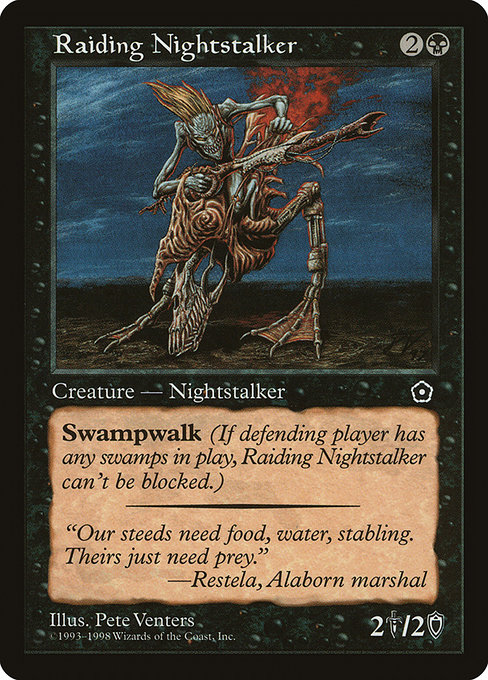
Image courtesy of Scryfall.com
Predictive data isn’t just for big-budget formats or spicy EDH stacks; it’s quietly reshaping how players approach deckbuilding in every corner of Magic: The Gathering. When you feed together card histories, matchup histories, and archetype performance, a deckbuilder can forecast which lines will click under pressure—before the first draft or test game. As a case study, we can look at a classic black creature from Portal Second Age: Raiding Nightstalker. This common, two-mana-for-two-black-budget creature carries the twin notions of stealth and terrain-awareness: Swampwalk, and its brethren-in-name, Landwalk. It’s a tiny window into how predictive systems think about value in ways that feel old-fashioned and delightfully tactical at the same time. 🧙♂️🔥💎
Raiding Nightstalker: a tiny mirror of predictive truth in black
Raiding Nightstalker is a 2/2 creature for {2}{B} from the Portal Second Age (P02) set. Its collection of keywords—most notably Swampwalk and Landwalk—hints at a design philosophy that loves terrain-based misdirection. Swampwalk means the Nightstalker can slip through unless the opponent has a swamp underfoot, while Landwalk adds a parallel sense of inevitability against land-heavy strategies. In practical terms, predictive deckbuilding tools translate those traits into scoring signals: how often an opponent’s deck expects to rely on basic swamps, the distribution of land types in your own deck, and the likelihood that Nightstalker becomes unblockable in the late game. This is where data-minded builders see real, actionable value. 🧭🎲
From a gameplay perspective, the card’s mana cost and stats keep it accessible in a range of black-focused builds. With a 2/2 body at common rarity, it’s sturdy enough to trade early and still menace as the game tightens. The flavor text—“Our steeds need food, water, stabling. Theirs just need prey.”—pays off a bit of Dark-Want-to-Win storytelling while reminding players that predictive tools aren’t just about math; they’re about recognizing patterns in how games unfold. The card’s dual walk mechanics invite the sort of opponent-reading that predictive systems excel at forecasting: where will the battlefield become favorable, and how soon can a Nightstalker exploit it? ⚔️🎨
“This creature isn’t about flash; it’s about finding the right moment to slip past a line of defense.”
That line of thought is exactly what modern deckbuilding tools are designed to simulate. By modeling land distribution, opponent tendencies, and format-specific constraints, predictive data helps you decide when a low-cost black beater with swamp- and landwalk can swing a game’s momentum. In legacy and other formats where Swampwalk and Landwalk aren’t just curiosities but actual needles on the pace gauge, Raiding Nightstalker becomes a useful proxy for how to balance tempo with inevitability. The data point isn’t “Raiding Nightstalker is good”; it’s “Raiding Nightstalker fits best when you’re leaning into terrain-based coverage and a lean mana curve.” 🧩💥
Why a single card becomes a data point in a larger strategy
Predictive deckbuilding relies on features that map closely to how players actually interact with the game. For Raiding Nightstalker, the relevant features include mana compatibility (B color identity, Swampwalk/Landwalk synergy), power/toughness (2/2 for a ladder of trades), and the card’s role as a common in a starter set. Predictive models then weight these features against broader trends: how often black removal and unblockable threats appear in popular archetypes, how frequently swamps show up in a typical mana base, and how resilient a late-game flip from a two-mana creature can be in a world of faster formats. The result isn’t a single verdict; it’s a probabilistic forecast that informs sideboarding, mulligan decisions, and the shape of your own color-splash decisions. 🔍📈
When designers incorporate this data into tools, the gains aren’t limited to “which card wins more.” They extend to better heuristics for card draw, mana balance, and threat density. The Nightstalker example demonstrates how a card’s limited scope—color, terrain interaction, and a modest stat line—can unlock nuanced recommendations about deck construction, such as packing enough swamps to keep swampwalk relevant, or balancing landwalk creatures with protection or disruption to maximize the odds Nightstalker’s evasion pays off. In short, predictive data helps you answer questions like: Which mana base supports swamp-based tempo? Which sideboard cards best complement a swampwalk creature? And how do you measure the marginal value of a two-mana 2/2 that can dodge a chunk of the early game? 🧠⚙️
On the design side, engineers and game designers are keenly aware that even a common card can become a cornerstone in certain modern-built realities when the data paints a consistent picture. Portal Second Age’s Raiding Nightstalker is emblematic: a modest creature that invites players to think about terrain, tempo, and the recurring interplay of land types. The predictive lens turns that emblematic idea into concrete guidance for how to tune a deck’s curve, how to size the land base, and how to anticipate the meta’s evolving emphasis on removal, blockers, and evasive threats. And in a larger sense, it’s a reminder that great data storytelling is part strategy, part lore—two sides of the same coin that MTG fans adore. 🧙♂️💎
Finally, the real-world experience of using predictive tools in deckbuilding sometimes mirrors real-life play testing: you picture the board states, you anticipate the opponent’s lines, you test hypothetical curves, and you walk away with a plan that feels both grounded and bold. That balance—between reliable math and imaginative play—is what makes the Raiding Nightstalker example so instructive. The card is a compact puzzle that reveals the broader virtue of predictive data: it makes complex strategic decisions accessible without dulling the magic, and it helps players discover the joy of building a deck that can surprise an opponent who thought they knew what to expect. 🧲🎲
Non-slip Gaming Mouse Pad Anti-Fray Edges 9.5x8inMore from our network
- https://blog.digital-vault.xyz/blog/post/beta-testing-with-early-adopters-turning-feedback-into-action/
- https://blog.digital-vault.xyz/blog/post/astrometric-wobble-reveals-a-companion-around-a-hot-b-star/
- https://wiki.digital-vault.xyz/wiki/post/pokemon-tcg-stats-bird-keeper-card-id-swsh3-159/
- https://blog.zero-static.xyz/blog/post/historical-inspirations-behind-friends-in-hisui-in-pokemon-tcg/
- https://wiki.digital-vault.xyz/wiki/post/pokemon-tcg-stats-golduck-card-id-bw7-34/
Raiding Nightstalker
Swampwalk (This creature can't be blocked as long as defending player controls a Swamp.)
ID: 0df2887c-e70b-4ff3-a437-450c0037fb07
Oracle ID: 5c4cb33d-2a79-4934-839f-d34e9ca284f8
Multiverse IDs: 6558
TCGPlayer ID: 196
Cardmarket ID: 9844
Colors: B
Color Identity: B
Keywords: Landwalk, Swampwalk
Rarity: Common
Released: 1998-06-24
Artist: Pete Venters
Frame: 1997
Border: black
EDHRec Rank: 29608
Set: Portal Second Age (p02)
Collector #: 84
Legalities
- Standard — not_legal
- Future — not_legal
- Historic — not_legal
- Timeless — not_legal
- Gladiator — not_legal
- Pioneer — not_legal
- Modern — not_legal
- Legacy — legal
- Pauper — legal
- Vintage — legal
- Penny — not_legal
- Commander — legal
- Oathbreaker — legal
- Standardbrawl — not_legal
- Brawl — not_legal
- Alchemy — not_legal
- Paupercommander — legal
- Duel — legal
- Oldschool — not_legal
- Premodern — not_legal
- Predh — legal
Prices
- USD: 0.34
- EUR: 0.40
More from our network
- https://crypto-acolytes.xyz/blog/post/nft-stats-bpw-1730-from-bonk-puppets-collection/
- https://crypto-acolytes.xyz/blog/post/nft-stats-bonklet48-from-bonklet-collection/
- https://blog.crypto-articles.xyz/blog/post/nft-data-memilady-174-from-memilady-collection-on-magiceden/
- https://wiki.digital-vault.xyz/wiki/post/pokemon-tcg-stats-gligar-card-id-swsh8-140/
- https://wiki.digital-vault.xyz/wiki/post/pokemon-tcg-stats-grumpig-card-id-sm4-42/