
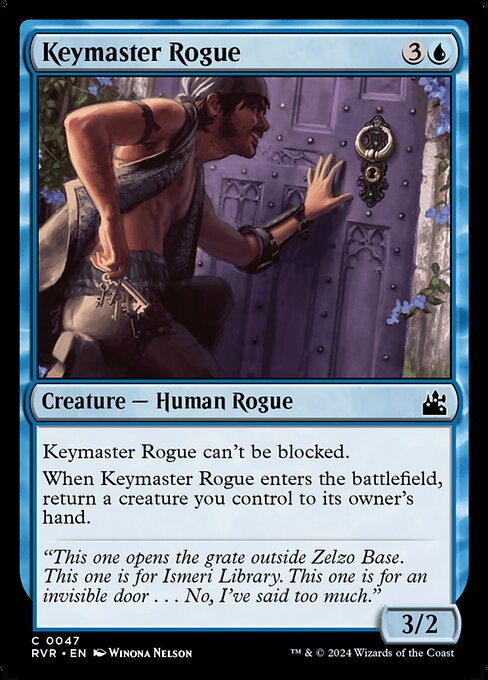
Image courtesy of Scryfall.com
Predictive Analytics in MTG Set Design: A Case Study from Ravnica Remastered
Designing a compelling Magic: The Gathering set is as much about probabilities as it is about flavor. Predictive analytics gives design teams a way to forecast how a card will feel in play—how it curves into the next turn, how it interacts with other colors, and whether its presence will tilt the metagame in a way that satisfies both new players and veterans 🧙♂️🔥. When you zoom in on a blue card like Keymaster Rogue, a 3Ua (three generic and one blue) creature with unblockable pressure and a capacity to reinvent the board on ETB, you start to see the delicate balance between tempo, card economy, and strategic depth. This particular card hails from Ravnica Remastered (the Masters-style reprint line), a set designed to tidy and celebrate a guild-wide flavor while preserving the classic feel that long-time collectors treasure 💎⚔️.
Card snapshot as data point
Keymaster Rogue is a Creature — Human Rogue with a mana cost of {3}{U}, a power/toughness of 3/2, and an ability that reads like a tempo spike: "This creature can't be blocked. When this creature enters, return a creature you control to its owner's hand." In plain terms, you get a nimble, evasive attacker who can ping the board with a reload effect on ETB, trading tempo for tempo and reshaping your board state mid-flight 🧙♂️. Its rarity is common, it’s printed in the blue color identity, and it lives in a Masters-era reprint loop that emphasizes accessibility and familiarity for players revisiting older formats. All of these attributes—mana cost, evasion, ETB tempo swing, rarity, color identity—are precisely the kinds of variables predictive models watch when assessing set viability and deck-building impact 🔎🎲.
What predictive analytics asks of set designers
- Color distribution and mana curves: Does blue get enough proactive plays with a mix of evasion and card-drawing, or does it lean too heavily on counterspells?
- Evasion and tempo balance: How often should unblockable creatures appear to keep the game feeling speedy without breaking it flat?
- Curiosity vs. consistency: Are ETB effects interesting but not overpowering in multiple colors, and do they interact well with reprint dynamics?
- Rarity and payoff: Do commons like Keymaster Rogue provide a satisfying early-game beatdown or do they need occasional back-ups to remain relevant in competitive scenes?
- Flavor-structure alignment: Do the card’s words, art, and lore reinforce a coherent story arc across the set?
These questions aren’t just about numbers; they’re about player experience. A model might simulate millions of games, tracking win rates, mana-sink efficiency, and the frequency of unblockable threats meeting boards with a bounce or a hand-refresh on ETB 🔬💎. When a card such as Keymaster Rogue appears, designers can test side-by-side with or without it, measure the delta in tempo, and decide whether to nudge its power or adjust its support cards in subsequent printings. The result is a more predictable yet still magical release—one that feels both fresh and comfortably familiar to the players who know Zelzo Base and Ismeri Library as more than just words on a card."
Design levers that a case study like this highlights
From a data-driven perspective, a Blue-unblockable creature with an ETB bounce ability offers several levers for tuning a set’s design space 🧭:
- Tempo vs. card economy: The card’s impact is felt immediately, but the hand-return effect introduces decisions about which creatures to bounce and when. Analytics help forecast how often such a play would accelerate or stall the game across archetypes.
- Inter-color synergy: Blue often plays a tempo game that interacts with green’s ramp, white’s removal, or black’s recursion. Predictive models can quantify the value of cross-color synergies and prevent color-wairing gaps.
- Power level consistency: By comparing Keymaster Rogue’s performance with other common-blue options, designers can ensure the color’s early-game options aren’t routinely outclassed by stronger rares or mythics.
- Flavor coherence: The lore line about routes through Zelzo Base and the invisible door hints at a set-wide theme. Analytics teams increasingly integrate flavor-driven metrics—how often a card’s name and flavor text map to meaningful board outcomes and memorable play moments 🧠🎨.
“If a card doesn’t change the board state in a clear, interactive way, it risks becoming wallpaper.” That sentiment sits at the heart of modern predictive set design—where data meets storytelling to avoid dullness and champion memorable moments ⚔️🎨.
Lore, flavor, and cross-set coherence
Keymaster Rogue’s flavor text—bridging locations and doors—serves as a microcosm of how a set’s narrative architecture should work in concert with its mechanical core. Predictive analytics isn’t just crunching numbers; it’s validating whether the flavor, art, and rules interact in ways that feel inevitable once you glimpse the story behind the card. In Ravnica Remastered, a Masters-style reprint, that coherence matters even more: it invites returning players to spot familiar guild vibes while celebrating the iconic imagery Winona Nelson contributed to the artwork 🧙♂️🔥.
Practical takeaways for players and collectors
For players, the Keymaster Rogue case highlights how a single card can shape a deck’s tempo and decision trees. For designers, it’s a reminder that every line of text is a data point: mana cost, evasion, ETB interactions, and flavor all feed into a broader model of how sets should feel and function in the wild. And for collectors, it’s a nod to the balancing act that makes reprints feel earned: keeping cards accessible as commons while ensuring the set remains a viable home for both nostalgia and modern play 🧭💎.
Connecting with fans and on-the-go play
In today’s MTG ecosystem, cross-promotion blends seamlessly with play discipline. If you’re chasing the thrill of carry-everything card lore while you’re out and about, a card-themed phone case can carry a little magic with you—an ideal companion for tournament weekends or casual FNM runs. The product below captures that spirit by merging utility with tabletop flair: a nod to the game’s tactile joy and the modern tech-enabled lifestyle 🎲📱.