

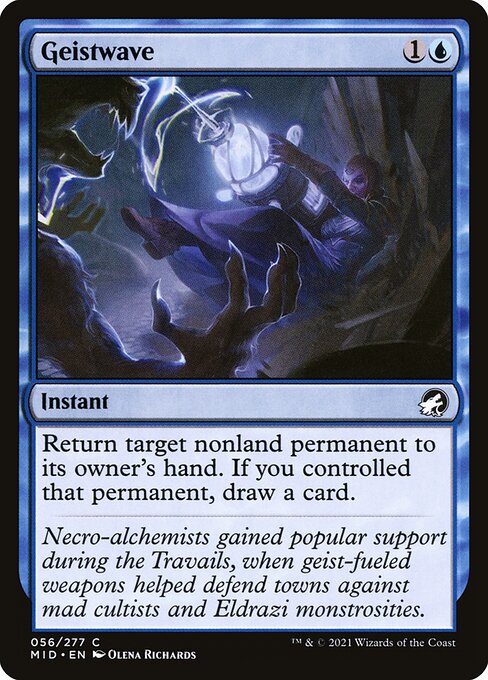
Image courtesy of Scryfall.com
Geistwave and the Quiet Science of Draw Odds
Blue magic has always thrived on tempo and information, but Geistwave quietly turns that dial a notch. For just two mana, {1}{U}, this instant shuffles a little bit of card-advantage into the main deck’s tempo engine. Return target nonland permanent to its owner's hand, and if you controlled that permanent, you draw a card. It’s a clean, lean tool from Innistrad: Midnight Hunt that rewards careful planning and deck modeling as much as it rewards precise timing. 🧙♂️🔥💎⚔️
What makes Geistwave compelling for deck modeling is not just the bounce, but the conditional card draw. The moment you control the permanent you bounce, Geistwave flips a subtle switch: you’re not just negating a threat or buying a turn; you’re potentially replacing that threat with a fresh card. The card’s set and rarity tell a story too—Midnight Hunt’s white-hot focus on eerie, moonlit necromancy gives Geistwave a flavor that fits perfectly in control-leaning blue shells or tempo-oriented lists. And yes, the art by Olena Richards carries that haunting, late-night vibe that MTG fans memorize on long commutes and even longer nights. 🎨
Why the math matters: odds, draws, and tempo
Deck modeling with Geistwave hinges on a few core ideas. First, calculate your chance to draw off the back of a bounce. If you bounce a permanent you didn’t control, you don’t get a card—so the value of Geistwave scales with how often you can bounce your own things or those you’ve gained control of. In practice, that means Geistwave shines in decks that run repeatable targets you own, or in lists where you can recast or re-enter the battlefield with additional value. The more robust your plan for recasting and reusing your bounced permanents, the higher the expected card-advantage per Geistwave you draw through the game. 🧙♂️
Consider a scenario common in workhorse blue decks: you’re sitting on Geistwave with a couple of low-cost threats and a handful of card-draw enablers. You bounce your own creature on turn two to draw a card, then replay that creature with another spell or ability later in the game. Each bounce becomes a small optimization step—you’re trading tempo for information, and information is power in a game where one extra draw can be the difference between stabilizing on a plan or folding to a stalled topdeck. The rarity and legality notes are a friendly reminder of where Geistwave belongs: a common spell that’s legal in Modern, Pioneer, Legacy, and many other formats where blue control thrives. 💎
Deck-building implications: where Geistwave fits
Geistwave is especially friendly to tempo-control shells that prize hand disruption or soft removal with a built-in redraw. Pair it with interactive counterspells and a few bounce-friendly targets to sculpt a plan that cycles through threats and answers while reducing reliance on hidden combos. It’s also a fine fit for midrange mariners who want to keep their resources flowing, even when the battlefield fills up with opposing threats. The key to maximizing Geistwave’s return is synergy: if you can bounce your own permanent, you swap a threat for a fresh draw; if you bounce an opponent’s threat, you’re buying time without losing card parity unless you’re also drawing. The effect is subtle but meaningful at the highest levels of play, where every decision nudges the outcome by a percentage point or two. 🎲
Flavor wise, Geistwave taps into the lore of the Travails era where necro-alchemy and spirit-infused weaponry shaped the local defense. The line about “Necro-alchemists gained popular support during the Travails, when geist-fueled weapons helped defend towns against mad cultists and Eldrazi monstrosities” isn’t just fluff; it mirrors how blue mages in the multiverse view control magic as both shield and toolkit. That dual identity—defensive tempo with an edge of inevitability—aligns nicely with Geistwave’s mechanical identity. It’s a card for players who savor the blend of calculated risk and precise execution. 🧙♂️
Practical tips for players exploring Geistwave’s deck-modeling potential
- Own your bounce targets: whenever possible, bounce your own nonland permanents to draw, not your opponent’s. The value scales with the density of your own prospects on the battlefield.
- Recursion helps: include a few ways to replay bounced permanents or re-enter the battlefield state; a successful loop turns a single Geistwave into multiple draws over the game.
- Tempo vs. value balance: Geistwave’s efficiency is strongest in lists that care about maintaining pressure while gradually improving hand quality. Don’t overcommit to bounce if it exposes you to a fast, aggressive clock.
- Compare with other bounce spells: Repeal and Boomerang-like effects mine similar space, but Geistwave offers the card draw component that can tilt longer games in your favor when fuel lines stay open. 🧩
As you craft your plan, remember that the card’s color identity is purely blue. Its mana cost is deliberately cheap to ensure you can fit it into a broad spectrum of builds, from tight control lists to more midrange-oriented midgames. The common rarity makes Geistwave a reliable pick for budget-minded players who still chase the thrill of a clean, well-timed bounce-and-draw moment. And in the ever-evolving metagame, that moment can be worth more than a few extra points of damage—it's about the sequence, the tempo, and the subtle advantage gained by seeing one more card. 🔥
To keep the momentum going off the table, consider pairing Geistwave with a thoughtful sideboard plan that protects your plan from silences and hard counters. The more you practice rating the odds of a successful bounce-and-draw swing, the more you’ll find Geistwave becoming a dependable, often underestimated piece of your blue toolkit. ⚔️
For readers chasing more practical experiments and data-driven insights, the cross-promotional section below offers a look at related analyses across our network, with five companion reads that explore forecasting, NFT data trends, and more—card-nerddom in full swing. 🧙♂️💎
Phone Grip Click-On Adjustable Mobile HolderMore from our network
- https://blog.digital-vault.xyz/blog/post/statistical-forecast-cirdan-the-shipwright-reprints/
- https://blog.zero-static.xyz/blog/post/warzone-pros-and-cons-explained-for-players-in-2025/
- https://blog.crypto-articles.xyz/blog/post/nft-data-himalaya-2113-from-himalaya-collection-on-magiceden/
- https://crypto-acolytes.xyz/blog/post/nft-stats-debros-303-from-debros-collection/
- https://crypto-acolytes.xyz/blog/post/nft-stats-catwifmask-nft-95-from-catwifmask-nft-collection/
Geistwave
Return target nonland permanent to its owner's hand. If you controlled that permanent, draw a card.
ID: f0e3d1ac-bec2-4bba-a6cf-a823996dde2d
Oracle ID: 14d5ed90-0aa7-48f0-9017-83912b9e89d1
Multiverse IDs: 534818
TCGPlayer ID: 248287
Cardmarket ID: 575023
Colors: U
Color Identity: U
Keywords:
Rarity: Common
Released: 2021-09-24
Artist: Olena Richards
Frame: 2015
Border: black
EDHRec Rank: 8356
Penny Rank: 6688
Set: Innistrad: Midnight Hunt (mid)
Collector #: 56
Legalities
- Standard — not_legal
- Future — not_legal
- Historic — legal
- Timeless — legal
- Gladiator — legal
- Pioneer — legal
- Modern — legal
- Legacy — legal
- Pauper — legal
- Vintage — legal
- Penny — not_legal
- Commander — legal
- Oathbreaker — legal
- Standardbrawl — not_legal
- Brawl — legal
- Alchemy — not_legal
- Paupercommander — legal
- Duel — legal
- Oldschool — not_legal
- Premodern — not_legal
- Predh — not_legal
Prices
- USD: 0.12
- USD_FOIL: 0.16
- EUR: 0.17
- EUR_FOIL: 0.24
- TIX: 0.03
More from our network
- https://crypto-acolytes.xyz/blog/post/stealth-mechanics-in-open-world-games-mastery-and-strategy/
- https://crypto-acolytes.xyz/blog/post/nft-stats-lion-of-liquania-1177-from-lions-of-liquania-collection/
- https://articles.zero-static.xyz/blog/post/how-mass-effect-andromeda-shaped-twitch-streaming-culture/
- https://blog.crypto-articles.xyz/blog/post/nft-data-blunt-of-the-corn-from-digireaperz-collection-on-magiceden/
- https://transparent-paper.shop/blog/post/why-creators-should-diversify-digital-marketplaces/