
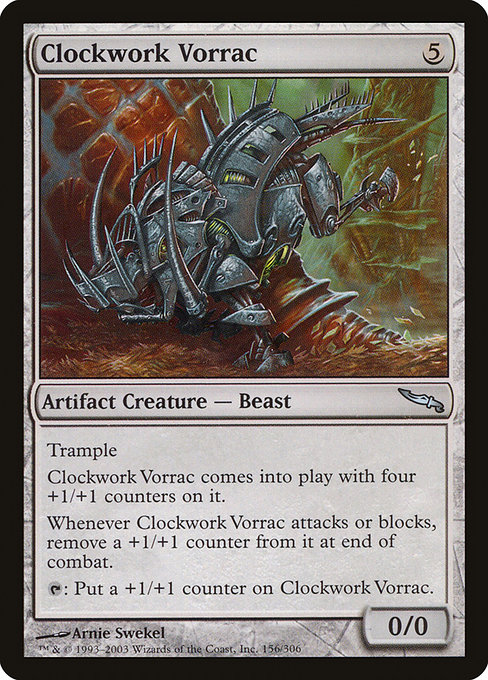
Image courtesy of Scryfall.com
A statistical look at reprint momentum for Clockwork Vorrac
When you start threading the gauntlet of price spikes, card availability, and nostalgia, Magic: The Gathering becomes a grand experiment in probability. Clockwork Vorrac — an artifact creature from Mirrodin that wears its 5-mana cost like a badge of stubborn fate — sits at a fascinating intersection of design and collector interest. This uncommon boar-beast arrives with four +1/+1 counters and trample, then slowly bleeds its counters away as it attacks or blocks, while a tap ability can add more counters. It’s the kind of card that feels like a relic of early 2000s mechanics: heavy, steel-gray flavor, and a reminder that permanents can age like fine, coppery circuitry. 🧙♂️🔥
Predicting reprints is less about crystal balls and more about reading the room: set themes, rarity, and the mana costs that echo across reprint cycles. Clockwork Vorrac’s home in Mirrodin (MRD) places it squarely in that era when artifact tribes and heavy-hitter Glow-in-the-Dark nostalgia ruled the day. Its color identity is effectively colorless, which helps it slide into diverse decks and formats, but its rarity is uncommon. That combination often means it’s not a slam-dunk for a modern-wide reprint, yet it’s exactly the kind of card that keeps older formats vibrant and budget-friendly as time marches on. 💎⚙️
What the data suggests about reprint probability
There’s a practical logic behind reprints: playability in multiple formats, nostalgia value, and rarity ceiling. For a card like Clockwork Vorrac, the 5-mana, colorless, artifact package checks a lot of those boxes. In MTG’s modern history, cards that are powerful enough to matter in Modern or Commander but not so ubiquitous that they destabilize prices tend to be reprinted in sets that celebrate artifact themes or create evergreen reprint slots. The design balance matters too: Vorrac’s four +1/+1 counters give it a persistent presence, while its end-of-combat counter removal adds a tactical edge that isn’t simply “stamp a bigger body.” This duality makes it a candidate for future printings in special sets or as a nod in Commander-focused releases that love artifact synergy. ⚔️🎨
“Statistics won’t predict the precise date of a reprint, but they can illuminate the structural signals: rarity distribution, set momentum, and the ebb and flow of demand across formats.” 🧭
Let’s ground this in concrete factors you can monitor as a fan or a potential investor in MTG nostalgia:
- Set context: Mirrodin’s artifact-centric era left a lasting imprint on the card pool. Reprints often occur in sets that celebrate artifacts or stalwart evergreen mechanics. The more a card’s identity aligns with a celebrated theme, the higher its odds of resurfacing in a future set that wants to evoke that era. 🔧
- Rarity and availability: An uncommon like Vorrac sits in a comfortable zone for reprinting; not a rare chase, but not a common filler either. This makes it a good candidate for reprint in a subset that aims to refresh older archetypes without flooding the market. 💎
- Mechanics resonance: Trample and +1/+1 counters are classic MTG design motifs that continue to appear in newer sets. A reprint could be framed as a modern nod to counter-based aggression, or a slipstream pick for artifact tribal commanders who adore counter management. 🪙
- Format applicability: In Legacy and Commander, clockwork-themed engines play well, while Modern can be less predictable. The card’s current power footprint, however, remains relevant enough to entice players curious about artifact synergy and counter-management. ⚔️
- Market sensibility: Price floors for non-foil copies are modest, and foil copies carry a premium that reflects scarcity rather than raw power. The economics of reprints often hinge on whether a card is a bridge between nostalgia and practical play. A well-timed reprint can revitalize interest without destabilizing the broader ecosystem. 💎
From a design-analysis perspective, Vorrac embodies a spatially elegant concept: heavy, durable on the battlefield, and self-supplementing via its tap ability. The fact that it remains a creature that can still participate meaningfully in combat after entering with a laundry list of counters makes it a stubborn favorite for old-school players who enjoy the tactile feel of “investing” counters in a creature that trades resource for board presence. This is exactly the kind of archetype that Wizards of the Coast historically returns to when they want to evoke the flavor of Mirrodin’s metallic soul—an ethos that fans respond to with a warm, almost ritualistic nostalgia. 🎲
How to use this lens in your own MTG journey
Whether you’re chasing a nice foil copy for your display shelf or evaluating long-term value for investments, use a simple framework: compare Vorrac to similar artifact creatures across sets, examine reprint patterns for uncommon artifacts with countertop mechanics, and watch how new design spaces in standard-banned or evergreen formats react to older counterparts. If a reprint is on the horizon, you’ll often see a coordinated push in a set that celebrates artifacts or an evergreen theme—perhaps alongside a few familiar names that echo Vorrac’s style. And yes, you can still draft it and play it in Commander with that same thunderous presence. ⚡
Slim Glossy Phone Case for iPhone 16 Lexan PC 1Meanwhile, if you’re curious to explore more angles on data-driven approach to predicting MTG trends, the broader network of articles below offers a spectrum of lenses—from sentiment analysis in card communities to optimization tactics for campaigns that study collectible markets. 🧠🔥
More from our network
- https://wiki.digital-vault.xyz/wiki/post/pokemon-tcg-stats-phione-card-id-dp5-27/
- https://blog.zero-static.xyz/blog/post/mtg-sentiment-analysis-talent-of-the-telepath-forum-reactions/
- https://blog.digital-vault.xyz/blog/post/boost-google-ads-ctr-with-these-simple-optimizations/
- https://crypto-acolytes.xyz/blog/post/nft-stats-nuked-ape-25-from-nuked-world-apes-collection/
- https://articles.zero-static.xyz/blog/post/lost-ark-server-performance-boosts-stability-and-uptime/
Clockwork Vorrac
Trample
This creature enters with four +1/+1 counters on it.
Whenever this creature attacks or blocks, remove a +1/+1 counter from it at end of combat.
{T}: Put a +1/+1 counter on this creature.
ID: 7e876938-1b8e-44cf-ade2-a42f8acdf24c
Oracle ID: e1a64bba-eaff-4f59-b85d-7df0b13e2e6b
Multiverse IDs: 46123
TCGPlayer ID: 11471
Cardmarket ID: 156
Colors:
Color Identity:
Keywords: Trample
Rarity: Uncommon
Released: 2003-10-02
Artist: Arnie Swekel
Frame: 2003
Border: black
EDHRec Rank: 23205
Set: Mirrodin (mrd)
Collector #: 156
Legalities
- Standard — not_legal
- Future — not_legal
- Historic — not_legal
- Timeless — not_legal
- Gladiator — not_legal
- Pioneer — not_legal
- Modern — legal
- Legacy — legal
- Pauper — not_legal
- Vintage — legal
- Penny — not_legal
- Commander — legal
- Oathbreaker — legal
- Standardbrawl — not_legal
- Brawl — not_legal
- Alchemy — not_legal
- Paupercommander — not_legal
- Duel — legal
- Oldschool — not_legal
- Premodern — not_legal
- Predh — legal
Prices
- USD: 0.12
- USD_FOIL: 0.50
- EUR: 0.08
- EUR_FOIL: 0.31
- TIX: 0.03
More from our network
- https://crypto-acolytes.xyz/blog/post/nft-stats-george-plays-clash-royale-epic-218-from-gpcr-nft-collection-collection/
- https://articles.zero-static.xyz/blog/post/getting-started-guide-for-pokemon-sword-and-shield-in-2025/
- https://crypto-acolytes.xyz/blog/post/top-horror-visual-novels-that-deliver-real-chill/
- https://blog.crypto-articles.xyz/blog/post/cosplay-inspired-bug-catcher-decks-for-pokemon-tcg/
- https://crypto-acolytes.xyz/blog/post/nft-stats-pill-money-podz-120-from-pill-money-podz-collection/