
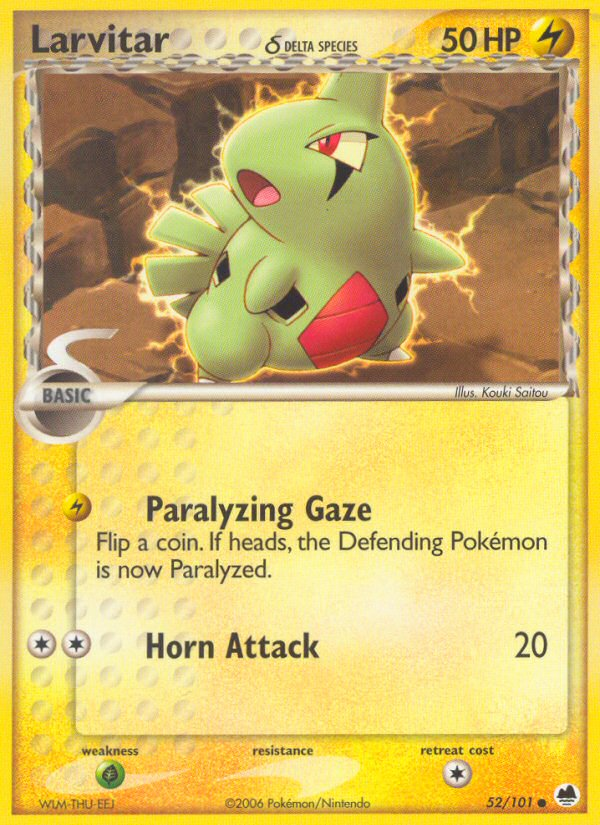
Image courtesy of TCGdex.net
Power Creep Analytics: Unpacking Larvitar δ in Delta Species
Power creep isn’t just a buzzword tossed around by competitive players; it’s a measurable pattern in how new cards push the pace, tempo, and payoff of the game. When we turn the lens to a Delta Species stalwart like Larvitar δ from Dragon Frontiers, we catch a snapshot of early data points that hint at how game designers and markets have steered the Pokémon TCG through successive generations. This particular Basic Lightning-type Larvitar carries a modest 50 HP and two attacks, yet it sits at a crossroads of design decisions that illuminate the creep—or the calibration—between risk, reward, and timing across eras. ⚡🎴
First, let’s anchor our analytics in the card’s concrete data. Larvitar δ is a common, non-holo Basic from the ex15 Dragon Frontiers set—an era famous for introducing Delta Species typings that could differ from a Pokémon’s traditional type in the video games. The card’s HP sits at 50, and its two attacks paint a clear tempo picture: Paralyzing Gaze, which costs a single Lightning energy and relies on a coin flip to potentially paralyze the Defending Pokémon, and Horn Attack, a straightforward 20-damage move for two Colorless energy. The contrast between a coin-flip-based status effect and a solid, predictable 20 damage on the second attack exemplifies the era’s design trade-offs. The card’s single-energetic potential to disrupt the opponent’s board—tempered by the randomness of paralysis—highlights how early power creep was less about guaranteed control and more about risk-managed tempo. 🌀
From a market analytics perspective, the Delta Species era cards didn’t command the same price premiums as later holo-rich reprints, but they tell a different story about value trajectory. CardMarket data shows an average price hovering around 0.37 EUR for the standard (non-holo) variant, with occasional dips toward the very low end (as low as 0.02 EUR) and occasional spikes depending on condition and demand. The trend metric for this card suggests a mild uptick over time, signaling a collector’s interest that often accompanies nostalgia for vintage mechanics like δ-typing and coin-flip randomness. In short, even basic, non-rotating pieces like Larvitar δ contribute to a broader market narrative: power creep isn’t just about raw numbers; it’s also about why collectors care about the historical context and the specific mechanics that defined an era. 🔎💎
So what does power creep look like in practice when you line up Larvitar δ against later entries? In modern sets, we often see higher HP ceilings, more reliable status effects, and attacks that scale with fewer conditional risks. The Paralyzing Gaze attack captures a core tension: it offers immediate disruption but hinges on randomness. Compare that to later Lightning-type cards that may deliver paralysis or special conditions with more consistent odds or cheaper energy costs. The delta-typing concept itself foreshadows a design ethos: giving a card a different type or ability class while keeping it thematically aligned with its original evolution line. That shift broadens a deck’s strategic palette and ultimately contributes to power creep by increasing the spectrum of viable plays in broader formats. ⚡🎨
Let’s also read Larvitar δ as a data point in a larger progression. The card’s two attacks demonstrate a classic early-game tempo: one efficient utility attack at low energy costs with a probability component, and a second, dependable damage option that helps ensure a fall-back plan. In practice, you could open with Paralyzing Gaze, hoping for a heads to slow the Defending Pokémon just long enough to set up a Horn Attack—assuming you have the Energy available to push both actions over turns. The price and collectible interest around Dragon Frontiers help explain how owners perceive this piece: not a power-curve behemoth, but a reliable historical anchor that showcases how special rules (like δ-typing) shaped play and collecting narratives at the time. Collectors often prize the art and lore as much as the mechanics, and Kouki Saitou’s illustration contributes to that enduring appeal. 🖌️
Gameplay strategy today might not hinge on Larvitar δ in modern tournaments, given the evolving legality and power level of contemporary decks. However, analyzing its role provides valuable insight into how early mechanics influenced deck archetypes and how the game’s balance evolved. For example, the deliberate choice to make a potentially paralyzing attack that costs only one Lightning energy foreshadows later design goals: to create tension between speed and reliability, encouraging players to weigh aggressive play against the risk of giving the opponent a tempo swing. This is the kind of analytic thread that helps players understand why certain cards, even when modest on raw numbers, continue to feel relevant within nostalgic or themed formats. ⚡🧭
Surrounding the card’s identity is a broader narrative about art, lore, and collector value. The Dragon Frontiers era is remembered for its distinctive flavor and its place in the Delta Species storyline, where Pokémon often sported alternate typings that opened fresh synergy opportunities and puzzle-like decision-making. Larvitar δ’s Grass-type vulnerability is a reminder that power creep often comes with trade-offs: the same era that broadened typing also reinforced the importance of matchup awareness in the field. For fans and graders, the combination of rarity (Common), the Delta Species novelty, and the potential pricing drift makes this card a thoughtful piece for a vintage Lightning-type-focused collection. 🔥🎴
As you weigh the analytics behind Larvitar δ, you can appreciate how early design experiments laid a foundation for later, more aggressive power-level targets. The card isn’t just a collectible relic; it’s a case study in how a single card’s stats, mechanic quirks, and market reception contribute to the complex mosaic of power creep across Pokémon TCG history. When you pair historical data with the ongoing pulse of market trends, you gain a richer sense of how the game’s designers balanced risk, tempo, and payoff—and how players at all levels can value those decisions in both play and collection. 🎮💎
Neon Tough Phone Case (Impact Resistant Glossy)More from our network
- https://blog.digital-vault.xyz/blog/post/luminous-blue-giant-sheds-light-on-galactic-motion/
- https://wiki.digital-vault.xyz/wiki/post/pokemon-tcg-stats-darkrai-card-id-sv03-136/
- https://crypto-acolytes.xyz/blog/post/nft-stats-bonkmeow45-from-bonkmeows-collection/
- https://wiki.digital-vault.xyz/wiki/post/pokemon-tcg-stats-elgyem-card-id-sv105b-040/
- https://wiki.digital-vault.xyz/wiki/post/pokemon-tcg-stats-pinsir-card-id-xy8-3/
Larvitar δ
Set: Dragon Frontiers | Card ID: ex15-52
Card Overview
- Category: Pokemon
- HP: 50
- Type: Lightning
- Stage: Basic
- Dex ID: 246
- Rarity: Common
- Regulation Mark: —
- Retreat Cost:
- Legal (Standard): No
- Legal (Expanded): No
Description
Attacks
| Name | Cost | Damage |
|---|---|---|
| Paralyzing Gaze | Lightning | |
| Horn Attack | Colorless, Colorless | 20 |
Pricing (Cardmarket)
- Average: €0.37
- Low: €0.02
- Trend: €0.59
- 7-Day Avg: €0.41
- 30-Day Avg: €0.37
Support Our Decentralized Network
Donate 💠More from our network
- https://blog.digital-vault.xyz/blog/post/luminous-blue-giant-sheds-light-on-galactic-motion/
- https://wiki.digital-vault.xyz/wiki/post/pokemon-tcg-stats-darkrai-card-id-sv03-136/
- https://crypto-acolytes.xyz/blog/post/nft-stats-bonkmeow45-from-bonkmeows-collection/
- https://wiki.digital-vault.xyz/wiki/post/pokemon-tcg-stats-elgyem-card-id-sv105b-040/
- https://wiki.digital-vault.xyz/wiki/post/pokemon-tcg-stats-pinsir-card-id-xy8-3/