
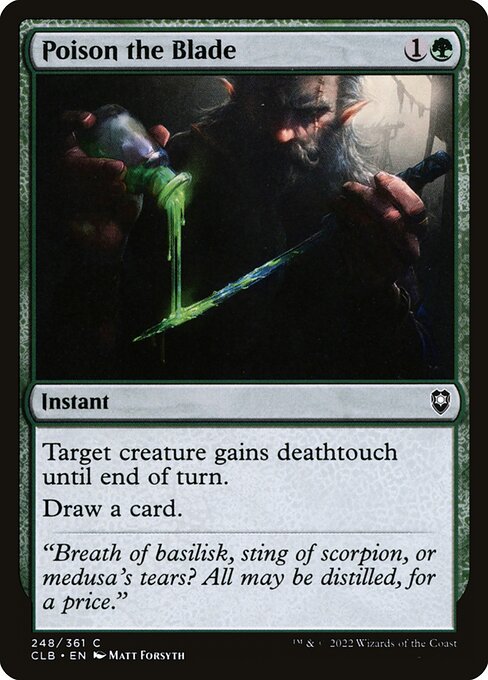
Image courtesy of Scryfall.com
Evolving illustration trends in modern MTG 🧙♂️🎨
Magic: The Gathering has always been a visual tapestry where artists translate a spell’s promise into a single moment of reality. Over the last few years, the illustration lane has shifted from grand, cinematic tableaux to a more intimate, texture-rich approach that rewards close inspection. We’ve moved from broad world-building moments to micro-dramas—faces, petals, rivers of magic, and the near-tangible feel of a card’s texture in your hand. And while every set invites a fresh aesthetic, green cards like Poison the Blade anchor a fascinating thread: nature’s quiet menace, tempered by mystery and a hint of botanical alchemy. 🚀
From the 2015 frame era to today, illustrators have embraced painterly brushwork, layered lighting, and a more tactile sense of material—fabrics, moss, stone, and organics—so that a single instant becomes a story you can almost touch. The green palette tends to lean into life: lush greens, mossy textures, and a glow that feels both Edenic and alive with hidden danger. Poison the Blade—an instant from Commander Legends: Battle for Baldur's Gate—exemplifies this shift. The card’s high‑res art gives us a moment where the blade and the basilisk-blue-green aura of magic meet, all while the text promises a practical outcome: deathtouch for a turn, plus card draw. It’s green as strategy and green as atmosphere. 🧙♂️
Poison the Blade: a closer look at both art and intent
This Magic card, a common instant from CLB, costs {1}{G} and delivers a compact two‑stage effect: grant deathtouch to target creature until end of turn, then draw a card. The choices behind that wording reveal design priorities that artists must honor. Deathtouch is one of green’s most iconic combat tools when it wants to press advantage in the midgame, and the card’s text channels that idea into a single moment of decisive action. The accompanying illustration communicates the same lean: a simple, potent image that feels both ancient and freshly modern. The flavor text—"Breath of basilisk, sting of scorpion, or medusa's tears? All may be distilled, for a price."—adds a dash of mythic, almost alchemical mystique, inviting players to imagine the card as part of a larger green lore. This synergy of text and art is precisely what fans now expect as the bar for new illustrations climbs higher. ⚔️💎
Illustration trends like these emphasize texture, atmosphere, and narrative clarity. The art team for CLB has a knack for balancing classic fantasy iconography with contemporary polish—think bold color separation, careful edge work, and lighting that feels like it could exist in a sun-dappled glade, yet crackles with the tension of a spell just cast. Matt Forsyth’s depiction brings a tactile, painterly finish to Poison the Blade, and the image quality—supported by Scryfall’s high‑res scans—lets players appreciate fine details even on a phone screen. The result is a card that reads crisply at a distance, but rewards zooming in for the subtle textures and the way magic seems to weave through the blade’s edge. 🎨
Where design meets gameplay: why trends matter in EDH and beyond
Green’s historical strength lies in card advantage and resilient stretches of board presence. A spell like Poison the Blade fits neatly into multiplayer formats where tempo and resource management matter. You play a two-mana instant to tilt combat, then refill your hand—an efficient payoff that mirrors green’s philosophy: leverage growth, draw power, and clever combat tricks to outlast opponents. The art’s emphasis on natural “hazard” aesthetics echoes this approach: the blade isn’t just a tool; it’s a fragment of a living ecosystem where risk and reward are braided together. Contemporary illustration trends that highlight this sense of natural danger help players feel the card’s identity before a single card is drawn. 🧷
The broader shift toward painterly, texture-forward art also informs how players select decks and appreciate card value. Commons can now feel iconic when the art tells a story that resonates with players—particularly EDH/Commander communities, where the flavor and lore enrich the experience as much as the mechanical text. The Commander Legends: Battle for Baldur's Gate era leans into cross‑franchise mythos, inviting artists to thread references to oaths, sigils, and monsters into every frame. Poison the Blade’s basilisk-flavored flavor text is a perfect nod to that sensibility: it acknowledges a shared mythology of peril that is both timeless and freshly imagined. 🔥
“All may be distilled, for a price.”
For collectors, the visual language behind a common card can be as compelling as a mythic card’s rarity. The card’s foil and nonfoil finishes, the painterly texture of the art, and the way the green mana glows in the image all contribute to its desirability in a collection. It isn’t just about the card’s price point or playability; it’s about the moment a viewer recognizes a shared memory—the basilisk, the forest, the ancient spell—that makes the artwork feel timeless. And that is where modern MTG illustration shines: in the fulsome, immersive, and sometimes cheeky resonance between image, text, and play. 💎
Practical thoughts for players and collectors
If you’re considering Poison the Blade for a green-based deck or you’re collecting CLB era art, note its accessible mana cost and dependable effect. Two mana buys you a chance to trade up a blocker with deathtouch for one turn and keep card advantage rolling. This is exactly the kind of tempo-play that green can leverage in midrange strategies, and the art’s strong, close-up focus helps you recall the moment you stabilized a board—the moment the blade’s glow and the basilisk whisper intersect in your mind’s eye. In addition, the card’s flavor and illustration pair well with a broader appreciation for nature’s hidden dangers—the same thread that runs through so many modern MTG designs. 🧙♂️⚔️
Want a little something to upgrade your desk while you brew your next deck? Check out a tactile companion that matches the neon energy of modern play spaces: Neon Desk Mouse Pad — Custom Rectangular One-Sided Print 3mm Thick. It’s a playful nod to the current era of bold art and vivid color palettes, a reminder that our hobby can be as tactile as it is cerebral. Neon Desk Mouse Pad Custom Rectangular One-Sided Print 3mm Thick 🧲
More from our network
- https://wiki.digital-vault.xyz/wiki/post/pokemon-tcg-stats-hydreigon-card-id-bw3-79/
- https://blog.crypto-articles.xyz/blog/post/nft-data-klout-genesis-hashtag-3500-from-klout-genesis-hashtags-collection-on-magiceden/
- https://blog.digital-vault.xyz/blog/post/entangling-vines-tech-for-control-matchups-and-wins/
- https://crypto-acolytes.xyz/blog/post/nft-stats-trench-ape-3859-from-trench-ape-solana-club-collection/
- https://crypto-acolytes.xyz/blog/post/nft-stats-nft-531-from-useless-unibots-collection/
Poison the Blade
Target creature gains deathtouch until end of turn.
Draw a card.
ID: 3de4bf10-a502-4748-9118-5459684542a7
Oracle ID: 8af22295-0d6b-4cdc-b815-eb81ade241ec
Multiverse IDs: 563131
TCGPlayer ID: 273347
Cardmarket ID: 660915
Colors: G
Color Identity: G
Keywords:
Rarity: Common
Released: 2022-06-10
Artist: Matt Forsyth
Frame: 2015
Border: black
EDHRec Rank: 9514
Set: Commander Legends: Battle for Baldur's Gate (clb)
Collector #: 248
Legalities
- Standard — not_legal
- Future — not_legal
- Historic — legal
- Timeless — legal
- Gladiator — legal
- Pioneer — not_legal
- Modern — not_legal
- Legacy — legal
- Pauper — legal
- Vintage — legal
- Penny — not_legal
- Commander — legal
- Oathbreaker — legal
- Standardbrawl — not_legal
- Brawl — legal
- Alchemy — not_legal
- Paupercommander — legal
- Duel — legal
- Oldschool — not_legal
- Premodern — not_legal
- Predh — not_legal
Prices
- USD: 0.09
- USD_FOIL: 0.14
- EUR: 0.18
- EUR_FOIL: 0.16
- TIX: 5.70
More from our network
- https://blog.crypto-articles.xyz/blog/post/omanyte-price-trends-and-collector-value-in-pokemon-tcg/
- https://transparent-paper.shop/blog/post/circinus-blue-giant-illuminates-low-metallicity-clues/
- https://blog.zero-static.xyz/blog/post/intertextuality-in-innistrad-nested-shamblers-echo/
- https://crypto-acolytes.xyz/blog/post/nft-stats-chubby-ape-gen2-2863-from-chubby-ape-gen2-collection/
- https://blog.rusty-articles.xyz/blog/post/using-cherry-trapdoor-in-end-builds-for-trails-and-tales/