
Image courtesy of Scryfall.com
Piracy and the Classics: MTG’s Fantasy Art Homages
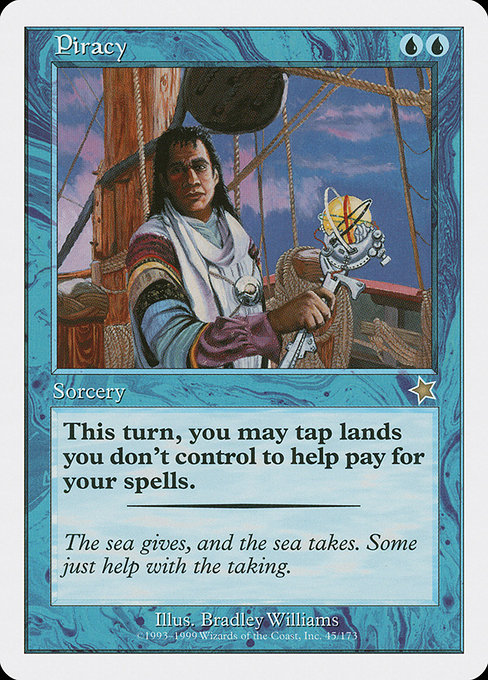
From the very first sleeves of Magic: The Gathering, fantasy art has been a guiding compass for the game’s atmosphere. The blue sorcery Piracy, issued in Starter 1999 (set type: starter; rarity: rare), serves as a vivid snapshot of how MTG artists wink at the grand tradition of nautical fantasy while threading the imagery into a playable moment. Crafted by Bradley Williams, the piece sits at the intersection of lore, illustration, and surface-level whimsy—the kind of card that makes you lean in and ask, “What classic seafaring tale is this riff on, exactly?” 🧭⚓️
The art on Piracy leans into that classic pirate-and-sea lore vibe with clarity and swagger. In an era when many sets sought to push the envelope with experimental borders, Starter 1999 kept its look approachable, almost like a treasure map you could hold in your hands. The color palette and composition evoke long voyages, hidden coves, and the thrill of a plan that might fail—or shine—at the last possible moment. It’s a homage not just to a type of character, but to a literary mood: the idea that the ocean offers both fortune and risk, a mood that resonates with fans who grew up devouring pulp fantasy and high-seas adventure tales. 🎨🏴☠️
Flavor text seals the mood: “The sea gives, and the sea takes. Some just help with the taking.” That line is a perfect microcosm of how MTG often weds flavor to function. Piracy’s effect—“Until end of turn, you may tap lands you don’t control for mana. Spend this mana only to cast spells.”—reads like a fleeting wind gust that characters from those stories would chase. It’s not just about raw efficiency; it’s about the drama of bending the rules for a moment and hoping the narrative payoff pays off as the spell resolves. 💎⚔️
How the card design echoes the fantasy canon
In gameplay terms, Piracy is a blue spell that embodies one of blue’s most seductive traits: tempo and manipulation. The two blue mana cost keeps it accessible in the early turns of a match, but its power lies in the temporary mana swing it generates. You can lean into a control or tempo plan by deploying it during a critical turn, tapping lands you don’t control to fuel your spellcasting for the turn. The restriction—“only to cast spells”—keeps the effect tasteful, preventing abuse with non-spell mana sinks and preserving the card’s narrative tension. The rarity (rare) and its {U}{U} mana cost nod to classic, underappreciated tools blue often uses to outthink the battlefield rather than overpower it outright. 🧙♂️💬
Bradley Williams’ artwork contributes to that sense of strategic storytelling, turning a simple blue sorcery into a moment you can imagine playing out in a storm-lashed, lantern-lit port. The piece captures both the romance and the danger of piracy—the audacity to bend reality for a moment, and the ever-present risk that the sea might reclaim what you’ve just seized. That tension mirrors the player’s own decision-making: do you commit to a risky tempo play now, or hold the line and wait for a more favorable window? 🎲🎨
Strategic takeaways for modern players
- Tempo levers: Piracy invites you to manipulate the mana economy by temporarily tapping lands you don’t control. In a control-heavy matchup, you can turn the tide by accelerating your spell tempo on a single turn, threatening to close out threats before your opponent stabilizes.
- Deck architecture: In a blue shell, Piracy shines alongside other mana-hacking or spell-doubling effects. It’s a natural fit in archetypes that prize card draw, counter-mantics, and careful sequencing, since the mana you generate is restricted to casting spells—but that’s often all you need to topple a plan that hinges on heavy permanence pressure.
- Risk vs. reward: The line between a clever tempo play and a misstep is slim. Tap too many lands you don’t control and you might slip past your own curve. Yet when executed with care, the momentary mana surge can fetch a key spell that dictates the rest of the game. 💡
- Flavor as tactic: The art and text align to remind you why pirates are such enduring archetypes in fantasy: cunning, boldness, and a willingness to bend rules for a fortune that might vanish with the tide. That narrative flavor can inform the way you present your plays to opponents, too—keeping pressure steady while you ride the current. 🔥
The art of collecting and the broader MTG culture
As Starter 1999 reprints and reissues circulated, Piracy found a home in the hearts of players who prize accessible entry points into the game’s rich history. Its artwork stands alongside other early blue classics as a reminder that in MTG, the illustration is not merely decorative; it’s a storytelling tool that can influence how you view the card long after it leaves the battlefield. The card’s blend of rarity, white-border charm, and the maritime motif makes it a gem for collectors who savor the lore as much as the mechanics. 💎
For fans who love the interwoven worlds of fantasy art and game design, Piracy is a compact case study: a crisp, evocative image paired with a simple, elegant mechanic that nonetheless invites deep strategic thought. It’s a reminder of how the game’s oldest vessels still carry some of the strongest currents today—proof that classic art can age like wine while remaining perfectly relevant to modern playstyles. 🧭🎲
Shop talk and a small crossover moment
Speaking of journeys and curiosities, sometimes a good scroll through the great libraries of fandom means stepping away from the table for a moment to refresh the gear that keeps you sharp during long sessions. If you’re navigating a sea of desk setups or looking for a little ergonomic polish between rounds, consider a practical upgrade that still feels right at home with the MTG nerd aesthetic—a neon foot-shaped mouse pad with ergonomic memory foam wrist rest. It’s a quirky, delightful accessory that aligns with the playful spirit of fantasy art homages while delivering real-world comfort as you map out your next big play. Pro tip: comfort fuels focus, and focus fuels flawless line-by-line mana management. 🧙♂️💺
To explore a little real-world gear that complements your gaming vibe, check out our shop’s neon-foot-shaped mouse pad with ergonomic memory foam wrist rest. It’s a fun, practical nod to the same delight you feel when you discover a perfect homage in your favorite card art. Neon Foot-Shaped Mouse Pad with Ergonomic Memory Foam Wrist Rest.
Neon Foot-Shaped Mouse Pad with Ergonomic Memory Foam Wrist RestMore from our network
- https://wiki.digital-vault.xyz/wiki/post/minecraft-block-stats-red_terracotta/
- https://blog.digital-vault.xyz/blog/post/generals-kabuto-how-rarity-scaling-affects-set-balance/
- https://blog.digital-vault.xyz/blog/post/boosting-customer-support-automation-with-ai-and-bots/
- https://wiki.digital-vault.xyz/wiki/post/pokemon-tcg-stats-jynx-card-id-xy3-37/
- https://crypto-articles.xyz/tmp_fxdg25i/index.html
Piracy
Until end of turn, you may tap lands you don't control for mana. Spend this mana only to cast spells.
ID: 323e3084-8d84-474f-b208-a4637b1ccb51
Oracle ID: 131acf69-fa5c-4ce7-9e39-2677af4f8907
Multiverse IDs: 21049
TCGPlayer ID: 355
Cardmarket ID: 14479
Colors: U
Color Identity: U
Keywords:
Rarity: Rare
Released: 1999-07-01
Artist: Bradley Williams
Frame: 1997
Border: white
EDHRec Rank: 20135
Set: Starter 1999 (s99)
Collector #: 45
Legalities
- Standard — not_legal
- Future — not_legal
- Historic — not_legal
- Timeless — not_legal
- Gladiator — not_legal
- Pioneer — not_legal
- Modern — not_legal
- Legacy — legal
- Pauper — not_legal
- Vintage — legal
- Penny — not_legal
- Commander — legal
- Oathbreaker — legal
- Standardbrawl — not_legal
- Brawl — not_legal
- Alchemy — not_legal
- Paupercommander — not_legal
- Duel — legal
- Oldschool — not_legal
- Premodern — not_legal
- Predh — legal
Prices
- USD: 48.89
- EUR: 32.12
More from our network
- https://blog.digital-vault.xyz/blog/post/hidden-synergies-for-inferno-fist-with-obscure-red-cards/
- https://blog.crypto-articles.xyz/blog/post/nft-data-solrock-71-from-solrocks-collection-on-magiceden/
- https://articles.digital-vault.xyz/blog/post/bird-keeper-timing-when-to-evolve-or-hold-pokemon-in-tcg/
- https://blog.crypto-articles.xyz/blog/post/nft-data-george-plays-clash-royale-1080-from-gpcr-nft-collection-collection-on-magiceden/
- https://crypto-acolytes.xyz/blog/post/nft-stats-l152-hydraulic-hammer-hydraulic-powerstriker-from-haste-weapon-collection/