
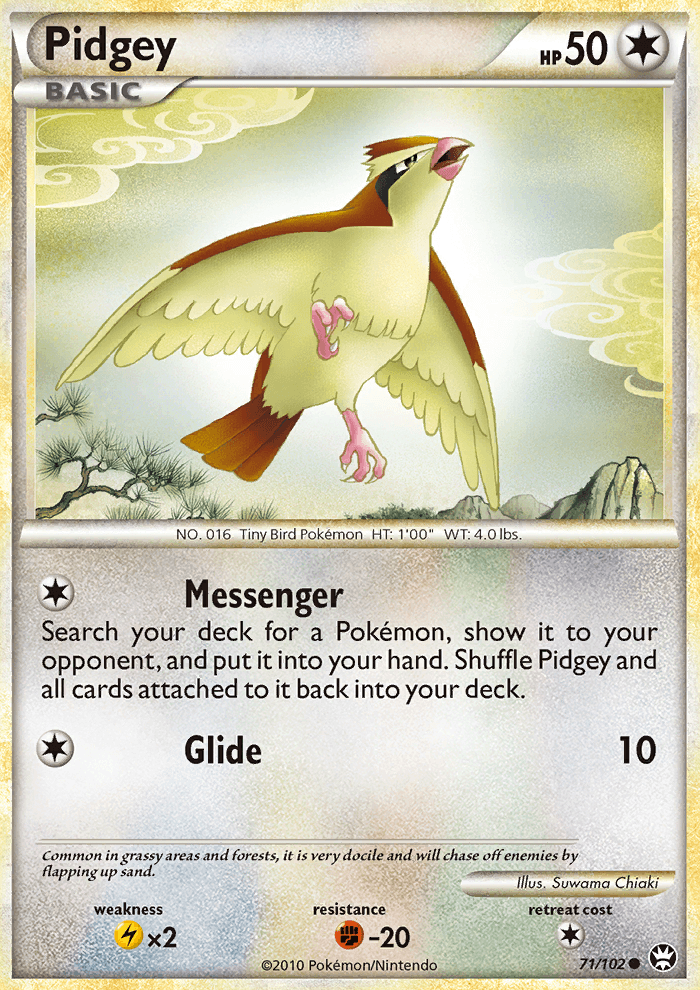
Image courtesy of TCGdex.net
Balancing Act: What a humble Pidgey reveals about Pokémon TCG strategy and the meta
In the long arc of the Pokémon Trading Card Game, balance often hides in the quiet corners of a card’s text. Pidgey, a common Colorless Basic from the Triumphant era, is a perfect case study. With a modest 50 HP, a pair of modest attacks, and a game‑changing defensive mechanism tucked into a single named ability, this little feathered Pokémon demonstrates how early game tempo, information control, and deck integrity work together to shape the meta. ⚡🔥
On the surface, Pidgey is a low‑stakes starter—not the kind that dominates matchups by raw numbers. But its Messenger attack, paired with Glide, invites a deeper look at how balance evolves across turns, decisions, and opponent expectations. The art by Suwama Chiaki captures a moment of calm before a flurry of tactics, a reminder that not every powerful play needs to be flashy to tilt a game. 🎴🎨
Card fundamentals: what the numbers and moves actually do
- Name: Pidgey
- HP: 50
- Type: Colorless
- Stage: Basic
- Attacks:
- Messenger — Colorless
- Effect: Search your deck for a Pokémon, show it to your opponent, and put it into your hand. Shuffle Pidgey and all cards attached to it back into your deck.
- Glide — Colorless
- Effect: 10 damage
- Weakness: Lightning ×2
- Resistance: Fighting −20
- Retreat: 1
- Illustrator: Suwama Chiaki
- Rarity: Common
- Set: Triumphant (hgss4), with 102 official cards in the run (103 total)
Messenger is the heartbeat of Pidgey’s balance. It asks you to pay one card’s worth of tempo for a longer-term gain: fetch a Pokémon of your choosing, present it to your opponent, and then shuffle not only Pidgey but also any attachments back into the deck. In practice, this creates a delicate exchange between information disclosure and deck integrity. You gain a crucial resource—the exact Pokémon you want, when you want it—while potentially telegraphing what you’re aiming to pull next. The return of Pidgey and attached cards to the deck ensures you can’t run away with infinite redeployments of a single engine. The price of this advantage is clear: you expose your plan, you reset your board state, and you reset part of your deck’s composition for the next few turns. It’s a microcosm of TCG balance in action. ⚡🎯
Glide, the second attack, is a classic reminder that not every tool needs to be a sword. A reliable 10 damage provides early pressure, helps you win tiny exchanges, and keeps Pidgey relevant enough to justify the decision to keep the stage clear for a potential evolution—if your deck calls for one. The card’s HP, a modest 50, paired with a retreat of 1 and a typical Colorless frame, nudges players toward careful bench management rather than reckless aggression. When you combine Messenger’s fetch power with Glide’s steady damage, you get a playable tempo engine that’s balanced by information costs and deck reshuffling. The result is a card that punishes impatience and rewards thoughtful sequencing. 🔥💎
Strategic implications: how Pidgey informs deck building and the evolving meta
From a strategic standpoint, Pidgey teaches several key balance lessons that echo across generations of Pokémon TCG design:
- Tempo vs. information cost: Messenger accelerates access to your ideal Pokémon, but revealing that choice to your opponent introduces a layer of mind games. The balance leans toward making you weigh whether the immediate card you fetch is worth the turn you lose to shuffling and the risk of information leakage. This is a prime example of how the game measures “value” not just in damage, but in knowledge and setup. 🧠
- Consistency without overpowering fetch: The card belongs to a basic, common tier, yet it offers deck-thinning style support without enabling a single, overpowering engine. In a broader sense, this mirrors how modern sets approach search mechanics—enabling reliable access without letting any one strategy run away with the game.
- Risk management in early turns: With 50 HP, Pidgey is not built to tank the early fight. It’s a sacrificial tempo piece that can pivot a game toward your longer-term plan if you manage your bench and the order of operations carefully. In tournaments and casual play alike, this encourages players to think several moves ahead rather than chasing immediate big hits. 🎯
- Relevance of evolution paths: While Pidgey itself is basic, the potential to progress toward a Pidgeotto or other evolving lines remains part of the strategic calculus. Messenger can fetch stabilizing Pokémon that support your evolving strategy, and the requirement to return Pidgey to the deck helps keep the eventual board state balanced. This mirrors how real meta decks often rely on a progression plan rather than a one-turn miracle. 🎴
In practice, you’ll see this balance play out in modern methods as well: search power is ubiquitous, but designers cap it with costs, reveal requirements, or deck‑thinning consequences to prevent runaway advantage. Pidgey is a nostalgic snapshot of that ongoing equilibrium, a reminder that strategy grows strongest when players respect both tempo and restraint. 🎮
Collector and market perspective: value, nostalgia, and historical context
Even as a common card, Pidgey from Triumphant carries collectible appeal. The set sits in the last wave of the HeartGold & SoulSilver era, a period cherished by many collectors for its art, flavor, and the long tail of deck-building ideas it spawned. In price data, non-holo copies show modest market activity, while reverse holos can command higher interest among collectors who chase variations and print runs. Current market observations indicate:
- Cardmarket (EUR): avg around 0.26 EUR; low around 0.02; trend around 0.29; holo variants can differ, reflecting demand and condition.
- TCGplayer (USD): normal copies show low prices (low around 0.15, mid around 0.29, high up to 1.49). Reverse holo foils tend to sit higher (market price around 5.9 USD, with broader upward potential for rare prints).
For players and collectors, Pidgey exemplifies a practical value proposition: a low-cost, nostalgia‑driven pick that still breathes life into discussions about how early-card text shapes the entire game. It’s a gentle reminder that great balance can appear in the smallest footprints. 💎
Art, lore, and the feel of a by-gone era
Suwama Chiaki’s illustration brings a bright, earthy tone to Pidgey—grounded in grassy habitats and forests that feel almost tactile in the older print style. This is not just about a card's function; it’s about a window into a time when the TCG explored new mechanics with experimentation and charm. The Triumphant set, with its distinctive logo and card backings, is a favorite for players who savor the tactile memory of opening boosters and spotting those classic silhouettes and fonts. The balance seen in Pidgey’s text is mirrored in the set’s broader approach: search and draw mechanics were becoming a focal point, but they were carefully tempered by costs and risk. A small bird offers big lessons in how to balance opportunity with restraint. 🦅
Practical takeaways for modern play (where applicable)
While Pidgey’s exact card won’t be legal in today’s Standard or Expanded formats, the underlying ideas still resonate in contemporary design. When you build decks today, consider:
- How much “fetch power” you’re comfortable granting your opponent to access your plan. Can you phrase your search to minimize information leakage?
- Whether your engine relies on continuous resets that keep the deck honest, rather than enabling a single unstoppable combo.
- Designing a plan that scales with the game’s tempo: early pressure, mid‑game setup, and late‑game finish all need to be harmonized.
In the end, Pidgey’s quiet balance and its humble toolkit remind us that strategy isn’t just about flashy attacks; it’s about shaping a game where patience, information, and careful sequencing can tilt the odds just enough to keep every match exciting. ⚡💡
Want to explore more about balance across the Pokémon TCG’s long arc of design? Read on and dive into the linked articles below for diverse takes on data, strategy, and the evolving meta.
Mobile Phone Stand Two-Piece Wobble-Free Desk DisplayMore from our network
- https://blog.crypto-articles.xyz/blog/post/nft-data-geek-2049-from-geeks-collection-on-magiceden/
- https://wiki.digital-vault.xyz/wiki/post/pokemon-tcg-stats-kirlia-card-id-ex1-34/
- https://crypto-acolytes.xyz/blog/post/monkey-biz-1773-monkey-business-nft-stats/
- https://blog.crypto-articles.xyz/blog/post/nft-data-wizi-148-from-wizi-order-collection-on-magiceden/
- https://blog.rusty-articles.xyz/blog/post/half-life-alyx-fan-theories-roundup-what-could-be-next/
Pidgey
Set: Triumphant | Card ID: hgss4-71
Card Overview
- Category: Pokemon
- HP: 50
- Type: Colorless
- Stage: Basic
- Dex ID: 16
- Rarity: Common
- Regulation Mark: —
- Retreat Cost: 1
- Legal (Standard): No
- Legal (Expanded): No
Description
Common in grassy areas and forests, it is very docile and will chase off enemies by flapping up sand.
Attacks
| Name | Cost | Damage |
|---|---|---|
| Messenger | Colorless | |
| Glide | Colorless | 10 |
Pricing (Cardmarket)
- Average: €0.26
- Low: €0.02
- Trend: €0.29
- 7-Day Avg: €0.4
- 30-Day Avg: €0.29
Support Our Decentralized Network
Donate 💠More from our network
- https://blog.crypto-articles.xyz/blog/post/nft-data-geek-2049-from-geeks-collection-on-magiceden/
- https://wiki.digital-vault.xyz/wiki/post/pokemon-tcg-stats-kirlia-card-id-ex1-34/
- https://crypto-acolytes.xyz/blog/post/monkey-biz-1773-monkey-business-nft-stats/
- https://blog.crypto-articles.xyz/blog/post/nft-data-wizi-148-from-wizi-order-collection-on-magiceden/
- https://blog.rusty-articles.xyz/blog/post/half-life-alyx-fan-theories-roundup-what-could-be-next/