

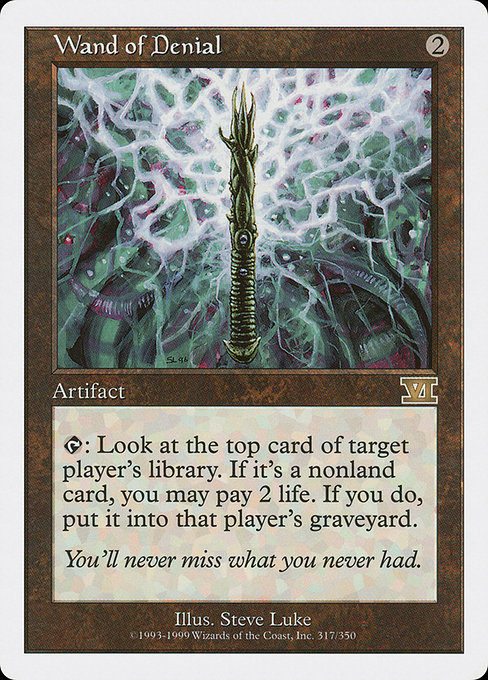
Image courtesy of Scryfall.com
Parody as a Bridge: Connecting Players Through Wand of Denial
Parody is more than punchlines and memes at the table; it’s a social glue that helps players of all levels feel seen, heard, and part of a larger story. In Magic: The Gathering, where the table can swing from tense strategic stalemates to gleeful mischief in a single turn, parody becomes a shared language. It lets friends laugh together about the quirks of a game that often rewards meticulous planning and patient defense. 🧙♂️🔥 And when that humor is grounded in the familiar, tangible artifacts of the past—like Wand of Denial from Classic Sixth Edition—it creates a nostalgic bridge between generations of players who’ve stood around a table, sleeves rolled up and a coffee-stain map of battlefield plans spread out in front of them. 💎🎲
Wand of Denial: a time-warped conduit for mischief
In a world of flashy rares and color-sleeved combos, Wand of Denial stands out for its simplicity and its sly humor. This artifact, costing 2 mana, is colorless and rare from Sixth Edition (6ed), a core set release that lives in the fluorescent glow of late-90s MTG memory. Its ability—
“Tap: Look at the top card of target player's library. If it's a nonland card, you may pay 2 life. If you do, put it into that player's graveyard.”
is as narrative, tactical, and cheeky as any parody card you might conjure up for a night of homebrew, parody drafts. The mechanic invites you to peek behind the curtain, decide if the top card is worth a dramatic life payment, and then yank the card into the graveyard as a playful renunciation of fate. The art by Steve Luke, with its offbeat charm, and the flavor text—“You'll never miss what you never had.”—teases at longing, mischief, and the shared joke that in a long game, sometimes a top-deck is more character than threat. It’s the kind of card that invites a storyteller’s approach to play: narrate the moment, lean into the joke, and watch the table settle into a rhythm where strategy and storytelling dance together. ⚔️🎨
From strategy to storytelling: how parody strengthens play
Parody at the table isn’t just about making people laugh; it’s a way to anchor players in a shared story. Wand of Denial becomes a storytelling prop as much as a strategic tool. When you tap it, you’re not only sifting through a library; you’re preemptively staging a moment of dramatic irony: a top card revealed, a choice made, a life payment offered, and the prospect of a graveyard pivoting the narrative. That tension—the push and pull between luck, choice, and humor—fosters engagement. Players lean in, not to protect their own plans alone, but to read the table’s mood and contribute to the running joke. The table becomes a collaborative stage where parody punctuates serious play, and every reveal is a cue for camaraderie. 🧙♂️🔥
- Parody lowers intimidation: new players can riff on familiar card names while seasoned players enjoy callbacks to classic cards and old formats.
- Shared narratives emerge: table talk turns “what if” into “what happened last game,” weaving personal memory into current strategy.
- Turn-by-turn banter strengthens trust: players learn to improvise, celebrate near-misses, and recover gracefully after a misplay, all in good fun.
- Clean humor, clean handling: ally-focused humor keeps the table collaborative rather than combative, preserving the social contract of the game.
- Parody spurs creativity: players craft silly side-quests, memes, or house rules that echo the card’s flavor, enriching the game’s culture beyond wins and losses.
Art, flavor, and nostalgia: the emotional texture of the game
The nostalgia engine of MTG runs on a steady diet of art, lore, and feel. Wand of Denial is a perfect microcosm: a simple artifact with a flavor text that nudges players toward reflection on opportunity and loss. The card’s 1999 frame and black-lettered rarity—while it’s no longer in standard rotation—lingers in the memory of players who learned the game with a starter deck and a stack of commons. The rarity, the border, the tone of the card, and the flavor text all come together to evoke a moment when the table felt like a shared theater rather than a single player’s path to victory. It’s a reminder that MTG thrives not only on power but on personality—on the stories we tell about our decks as much as the cards themselves. 💎🧩
“You'll never miss what you never had.”
In crafting parody-friendly decks or just a night of tongue-in-cheek gameplay, Wand of Denial becomes a touchstone—an emblem of the way a community can celebrate both the game’s depth and its whimsy. The card’s colorless identity makes it a flexible talking point: a reminder that in MTG you don’t have to be a master of a single color to contribute to a table’s culture; you can be the one who sketches a story from a top-deck, a flourish of misdirection, or a cheeky turn of phrase that lands perfectly with friends. 🧙♂️🎲
Collectibility, history, and the value of shared memory
From a collector’s lens, Wand of Denial anchors a moment in time: Classic Sixth Edition’s early-into-mid-90s vibe, when artifact strategies were gaining steam, and players were discovering how to bend rules (and laugh at the bends) in equal measure. The card is a rare nonfoil with an aura of collectible charm, holding a place on shelves and in binders alongside other nostalgia-driven staples. Its value isn’t just monetary; it’s a social currency—the memory of a particular night, the friend who pulled it off the top, or the joke that only made sense to the people at the table that evening. This is the essence of parody as cultural glue: it binds people with shared recollection, a mutual grin, and a story that travels with them to future games. 🔥💎
For format enthusiasts, Wand of Denial sits comfortably within formats that welcome older, non-rotating cards, and its historical footprint invites discussion about how card design and flavor have evolved. The interplay of text, art, and rarity offers a window into how Wizards balanced simple utilities with the social dimension of play—an ongoing conversation that parody keeps alive whenever players gather to laugh, trade jokes, and swap top-deck tales.
As you think about how parody can deepen your own play, consider how Wand of Denial would fit into your next session: a moment to provoke a top-deck reveal, to tease a friend’s misplays in good spirits, or to spark a story you’ll retell for months to come. After all, MTG isn’t just about cards; it’s about the community that surrounds them, the laughter they spark, and the connections that endure long after the last card is drawn. ⚔️🎨
Neon Phone Case with Card Holder MagSafe Polycarbonate Glossy MatteMore from our network
- https://blog.crypto-articles.xyz/blog/post/nft-data-monos-147-from-monos-collection-on-magiceden/
- https://crypto-acolytes.xyz/blog/post/nft-stats-bagyo-651-from-bagyo-collection/
- https://blog.crypto-articles.xyz/blog/post/tangrowth-price-trends-and-collector-value-in-the-pokemon-tcg/
- https://donation.digital-vault.xyz/donation/post/support-free-education-and-resources-for-all-learners/
- https://wiki.digital-vault.xyz/wiki/post/pokemon-tcg-stats-metal-saucer-card-id-swsh1-170/
Wand of Denial
{T}: Look at the top card of target player's library. If it's a nonland card, you may pay 2 life. If you do, put it into that player's graveyard.
ID: f6f37dd8-87d6-432f-a60d-a7a699da3080
Oracle ID: 9d32da71-60e5-4eb3-97ca-ae76e2f5df57
Multiverse IDs: 15411
TCGPlayer ID: 2796
Cardmarket ID: 11160
Colors:
Color Identity:
Keywords:
Rarity: Rare
Released: 1999-04-21
Artist: Steve Luke
Frame: 1997
Border: white
EDHRec Rank: 18700
Penny Rank: 8177
Set: Classic Sixth Edition (6ed)
Collector #: 317
Legalities
- Standard — not_legal
- Future — not_legal
- Historic — not_legal
- Timeless — not_legal
- Gladiator — not_legal
- Pioneer — not_legal
- Modern — not_legal
- Legacy — legal
- Pauper — not_legal
- Vintage — legal
- Penny — not_legal
- Commander — legal
- Oathbreaker — legal
- Standardbrawl — not_legal
- Brawl — not_legal
- Alchemy — not_legal
- Paupercommander — not_legal
- Duel — legal
- Oldschool — not_legal
- Premodern — legal
- Predh — legal
Prices
- USD: 0.52
- EUR: 0.51
More from our network
- https://crypto-acolytes.xyz/blog/post/rayquaza-ex-balancing-rng-and-consistency-in-competitive-tcg/
- https://blog.crypto-articles.xyz/blog/post/nft-data-planet-kaiju-6605-from-planet-kaiju-collection-on-magiceden/
- https://wiki.digital-vault.xyz/wiki/post/pokemon-tcg-stats-spoink-card-id-sm7-59/
- https://wiki.digital-vault.xyz/wiki/post/pokemon-tcg-stats-drampa-card-id-sm12-159/
- https://wiki.digital-vault.xyz/wiki/post/pokemon-tcg-stats-maushold-card-id-sv08-158/