
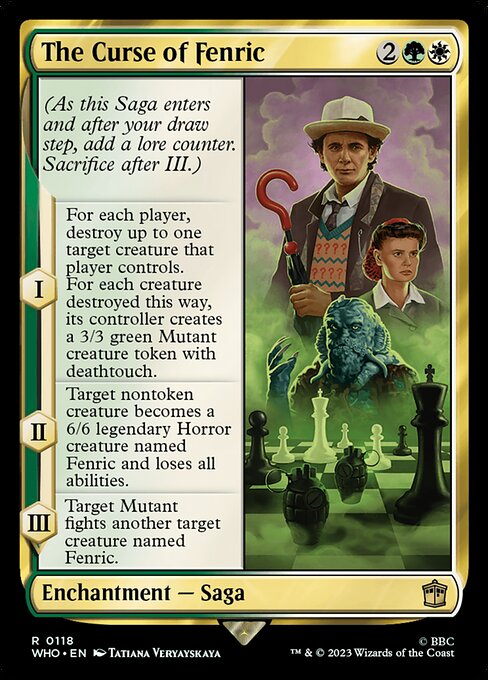
Image courtesy of Scryfall.com
Parody Cards Through the Doctor Who Lens: A Case Study in MTG Culture
Parody cards are more than punchlines or meme fuel. They’re cultural touchpoints that let players riff on shared experiences—nostalgia, humor, and the odd dream of crossovers colliding in a single tabletop moment 🧙♂️🔥. The Curse of Fenric, a rare enchantment from the Doctor Who crossover set, stands as a vivid example of how parody cards ride the line between fan service and genuine game design. This GW color pairing—green and white—invites a particular brand of collaborative play: lush, token-rich boards meeting patient, under-the-surface disruption. And yes, it’s as cheeky as it sounds, in the best possible way ⚔️💎.
At first glance, The Curse of Fenric is a Saga—a storytelling enchantment that unveils its tale across three chapters. Sagas have long been a narrative backbone in MTG, delivering a mini-arc that accelerates from setup to payoff. This card uses that arc to stage a playful “what-if” across the battlefield: what if a Doctor Who antagonist could rewrite fate on your terms? The Curse of Fenric costs {2}{G}{W} to cast, landing in a format that already thrives on interaction and longer games. Its rarity (rare) and its placement in the Who set signal a deliberate celebration of pop culture within the simulated time-stream of a card game 🧩🎲.
Card Spotlight: The Curse of Fenric
The first chapter arrives with a bang: “For each player, destroy up to one target creature that player controls. For each creature destroyed this way, its controller creates a 3/3 green Mutant creature token with deathtouch.” It’s a mouthful, but the flavor lands: a world-shaking cleansing that multiplies trouble in the most green-white way imaginable. The token symmetry—destroying creatures to spawn Mutants—feels like a wink to the chaos fans crave when a crossover character invades the arena. It also showcases a neat design trick: a paradoxical gift that makes players rethink board state with every resolved line of text 🧙♂️⚔️.
Chapter II ramps the weirdness up: “Target non-token creature becomes a 6/6 legendary Horror creature named Fenric and loses all abilities.” Here the parody breathes: a legendary Horror version of Fenric stepping onto the battlefield, stripped of anything that might restrain him, a nod to fan-love for rebranding an iconic foe. This is not just flavor; it’s a mechanical joke with teeth. The creature becomes a towering, singular menace whose identity is as much about narrative punch as about numbers on a card frame. It’s a reminder of how crossovers can transform identity within a game without sacrificing balance—just enough to spark conversation and a few “what happens if” moments 🧠💡.
Chapter III closes with a literal showdown: “Target Mutant fights another target creature named Fenric.” The fight mechanic—where creatures deal damage to each other—takes center stage, letting players orchestrate cinematic clashes that feel straight out of a sci-fi showdown. It’s a flourish that crystallizes parody into a playable moment, a tiny theater of combat where flavor and function collide in glorious fashion. The entire trilogy of effects captures why parody cards land so deeply: they reward players for keeping up with lore, conventions, and a shared sense of humor 🎭🔥.
“Parody cards are less about power and more about storytelling. In a format built on strategic depth, they give us a reason to grin and gawk at the card art while we plan our next move.”
Beyond the novelty, Fenric’s design invites players to talk about what makes a card memorable. The mix of removal, token generation, identity swaps, and a climactic fight gives players multiple angles to explore in a deck-building sense. It isn’t merely about slapping a Doctor Who label on a card; it’s about wiring pop culture into the engine of strategic play, so casual fans and theorycrafters alike can share a myth in the same moment 🧠🎨.
Gameplay Angles and Deck-Building Ideas
From a gameplay perspective, The Curse of Fenric shines in Commander and other multiplayer environments where the saga’s first chapter can clear a path while triggering rewarding token plays. The token swarm acts as a natural foil to mass-removal strategies, inviting a swingy tension: do you leverage the tokens for pressure, or pivot to chase Fenric’s transformed form in Chapter II? The answer often lies in timing and board state, a reminder that parody cards reward thoughtful planning as much as spontaneity 💎⚔️.
- Theme synergy: A GW token-heavy approach pairs well with enchantments and board-proliferation engines. If you’re leaning into tokens, Fenric’s lore supports a combat-forward plan that isn’t afraid to lean into aggressive play.
- Interaction focus: Chapter I’s mass destruction can be a double-edged sword in multiplayer; use protection spells or friendly auras to maximize value while keeping opponents honest. It’s a test of tempo and diplomacy as much as brute force 🧭.
- Transformative play: Chapter II’s ability to rewrite a creature’s fate is a dramatic pivot—great for surprise swings and political play in a set where pop culture magic can still feel canonical and thematic.
- Flavor as strategy: The naming of Fenric as a legendary Horror isn’t just a silly twist; it anchors a storytelling arc that invites you to craft a backstory around your board state, turning a game into a shared narrative 🎲.
- Collectibility and culture: The card’s Universes Beyond label and Doctor Who tie make it a talking point at tables and in online discussions, a badge of the era when M:tG embraced crossovers as a cultural mirror 🔎.
Collectors also take note: The Curse of Fenric appears in foil and nonfoil, with a modest market footprint (prices hovering around a few dollars for foil and nonfoil variants). Its rank on EDHREC sits in the mid-range—enough to be a signature when you’re building a themed deck, but approachable for casual use as a flavorful centerpiece. The card is a reminder that pop culture crossovers, when designed with care, can coexist with sturdy mechanics and a robust multiplayer experience 🧩💎.
Slim Glossy Phone Case for iPhone 16More from our network
- https://wiki.digital-vault.xyz/wiki/post/pokemon-tcg-stats-dedenne-card-id-a1a-030/
- https://blog.zero-static.xyz/blog/post/nba-jam-sequel-wishlist-features-fans-want-on-pc-and-consoles/
- https://crypto-acolytes.xyz/blog/post/nft-stats-lnp458-from-line-and-pixels-collection/
- https://wiki.digital-vault.xyz/wiki/post/pokemon-tcg-stats-fire-energy-card-id-gym1-128/
- https://crypto-articles.xyz/tmpo8npcg1r/glossy-matte-neon-phone-case-with-card-holder.html
The Curse of Fenric
(As this Saga enters and after your draw step, add a lore counter. Sacrifice after III.)
I — For each player, destroy up to one target creature that player controls. For each creature destroyed this way, its controller creates a 3/3 green Mutant creature token with deathtouch.
II — Target nontoken creature becomes a 6/6 legendary Horror creature named Fenric and loses all abilities.
III — Target Mutant fights another target creature named Fenric.
ID: 0e399b70-d793-4833-8317-557fa98a611c
Oracle ID: ef7fce1b-0d95-4f92-a8ad-09d9756fa0e4
Multiverse IDs: 634813
TCGPlayer ID: 518881
Cardmarket ID: 738705
Colors: G, W
Color Identity: G, W
Keywords: Fight
Rarity: Rare
Released: 2023-10-13
Artist: Tatiana Veryayskaya
Frame: 2015
Border: black
EDHRec Rank: 16234
Set: Doctor Who (who)
Collector #: 118
Legalities
- Standard — not_legal
- Future — not_legal
- Historic — not_legal
- Timeless — not_legal
- Gladiator — not_legal
- Pioneer — not_legal
- Modern — not_legal
- Legacy — legal
- Pauper — not_legal
- Vintage — legal
- Penny — not_legal
- Commander — legal
- Oathbreaker — legal
- Standardbrawl — not_legal
- Brawl — not_legal
- Alchemy — not_legal
- Paupercommander — not_legal
- Duel — legal
- Oldschool — not_legal
- Premodern — not_legal
- Predh — not_legal
Prices
- USD: 0.09
- USD_FOIL: 0.39
- EUR: 0.17
- EUR_FOIL: 0.37
More from our network
- https://articles.zero-static.xyz/blog/post/world-building-analysis-in-ratchet-clank-up-your-arsenal/
- https://wiki.digital-vault.xyz/wiki/post/pokemon-tcg-stats-zorua-card-id-sv105w-061/
- https://crypto-acolytes.xyz/blog/post/why-mounts-and-travel-systems-drive-player-retention/
- https://wiki.digital-vault.xyz/wiki/post/pokemon-tcg-stats-magikarp-card-id-a1-077/
- https://crypto-acolytes.xyz/blog/post/nft-stats-rtfiv63-from-retardio-family-lv-collection/