
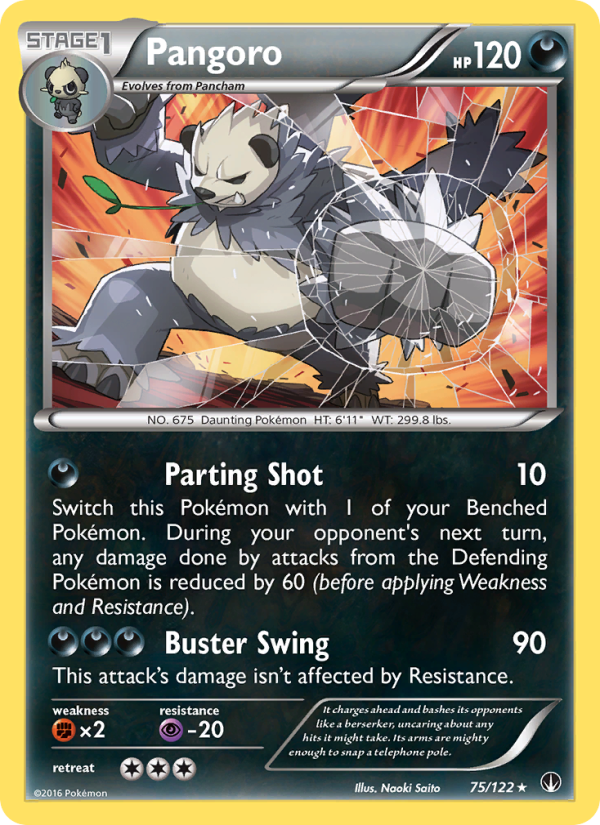
Image courtesy of TCGdex.net
Why rare cards spark a spark in the human psyche—even when you’re deep into the game
Pokémon TCG rarities aren’t just about collecting badges of honor on a card sleeve; they’re about the thrill of the chase, the story behind a print run, and the tactile glow of a holo shining under a lamp. Take Pangoro, a rare holo from the XY Breakpoint era, for example. This Dark-type Stage 1 card evolves from Pancham and sports a commanding 120 HP, a design by Naoki Saito, and a pair of attacks that shape both gameplay and collector sentiment. The card’s rarity isn’t a mere sticker on the corner—it’s a signal that invites players and collectors to invest attention, time, and emotion into a single, gleaming snapshot of a Pokémon’s journey.
Scarcity, status, and the thrill of completion
- Scarcity creates value perception: The Breakpoint set, with its 122 official cards and a total of 126, makes each rare holo feel like a limited artifact in a vast ocean of cards. The psychology here borrows from classic consumer behavior: items that are harder to obtain carry a premium in the mind, even if the statistical price difference isn’t enormous.
- Progression matters: Pangoro’s evolution from Pancham adds a narrative layer—collectors aren’t just chasing a single card, they’re pursuing a meaningful chapter in a Pokémon’s ongoing story arc. The evolution line becomes a mini-saga that fans can complete over time.
- Display and ownership signals: Holo or reverse-holo variants—both present in Breakpoint—offer different visual experiences. A holo Pangoro catches light with a shimmer that many players describe as “owning a piece of the scene.” This tactile glamour translates into social currency in leagues, shops, and online communities.
Gameplay flavor: how rarity intersects strategy
Pangoro grounds its appeal not only in aesthetics but also in how it plays. With 120 HP and a pair of distinctly strategic attacks, this card embodies the tension between offense and control that draws players to rare pulls. The first attack, Parting Shot, costs a single Darkness energy and lets Pangoro swap with a benched Pokémon while weaving into timing: during the opponent’s next turn, any damage dealt by the Defending Pokémon is reduced by 60 before weakness and resistance. The second attack, Buster Swing, demands three Darkness energies and delivers 90 damage, with a notable caveat: its damage ignores Resistance. In a meta where resistances often dull big hits, Buster Swing rewards risk and energy investment, amplifying the lure of a rare card that empowers bold plays or clutch comebacks.
The card’s Dark-typing aligns with the broader BREAKpoint era’s emphasis on aggressive, resourceful play. Pangoro’s weakness to Fighting at ×2 and its Psychic resistance provide a balanced risk-reward package. The Retreat Cost of 3 nudges players toward thoughtful bench management—a subtle reminder that rarity isn’t just about the card you flip but the deck you curate. In Expanded format, where Pangoro remains legal, rare holos become more than simply “eye candy” on the table; they become anchors for deckbuilding narratives, bluffs, and tempo battles against diverse strategies.
Art, lore, and the collector’s gaze
Naoki Saito’s artwork for Pangoro captures a poised, almost pugilist moment—the sort of stance that makes you want to study the card for a long minute. In the Breakpoint line, the holo variant amplifies this sense of presence, turning the Pokémon into a dynamic focal point on the table. Collectors aren’t just seeking power; they’re seeking identity. A holo Pangoro becomes a centerpiece in a binder, a talking point in a trade, and a cherished memory of the first time a player realized how much a single card can tell a story about a single battle. The rarity and art, working in tandem, translate into a compelling emotional bond that trading cards have perfected since the hobby’s earliest days.
From a broader lens, Pangoro’s place in the XY era—an era famous for its dramatic holo finishes and vivid character design—highlights why rare cards endure in both nostalgia and utility. The card’s evolution line, the dramatic attack animations, and the tactile glow of holo shine combine into a classic example of how rarity amplifies storytelling in the Pokémon TCG. It’s a dance of design, chance, and memory—a ritual that keeps players chasing the next big pull even as they celebrate the beauty of the card right in front of them.
Market signals: value, rarity, and the pulse of the community
Beyond the table, Pangoro’s rarity and holo status affect trading value across marketplaces. A snapshot of recent pricing hints at the market’s behavior when rarity meets utility. On CardMarket, Pangoro holo cards show an average around 0.92 EUR, with a broader low-to-high spread that reflects both condition and demand. The non-holo normal copy sits closer to 0.26 EUR on average, illustrating how holo finishes consistently fetch a premium due to visual appeal and collectibility. On TCGPlayer, normal copies trend around 0.26 USD mid-price, with highs that can climb into the dollar range depending on copy quality and rotation status. Reverse-holo variants can spike to higher values—up to nearly 5 USD in some listings—when demand spikes for rare finishes in a thriving market. These numbers, captured in late 2025, remind us that rarity influences not only gameplay value but also the emotional and financial arcs collectors experience as they pursue the rainbow of Pangoro options across formats.
For fans who love both the game and the grind, rare Pangoro cards are a lesson in patience and taste. They teach that value isn’t merely economic—it’s experiential. Each holo glow, each swap in a trade, each moment of anticipation before flipping a card—all of it contributes to a larger narrative about what makes rare Pokémon cards so psychologically compelling. ⚡🔥💎
As you navigate the hobby, consider how the Pangoro print embodies a balance of power, art, and rarity. The card’s official status in Expanded and its holo presence make it a standout piece for collectors who relish both strategic depth and the beauty of a well-timed pull. The Breakpoint line remains a touchstone for many—proof that even in a vast universe of Pokémon, certain cards resonate as little works of psychology, art, and play all rolled into one glossy rectangle of nostalgia. 🎴🎨🎮
Curious to explore more about the intersections of data, strategy, and rare collectibles? Check out related reads and perspectives from across our network below.
Product spotlight — Custom Rectangular Mouse Pad 9.3x7.8 in Non-Slip
Custom Rectangular Mouse Pad 9.3x7.8 in Non-SlipMore from our network
- https://blog.crypto-articles.xyz/blog/post/nft-data-geek-219-from-geeks-collection-on-magiceden/
- https://crypto-acolytes.xyz/blog/post/winning-gym-leader-strategies-for-black-2-and-white-2/
- https://wiki.digital-vault.xyz/wiki/post/pokemon-tcg-stats-shuppet-card-id-a3-074/
- https://blog.crypto-articles.xyz/blog/post/nft-data-jupz-47-from-jupz-collection-on-magiceden/
- https://crypto-acolytes.xyz/blog/post/nft-stats-pfp-194-from-pumpfun-pepe-collection/
Pangoro
Set: BREAKpoint | Card ID: xy9-75
Card Overview
- Category: Pokemon
- HP: 120
- Type: Darkness
- Stage: Stage1
- Evolves From: Pancham
- Dex ID: 675
- Rarity: Rare
- Regulation Mark: —
- Retreat Cost: 3
- Legal (Standard): No
- Legal (Expanded): Yes
Description
Attacks
| Name | Cost | Damage |
|---|---|---|
| Parting Shot | Darkness | 10 |
| Buster Swing | Darkness, Darkness, Darkness | 90 |
Pricing (Cardmarket)
- Average: €0.26
- Low: €0.05
- Trend: €0.22
- 7-Day Avg: €0.2
- 30-Day Avg: €0.29
Support Our Decentralized Network
Donate 💠More from our network
- https://blog.crypto-articles.xyz/blog/post/nft-data-geek-219-from-geeks-collection-on-magiceden/
- https://crypto-acolytes.xyz/blog/post/winning-gym-leader-strategies-for-black-2-and-white-2/
- https://wiki.digital-vault.xyz/wiki/post/pokemon-tcg-stats-shuppet-card-id-a3-074/
- https://blog.crypto-articles.xyz/blog/post/nft-data-jupz-47-from-jupz-collection-on-magiceden/
- https://crypto-acolytes.xyz/blog/post/nft-stats-pfp-194-from-pumpfun-pepe-collection/