

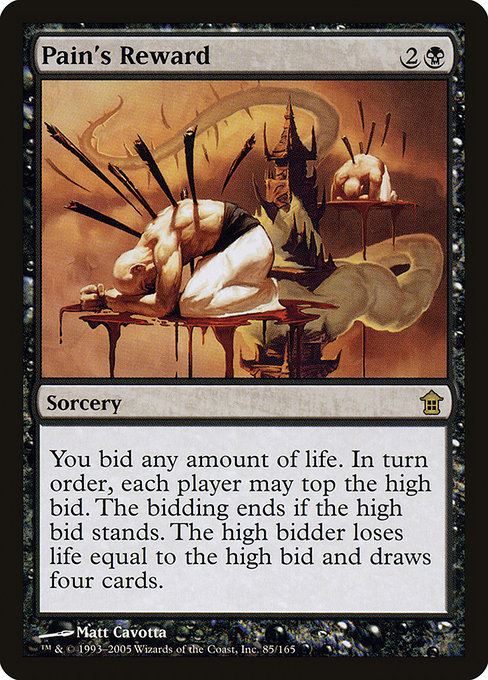
Image courtesy of Scryfall.com
Why Pain's Reward Redefined What a Black Spell Could Do
When Pain's Reward first appeared in Saviors of Kamigawa, the design team threw a curveball at players and table talk alike. This black sorcery, costing {2}{B}, carries a simple but radical premise: invite every player to bid life, start with any number, and let the high bid decide who gets to draw—at the cost of life lost equal to the bid. The eye-catching twist is that the high bidder isn’t just drawing extra cards for themselves; they’re risking a life toll that could tilt a game’s balance in surprising directions. In a line of text that reads like a nervy wager at a tavern, Pain's Reward turned the standard, mana-for-effects exchange on its head and invited players to negotiate with life totals as openly as they bid for resources. 🧙♂️🔥
Each player may bid life. You start the bidding with a bid of any number. In turn order, each player may top the high bid. The bidding ends if the high bid stands. The high bidder loses life equal to the high bid and draws four cards.
That single paragraph illustrates why the card felt ahead of its time. It isn’t a straightforward card advantage engine or a pure value play; it’s a social contract, a micro-drama that forces players to weigh immediate gain against collective risk. The card’s black mana identity anchors it in a color tradition of life manipulation and hand advantage, but its method of delivery is the real break from convention. It’s not about paying mana or creating tokens—it’s about bargaining with life as a resource, and letting the result ripple through the entire table. ⚔️
What conventions did it challenge?
- Table politics as the core engine: The bidding process makes every game state, even a near-stable mana curve, into a negotiation. A high life total can invite others to push the bid higher, while a low life total may force riskier plays. The card rewards players who can read the table and manage risk in real time. 🎲
- Life total as a mortgage, not just a resource: Traditionally, life loss is a outcome to avoid. Pain's Reward reframes life as a currency people can gamble, loan, or leverage during a single spell’s window. That pivot opened doors for future designs to experiment with life as a more interactive resource. 🧙♂️
- All players affected by one spell: Most effects target a player or a subset. This spell nuzzles the boundaries of multiplayer politics by making everyone a stakeholder in the same bidding war, which can swing the outcome in unpredictable directions. 💎
- Guardrails that aren’t mana-based: The bid isn’t limited by the usual mana framework; the only real constraint is a player’s willingness to risk life for cards. It’s a design space that invites future exploration of non-paid costs and alternative power trades. 🎨
In gameplay terms, Pain's Reward isn’t just a card draw engine; it’s a modular negotiation tool. If you’re the high bidder, you’re not only paying life but inviting everyone at the table to reevaluate how close they are to the danger zone. If you abstain or offer a lean bid, you may lose the chance to draw, but you preserve life totals and maintain leverage for later turns. The dynamic is what makes the card memorable, and why it’s still cited in discussions about bold design decisions. 🧭
The art and flavor reinforce the concept too. Matt Cavotta’s illustration captures a tense, almost duel-like moment of life-tension and reward, matching the card’s theme of risk and revelation. The frame and printing era—Saviors of Kamigawa—also mirror a time when Wizards of the Coast was leaning into experimental mechanics that mixed politics, timing, and raw resource risk. The card’s rarity (rare) in that set underscores its status as a bold, collectible experiment rather than a bread-and-butter staple. 🔥
From a modern perspective, Pain's Reward still resonates as a design case study. It shows how a single spell can become a microcosm of a format’s social contract, especially in multiplayer formats where negotiations and betrayals pace the game as much as cards do. It’s a reminder that sometimes the biggest creative breakthroughs come from stepping away from the standard issue of “draw cards, gain advantage, win” and leaning into the messy, delightful, and very Magic chaos of life as a bet. 🧙♂️🎲
Collector aside, the card’s enduring curiosity lies in its viability and historical footprint. In digital and older print formats, Pain's Reward remains a showpiece for conversations about risk, exchange, and the shadows of strategy that emerge when you invite the entire table into the wager. Its modern-play legality across formats like Modern and Legacy testifies to a timeless design: provocative, interactive, and undeniably memorable. The foil version commands attention, and even the nonfoil remains a talking point among vintage-leaning collectors. ⚔️💎
As a design reference, Pain's Reward invites designers to ask: How far can you push a mechanic before it stops being fun and starts stalling the table? The answer, as this card demonstrates, is that bold bets—when executed with clarity and ripe thematic flavor—can redefine what a single spell can accomplish in the grand magic of the game. 🧙♂️
Interested in a tactile reminder of bold desk essentials while you ponder a table full of bids? Check out the shop’s stylish desk accessory—a customizable desk mouse pad that fits neatly into any creative workflow. It’s a playful cross-promotion that mirrors the card’s spirit of personal choice and flair. Because even innovators need a comfortable space to plan their next big gamble.
Customizable Desk Mouse Pad (Rectangular, 0.12in Thick, One-Sided)More from our network
- https://blog.crypto-articles.xyz/blog/post/celebrating-seviper-card-art-a-fan-look-at-illustrators-style/
- https://crypto-acolytes.xyz/blog/post/nft-stats-zmb3y-1824-from-zmb3ys-collection/
- https://wiki.digital-vault.xyz/wiki/post/pokemon-tcg-stats-glaceon-vmax-card-id-swsh7-41/
- https://crypto-acolytes.xyz/blog/post/nft-stats-pirate-133-from-golden-pirates-collection/
- https://crypto-acoly.xyz/blog/post/what-sparked-2z-trending-on-solana-meme-coin/
Pain's Reward
Each player may bid life. You start the bidding with a bid of any number. In turn order, each player may top the high bid. The bidding ends if the high bid stands. The high bidder loses life equal to the high bid and draws four cards.
ID: 6d16da68-85f6-4d54-9751-9cf046f5e99a
Oracle ID: 4608c663-e088-40ca-a915-b6e39253eb98
Multiverse IDs: 75340
TCGPlayer ID: 12507
Cardmarket ID: 12735
Colors: B
Color Identity: B
Keywords:
Rarity: Rare
Released: 2005-06-03
Artist: Matt Cavotta
Frame: 2003
Border: black
EDHRec Rank: 12956
Penny Rank: 10354
Set: Saviors of Kamigawa (sok)
Collector #: 85
Legalities
- Standard — not_legal
- Future — not_legal
- Historic — not_legal
- Timeless — not_legal
- Gladiator — not_legal
- Pioneer — not_legal
- Modern — legal
- Legacy — legal
- Pauper — not_legal
- Vintage — legal
- Penny — legal
- Commander — legal
- Oathbreaker — legal
- Standardbrawl — not_legal
- Brawl — not_legal
- Alchemy — not_legal
- Paupercommander — not_legal
- Duel — legal
- Oldschool — not_legal
- Premodern — not_legal
- Predh — legal
Prices
- USD: 7.88
- USD_FOIL: 36.98
- EUR: 3.33
- EUR_FOIL: 11.00
- TIX: 0.02
More from our network
- https://blog.digital-vault.xyz/blog/post/ninja-inspired-artwork-cultural-threads-behind-sai-of-the-shinobi/
- https://blog.rusty-articles.xyz/blog/post/how-pineco-fits-into-the-pokemon-tcg-lore/
- https://wiki.digital-vault.xyz/wiki/post/pokemon-tcg-stats-drampa-card-id-sm2-97/
- https://crypto-acolytes.xyz/blog/post/rare-arcade-light-gun-failures-and-what-causes-them/
- https://crypto-acolytes.xyz/blog/post/nft-stats-demian-271-from-dems-empire-collection/