
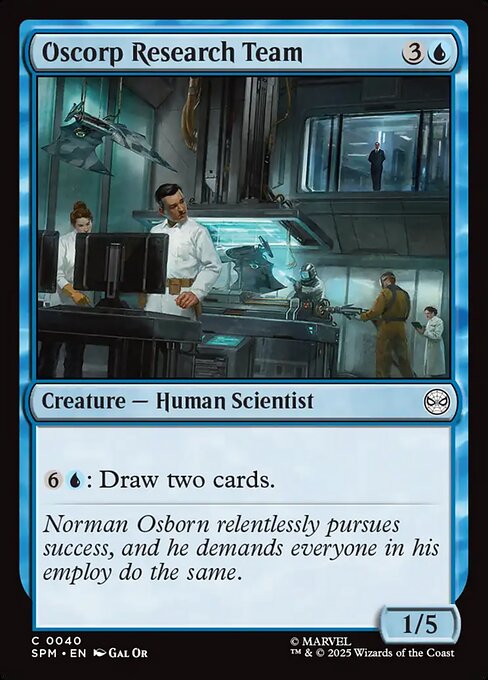
Image courtesy of Scryfall.com
Measuring Luck and Logic: Trigger Probabilities with Oscorp Research Team
Blue magic has always loved the idea of turning thought into action, and Oscorp Research Team embodies that spirit in a very MTG way 🧪. This creature from Marvel's Spider-Man— Universes Beyond crossover—puts a disciplined lab mindset on the battlefield: pay a premium to draw, and let your mind do the rest. The card itself sits at common rarity, a reminder that sometimes the best card draw isn’t flashy—it's efficient and repeatable. The spellcasting budget is {3}{U} to drop the 1/5 Human Scientist onto the table, but the real payoff lives in its activated ability: {6}{U}: Draw two cards. In a world where every extra card can tilt the balance, this lab-coat-wearing strategist invites you to run the numbers as passionately as you run the foil razzle-dazzle of a web-slinging hero 🎯💎.
“Norman Osborn relentlessly pursues success, and he demands everyone in his employ do the same.”
Let’s unpack what that activated ability really means for a deck builder and a math nerd alike. The cost to activate is substantial: six colorless and one blue, or in the shorthand of the card text, a {6}{U} payment. If you can assemble the mana to pay that cost, you’re guaranteed to draw two cards—there’s no luck roll, no coin flip, just straight-up card draw. The nuance, then, isn’t whether you will draw two cards when you cast it; it’s when you choose to pay for that draw and how often you choose to pay in a game where resources are never unlimited. This is where probability meets playstyle 🧙♂️🔥.
How to think about trigger probabilities in practice
The mathematics behind Oscorp Research Team’s ability is deceptively simple: each activation yields two cards. If you can activate multiple times in a game, you compound your card advantage linearly with the number of activations. For example, with k activations, you’ve drawn 2k cards from your library and shuffled into your hand. That sounds like a slam-dunk win in most blue-heavy strategies, but the real world adds a few wrinkles: ramp speed, color-source reliability, and the cadence of turns in which you can actually pay {6}{U}. If you routinely reach seven mana (7 total mana, to be precise) by midgame thanks to rocks, fetches, or other accelerants, you unlock the possibility of repeated activations as a credible engine 🔧🎲.
From a probabilistic lens, you’re not chasing a single event; you’re managing a stream of opportunities. Suppose you activate Oscorp Research Team exactly three times in a game. You’ll draw six cards from your deck that turn, elevating the odds that you see a critical answer or a needed tutor. If your deck is tuned with an appropriate density of card-draw enablers, those six cards can become the difference between stalling and sprinting toward victory. If you’re stacking draw effects with other blue staples—think of it as a rhythm section for your library—the probability of finding a crushing answer or a game-ending sequence grows with each activation, even if each individual activation is a guaranteed two-card payout. 🧙♂️⚔️
For players who love a concrete touchstone, consider a simple hypergeometric-style intuition: if your deck contains a finite number of copies of a sought-after card, the chance to draw at least one of them grows with the number of total cards drawn, but it grows more slowly as you exhaust the library. In practical terms, even with two cards per activation, you’re trading tempo for inevitability—on a good draw-heavy turn you can accelerate your board state, then rely on your blue toolkit to protect it. The flavor text nods to a relentless pursuit of success, and the math behind that pursuit is as careful as any lab protocol 🧪🎨.
Deckbuilding takeaways
- Ramp reliability: As Oscorp Research Team’s activation cost looms large, decks that want to lean on it should prioritize consistent mana sources—lands, rocks, and other forms of acceleration that can reliably deliver seven mana by the midgame. The better your ramp, the more activations you can squeeze in, and the higher your average card draw per game 🔮.
- Card composition: Since the effect is a fixed two cards, you want to pair it with draws that maximize value on the next turn. Cards like heavy card draw suites or counterspells that stall while you set up your engine can make those two-card increments feel like a ladder toward a game-winning sequence 🎲.
- Tempo vs. value: The card’s mana cost to cast is modest for its printed power in a ramp shell, but the activated ability is where real value lives. If you’re playing a tempo-oriented strategy, you’ll need to balance board control with the long game of two-card increments that eventually break open a win condition 🗡️.
- Interactions with flavor and synergy: The Marvel’s Spider-Man set highlights a world where corporate ambition and super-science collide. Oscorp Research Team fits neatly into themes of research, invention, and strategic advantage—perfect for players who like to narrate prime-move plays with flavor and drama 🎨.
In the end, Oscorp Research Team embodies a clean principle: a reliable draw engine, even when you pay a nontrivial activation cost. It’s a wonderful microcosm of blue’s identity in Commander or EDH—a deck built on planning, draws, and decision points rather than pure lightning-strike speed. If you’re chasing a steady stream of options and you relish turning knowledge into power, this little lab-coated strategist has your back. And yes, that flavor text about demanding excellence is a nudge to keep your own collection sharp, too 🧭💎.
For readers who love to connect MTG theory with market vibes, this card’s play pattern also invites a broader look at how card-draw has evolved in crossovers and Universes Beyond sets. It’s a reminder that MTG remains a game of numbers and narrative, where a single activation can flip a game state and a paragraph of flavor text can spark a thousand memes. The fusion of Spider-Man lore with a blue card-draw engine is a playful reminder that the multiverse is big enough for both math majors and web-slingers alike 🎨🕸️.
Phone Click-On Grip Back-of-Phone Stand HolderMore from our network
- https://crypto-acolytes.xyz/blog/post/nft-stats-retardio-traits-s0-rabies-from-retardio-traits-collection/
- https://blog.crypto-articles.xyz/blog/post/nft-data-nft-417-from-deb00tyclub-ii-collection-on-magiceden/
- https://blog.digital-vault.xyz/blog/post/namazu-trader-reading-its-color-identity-through-gameplay/
- https://crypto-acolytes.xyz/blog/post/nft-stats-xp-56-from-xp-collection/
- https://blog.crypto-articles.xyz/blog/post/nft-data-society-254-from-the-bagged-society-collection-on-magiceden/
Oscorp Research Team
{6}{U}: Draw two cards.
ID: a800ffb4-0c48-41eb-b221-cf1d855131d9
Oracle ID: 4d2e233c-0173-417f-82a0-1e692a400ae1
TCGPlayer ID: 646031
Cardmarket ID: 839541
Colors: U
Color Identity: U
Keywords:
Rarity: Common
Released: 2025-09-26
Artist: Gal Or
Frame: 2015
Border: black
EDHRec Rank: 23867
Set: Marvel's Spider-Man (spm)
Collector #: 40
Legalities
- Standard — legal
- Future — legal
- Historic — legal
- Timeless — legal
- Gladiator — legal
- Pioneer — legal
- Modern — legal
- Legacy — legal
- Pauper — legal
- Vintage — legal
- Penny — legal
- Commander — legal
- Oathbreaker — legal
- Standardbrawl — legal
- Brawl — legal
- Alchemy — legal
- Paupercommander — legal
- Duel — legal
- Oldschool — not_legal
- Premodern — not_legal
- Predh — not_legal
Prices
- USD: 0.02
- USD_FOIL: 0.06
- EUR: 0.04
- EUR_FOIL: 0.10
More from our network
- https://crypto-acolytes.xyz/blog/post/nft-stats-pumpcard-670-from-pumpcard-collection/
- https://blog.crypto-articles.xyz/blog/post/nft-data-identity-84-from-identity-collection-on-magiceden/
- https://crypto-acolytes.xyz/blog/post/nft-stats-george-plays-clash-royale-717-from-gpcr-nft-collection-collection/
- https://blog.zero-static.xyz/blog/post/maro-on-buyouts-and-small-set-mtg-cards/
- https://crypto-acolytes.xyz/blog/post/nft-stats-cannoli-509-from-holy-cannoli-collection/