

Image courtesy of Scryfall.com
Obsidian Giant and the Dance of Theme and Mechanics in Set Design
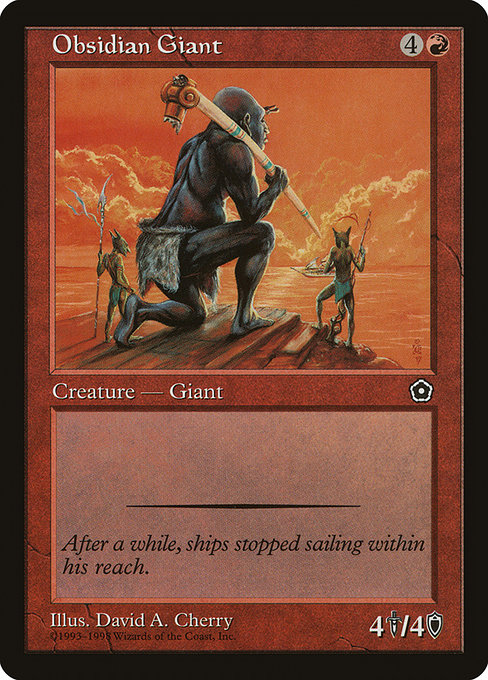
In the world of Magic: The Gathering, every set carries a mood, a story, and a set of mechanical promises that guide what gets printed and how players approach the table. When a color—or a whole set—leans into a particular theme, the mechanics follow like a chorus. The Obsidian Giant, a red, 4/4 creature from Portal Second Age, is a perfect lens for this idea. For a card that sits at five mana, this vanilla behemoth embodies red’s hunger for brute force, tempo, and straightforward threat pressure 🧙♂️🔥. The moment you glance at its mana cost {4}{R} and its 4/4 body, you feel red’s classic promise: tempo with heft, aggression with reliability, and a curve that says “play a creature, swing, maybe two.”
The Portal Second Age set, tagged as a starter, is a fascinating snapshot of late-90s design philosophy. It’s blueprinted for accessibility—cards that teach the basics without overwhelming new players. Yet even within that simplicity, Obsidian Giant signals how set themes influence mechanics. The art, the flavor text, and the decision to grant a strong, cost-efficient body without a single keyword highlight a deliberate design choice: in a learning-focused format, massive statlines beat flashy abilities when you’re trying to communicate core gameplay concepts. The rarity, too—uncommon in a starter set—places Obsidian Giant as a reliable, splashable threat in red decks, ideal for teaching players to value a solid top-end body as part of a cohesive plan ⚔️🎨.
After a while, ships stopped sailing within his reach.
That flavor text isn’t mere decoration. It roots Obsidian Giant in a world where power has consequences, where a towering stone sentinel blocks passage and warps the seas’ tempo. In a red-influenced theme, this mix of lore and mechanical presence reinforces a set’s emphasis on aggression and pressure rather than complication. Red’s role across many sets tends toward speed, direct interaction, and payoff through quick, efficient threats. Obsidian Giant distills that into a single, memorable body: big enough to trade with most early-to-mid-game creatures, aggressive enough to threaten a swing-frenzy on board, and simple enough to be grasped by players stepping into Casual and Commander play alike 🧙♂️🔥. The card’s statline—4 power and 4 toughness for five mana—reflects a red package that values cost-effective power in a world where tempo matters as much as raw damage 💎⚔️.
Theme-driven mechanics in practice: how set design shapes choices
Three concrete ways set themes steer mechanic choices emerge, and Obsidian Giant is a clean example:
- Color identity and power pacing: Red commonly champions aggressive bodies and direct combat presence. When a starter set like Portal Second Age foregrounds simplicity, you still see red delivering a sturdy 4/4 on turno five, guaranteeing a tempo push even when no extra abilities are printed. It’s a deliberate lesson in mana curve and board presence.
- Flavor guiding functionality: The giant’s flavor text about ships and horizons nudges players toward themes of control and assertion—red’s tendency to assert presence at the table rather than wait for perfect conditions. In design terms, flavor and mechanics align to help players “feel” the theme, not just read the text 🧙♂️.
- Accessibility over complexity: In starter sets, designers prune away complexity to ensure onboarding is smooth. Obsidian Giant’s lack of keywords demonstrates that a card can be deeply satisfying and narratively rich without intricate rules text. This teaches players that not every powerful card needs a gimmick—sometimes a big body is the whole strategy, especially when your opponent has a mountain of decisions to manage 🔥🎲.
For collectors and old-school players, the artifact of design history is deliciously on display. The art, by David A. Cherry, and the period’s frame all contribute to a tactile memory: a time when a five-mana red creature could feel like a genuine anchor in a deck, not just a tempo blip. And while Obsidian Giant isn’t legal in every format, the vintage and legacy circles still celebrate that era’s curiosity—cards that favored sturdy tempo and straightforward narratives over overbearing rules text. That balance is a nostalgic reminder of why we loved early multi-set blocks: you could tell a story with a single swing of a 4/4 giant 🧙♂️💎.
From a gameplay perspective, Obsidian Giant remains relevant in casual and Commander circles where players enjoy big, raw power and reciprocal combat. Its five-mana commitment is a stern but fair test of if your red deck is built to push tempo or to weather a field of early threats. When you pair it with burn spells, pump effects, or predictable creature swarms, Obsidian Giant becomes the kind of predictable, dependable bar to reach for when you want to slam the door and say, “this game is mine now.” The simplicity invites experimentation—perhaps a red artifact build, perhaps a quick-forcing of trades—and that is precisely the kind of design virtue that legacy and modern players often rediscover in retro sets 🧙♂️🔥.
As a collectible artifact, the price point in a modern context is modest, a reminder that not all nostalgia comes with a premium: the card’s current value hovers in accessible territory, inviting new players to explore Vintage and Legacy-friendly spaces without breaking the bank. It’s a little gem for a deck that loves a strong front door and a bold, unspoken promise: when you drop Obsidian Giant, you’re not just playing a card—you’re stamping a theme onto the battlefield with a confident, old-school shout ⚔️💎.
Neon Desk Mouse PadMore from our network
- https://blog.rusty-articles.xyz/blog/post/luigis-mansion-3-expansion-rumors-roundup/
- https://wiki.digital-vault.xyz/wiki/post/pokemon-tcg-stats-weedle-card-id-xy12-5/
- https://crypto-acolytes.xyz/blog/post/nft-stats-chubby-ape-gen2-3583-from-chubby-ape-gen2-collection/
- https://crypto-acolytes.xyz/blog/post/nft-stats-gorbage-chest-355-from-gorbage-chest-collection/
- https://blog.rusty-articles.xyz/blog/post/why-groudon-became-a-fan-favorite-in-pokemon-tcg-deck-builds/

Obsidian Giant
ID: aad8a194-cee7-4671-8310-19357fc1a450
Oracle ID: f7a96612-4fc5-4944-8b74-9eb6f24190b4
Multiverse IDs: 6599
TCGPlayer ID: 182
Cardmarket ID: 9929
Colors: R
Color Identity: R
Keywords:
Rarity: Uncommon
Released: 1998-06-24
Artist: David A. Cherry
Frame: 1997
Border: black
EDHRec Rank: 29924
Set: Portal Second Age (p02)
Collector #: 109
Legalities
- Standard — not_legal
- Future — not_legal
- Historic — not_legal
- Timeless — not_legal
- Gladiator — not_legal
- Pioneer — not_legal
- Modern — not_legal
- Legacy — legal
- Pauper — not_legal
- Vintage — legal
- Penny — not_legal
- Commander — legal
- Oathbreaker — legal
- Standardbrawl — not_legal
- Brawl — not_legal
- Alchemy — not_legal
- Paupercommander — not_legal
- Duel — legal
- Oldschool — not_legal
- Premodern — not_legal
- Predh — legal
Prices
- USD: 0.14
- EUR: 0.19
More from our network
- https://blog.rusty-articles.xyz/blog/post/carbink-scarcity-the-philosophy-behind-collectible-value/
- https://crypto-acolytes.xyz/blog/post/nft-stats-pix-apes-nft-collection-603-from-pixel-ape-of-the-hill-collection/
- https://wiki.digital-vault.xyz/wiki/post/pokemon-tcg-stats-bibarel-card-id-bw6-107/
- https://wiki.digital-vault.xyz/wiki/post/pokemon-tcg-stats-luxio-card-id-xy2-33/
- https://transparent-paper.shop/blog/post/how-to-build-a-lean-digital-business-plan-for-growth/