
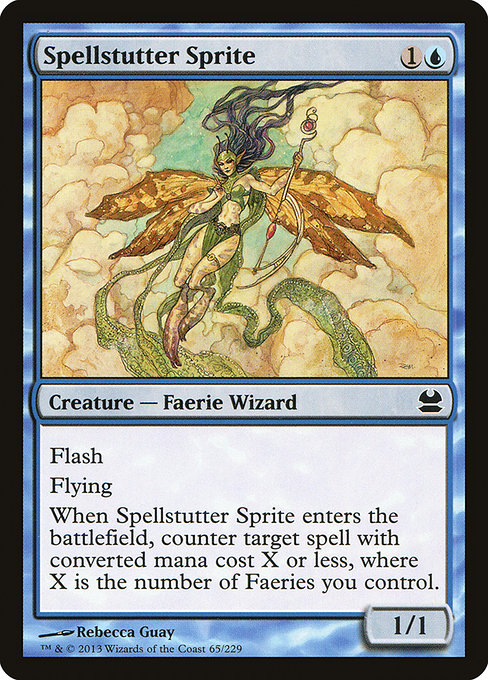
Image courtesy of Scryfall.com
Opening Hands That Win with Spellstutter Sprite
Spellstutter Sprite is one of those blue mischief-makers that asks you to plan ahead while flaunting a cheeky bit of tempo 🧙♂️. For a card that costs a modest {1}{U} and arrives with Flash and Flying, its real power blooms when you’ve stacked the battlefield with Faeries. On ETB, it counters a target spell with mana value X or less, where X is the number of Faeries you control. That means your first spell entering the battlefield shapes what you can stop on the spark of play. If you’ve got even a single Faerie on the table, you’ll be countering 1-CMC or smaller spells as Spellstutter Sprite swoops in. Add more Faeries, and the threshold climbs, turning your opponent’s early plans into tidal waves of counter magic. It’s a little like having a tiny, gleaming firewall that grows as your faerie army swells 🔥⚡.
From a gameplay perspective, the mulligan decision hinges on three pillars: mana reliability, early presence, and the reliability of the counter-moment. You’re not only trying to drop a 2-drop that threatens a quick clock; you’re aiming to bend the early game to your will by locking down your opponent’s cheap spells while you set up your board. The Sprite’s power is most felt in decks that already lean into Faeries or blue tempo elements, because those strategies give you the necessary Faerie count to maximize X on ETB. In a pinch, the sprite can also be a flying beater that buys you a turn or two when you’re light on lands, but that’s not where it shines. Its job is to be a tempo anchor and a soft counterspell with legs 🧙♂️🎯.
Oracle Text: “Flash; Flying. When this creature enters, counter target spell with mana value X or less, where X is the number of Faeries you control.”
To decide whether to keep or ship a hand back to the deck, imagine you’re piloting a blue-based tempo deck with a Faerie backbone. A keep should feel like a deliberate setup: you want to cast Spellstutter Sprite by turn 2 (ideally turn 1-2 if possible) and have at least a couple of blue sources to ensure you can protect the Sprite with follow-up plays. If your hand is heavy with colorless lands, or it lacks a plan to generate or accelerate Faeries, the mulligan becomes a no-brainer. In practice, you’re weighing: can I play Spellstutter Sprite on turn 2 and still have gas to protect it or follow up with another threat? If the answer is uncertain, you’re probably better off mulliganing down to a leaner, more coherent plan 🧙♂️💎.
Consider how the count of Faeries is built in your list. If you’re playing Bitterblossom or a token generation suite, Spellstutter Sprite can become a nightmare for your opponent: you drop the Sprite on turn 2, and the board begins to hum with a growing chorus of Faerie creatures. In those contexts, even a hand with a single blue source and Spellstutter Sprite can be keepable if you have a way to fix mana and a route to pump Faeries quickly. Otherwise, you might be staring at a turn-2 play without a meaningful X, which makes your Sprite less efficient than a simple cantrip or a hard counter spell. The sweet spot is a streamlined hand that merges mana fidelity with a confident plan to accumulate Faeries early on 🧙♂️🔥.
Practical opening-hand templates
- Strong keep: Spellstutter Sprite, a second blue source, a draw spell or cantrip, and a cheap 1-mana follow-up (or a Faerie-generating card). You’re set to deploy Sprite on 2, then back it up with gas to keep the tempo rolling.
- Moderate keep: Spellstutter Sprite plus two blue sources and a cheap acceleration or token-gen piece. Even if you don’t immediately counter a spell on ETB, you’ll threaten counter pressure while you establish a board of Faeries.
- Weaker keep (mulligan-worthy): A hand with many non-blue lands, or a bevy of high-cost spells with no way to fix mana or accelerate Faeries. In those cases, sending it back tends to pay off in a more coherent follow-up with a cleaner curve.
As a rule of thumb, you want to keep a hand that feels like it has a plan you can execute by turn 2 or 3. If you’re staring at a slow start and the opponent is dumping early pressure, the value of Spellstutter Sprite may be blunted—mulliganing toward tempo and mana-fix becomes the smarter play 🧙♂️⚔️.
Another practical note: the card’s power is situationally amplified in formats where you expect a lot of low-mana spells—think tempo mirrors, early removal, or cheap artifacts. In those matchups, the Sprite not only disrupts your opponent’s early turns but also keeps you in the game long enough to land a more threatening follow-up. The decision to mulligan, therefore, should also weigh the expected proliferation of Faeries in your environment and how quickly you can get your board to critical mass. It’s a game of tempo and patience, with a glint of blue magic that can tilt the course of a game the moment you reveal a flying interruption 🧙♂️💫.
Flavor, art, and the joy of a well-timed counter
Spellstutter Sprite’s art, painted by Rebecca Guay, captures the whisper-thin grace of a Faerie on the cusp of mischief. The subtle blue glow of the sprite’s wings and the gleam of a cunning plan evoke the charm of the Lorwyn-tinged Faerie world, even as the card shows up in Modern Masters. The glow of that era—where subtle tempo plays and clever counterplay reigned supreme—lives on in the decisions you make when you mulligan for this sprite. In the end, the art isn’t just decoration; it’s a reminder that MTG is as much about how you feel when you spin the top of your library as it is about the precise math of mana values and the board state 🎨🧙♀️.
Among the reasons Spellstutter Sprite endures in discussion is its elegant simplicity: a flash creature that buys you air time and a method to discourage your opponent from overcommitting on the cheap spells they lean on. It’s a tiny, stylish hammer in a blue toolbox, a reminder that great games hinge on small, well-timed interactions as much as big, dramatic plays. If you’re jamming a Faerie-rich tempo shell, mulligans aren’t just about cards; they’re about shaping the game you want to play, one decision at a time 🧙♂️🎲.
Custom Mouse Pad 9.3x7.8 in White Cloth Non-SlipMore from our network
- https://blog.rusty-articles.xyz/blog/post/a-simple-solution-to-complex-carry-magsafe-card-holder-case/
- https://crypto-acolytes.xyz/blog/post/nft-stats-catwifmask-nft-400-from-catwifmask-nft-collection/
- https://blog.rusty-articles.xyz/blog/post/two-tone-magsafe-phone-case-with-card-holder-polycarbonate/
- https://wiki.digital-vault.xyz/wiki/post/pokemon-tcg-stats-houndoom-card-id-neo2-23/
- https://blog.digital-vault.xyz/blog/post/red-giant-maps-galactic-flow-through-radial-velocity/
Spellstutter Sprite
Flash
Flying
When this creature enters, counter target spell with mana value X or less, where X is the number of Faeries you control.
ID: 3899605d-2203-4ab6-9ff5-69490382eea4
Oracle ID: 32e60fb4-e841-4f82-9c83-5e63766e8e6f
Multiverse IDs: 370380
TCGPlayer ID: 68335
Cardmarket ID: 262030
Colors: U
Color Identity: U
Keywords: Flying, Flash
Rarity: Common
Released: 2013-06-07
Artist: Rebecca Guay
Frame: 2003
Border: black
EDHRec Rank: 4202
Set: Modern Masters (mma)
Collector #: 65
Legalities
- Standard — not_legal
- Future — not_legal
- Historic — not_legal
- Timeless — not_legal
- Gladiator — not_legal
- Pioneer — not_legal
- Modern — legal
- Legacy — legal
- Pauper — legal
- Vintage — legal
- Penny — not_legal
- Commander — legal
- Oathbreaker — legal
- Standardbrawl — not_legal
- Brawl — not_legal
- Alchemy — not_legal
- Paupercommander — legal
- Duel — legal
- Oldschool — not_legal
- Premodern — not_legal
- Predh — legal
Prices
- USD: 3.58
- USD_FOIL: 5.68
- EUR: 4.29
- EUR_FOIL: 7.11
- TIX: 0.03
More from our network
- https://articles.zero-static.xyz/blog/post/popular-spruce-trapdoor-builds-for-minecraft-bases/
- https://blog.crypto-articles.xyz/blog/post/nft-data-gold-bar-913-from-solana-gold-bars-collection-on-magiceden/
- https://articles.digital-vault.xyz/blog/post/how-bravely-default-iis-story-stacks-up-against-prior-titles/
- https://blog.zero-static.xyz/blog/post/shattering-spree-fanfiction-artifacts-alliances-and-planeswalkers/
- https://rusty-articles.xyz/tmpjvugwd2n/34b18241.html