
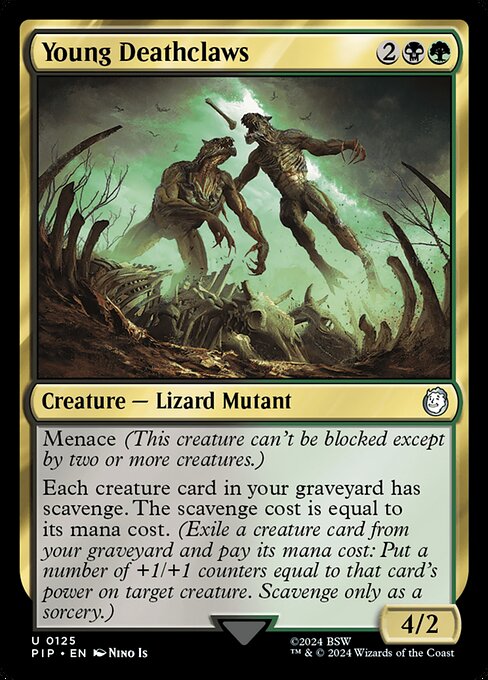
Image courtesy of Scryfall.com
Tracking Young Deathclaws Art Reprint Frequency Across Sets
When you pile up the data on MTG art, one theme keeps popping up: certain creature portraits enjoy a longer life in print than others, often reemerging with different frames, finishings, or entirely new palettes. Today we zoom in on a single, striking piece from a recent Commander-style release—Young Deathclaws—and ask a bigger question: how often does its art reappear across sets, and what does that mean for collectors, players, and the storytelling fabric of the game? 🧙♂️🔥💎⚔️
First, a quick guardrail about the subject: Young Deathclaws is a creature card from the Fallout set, part of a Commander-oriented line. It’s a Mardu-esque mash of the graveyard mechanic and a pugnacious front line, hovering between black and green—colors that love graveyard plays and +1/+1 counter shenanigans. Its mana cost is {2}{B}{G}, a lean path to a menacing, 4/2 body with Menace. The card text centers on two layered ideas: Menace makes it hard to block by a single creature, and Scavenge turns exiled graveyard creatures into an army of buff counters. All of that is wrapped in a rare but not insane price tag in real-world markets, hinting at broad appeal but not over-saturation. This is exactly the kind of card that players discuss when they map reprint patterns across sets. 🧙♂️🎲
What drives art reprint frequency in MTG?
- Art reuse vs. new art: Some cards keep the same image through reprints, while others receive alternate art—sometimes in special editions, commander decks, or Universes Beyond crossovers. The decision often hinges on licensing, the thematic fit for the new product, and whether the card’s identity benefits from a fresh look. 🧭
- Product type and cadence: Standard reprints in major sets are the most visible, but Commander products, Masters sets, and secret lairs can introduce alternate illustrations or border treatments. For a card like Young Deathclaws, which sits in a Commander-oriented release, the art’s life beyond its initial print often trails the cadence of those products. 🔄
- Universes Beyond and crossovers: The card carries a Universes Beyond label in its metadata, signaling potential cross-promotional prints. That doesn’t guarantee a future reprint, but it raises the odds that the image could reappear in a multi-property crossover. That kind of cross-pollination is a magnet for collectors who chase unique variants. 🧩
- Graveyard strategy lifecycles: Cards that leverage the graveyard and scavenge tend to sustain interest among EDH/Commander players, which can boost demand for reprints with alternate art or new framing to keep the card fresh in casual and competitive circles. ⚔️
From a data perspective, the card Young Deathclaws—coded as a Fallout Commander card with rarity uncommon—shows a current stance where its art has not yet shown up as a widely reprinted alternate version. Its initial release date sits at 2024-03-08, and the card’s primary print remains in that Fallout set. The fact that it’s printed in both foil and nonfoil forms helps the art endure in players’ collections, even if a reprint with different art hasn’t materialized yet. The presence of its artist, Nino Is, and the unique lore of the Fallout crossover also fuels speculation about future appearances, especially in Universes Beyond lines. 💎
Data signals every collector should watch
- Reprint status: As of the latest data, Young Deathclaws has not been reprinted with alternate art in standard MTG channels. This makes it a relatively clean case study for how a card’s image behaves before any reprint cycle begins. 🔎
- Set type and lifecycle: Fallout is a commander-centric product, which means reprints are often guided by long-term play patterns rather than a single rotation window. This can push art reprints toward special sets, rather than core-line reissues. 🧭
- Market signals: The card’s price point—low in USD terms, with foil slightly higher—suggests a broad but not explosive demand. A reprint with alternate art could shift collector interest but may not dramatically affect casual play value. ⚖️
- Variant pathways: If alternate art appears, expect it in a product that emphasizes visual novelty—perhaps a deluxe collector edition, a Universes Beyond crossover, or a special Commander deck that highlights the Fallout theme. 🎨
- Community tracking: EDHREC and analogs will often note when a card’s image resurfaces, serving as a cultural temperature check for how players perceive the card’s aesthetics and utility. 🧙♂️
In practice, Young Deathclaws represents a fusion of fragile art life with robust gameplay. The creature’s 4/2 body, cost, and Marrow-Minded synergy—holding onto graveyard cards to empower its growth via scavenge—makes it a stubborn early pickup for graveyard-focused builds. The Menace keyword adds a layer of tactical pressure in multiplayer formats, encouraging opponents to interact with it or risk a snowball of counters once a few GP (gravy pile) cards hit the yard. All of this makes the artwork’s presence in future printings a topic worth tracking for designers and collectors alike. 🧙♀️🔥🎯
For players who enjoy the nuts-and-bolts of data-driven collection, the case study here showcases how a single card’s art can drift through MTG’s vast printing ecosystem. It also highlights how legal and thematic crossovers—like Universes Beyond—can seed future print opportunities without deviating from the card’s mechanical identity. The art remains a conversation piece at casual tables and in high-visibility showroom displays, where the visual storytelling matters as much as the mechanics on the battlefield. 🎲🎨
Practical takeaways for collectors and players
- Keep an eye on Universes Beyond previews; even if a reprint isn’t announced, cross-promotional art can surface in unexpected places. 🧭
- When a card shows strong graveyard synergy (like scavenge from Young Deathclaws), a reprint with alternate art may emphasize the theme—great for display-worthy decks and collection spreads. 🔥
- Budget-conscious players can snag the current nonfoil print while the foil option offers a boost for display value, without a dramatic impact on gameplay. 💰
- As always, note the card’s Commander-legal status and its place in casual EDH metagames; nonstandard formats may experiment with the card’s unique graveyard toybox. ⚔️
- Follow price-trending sites and Scryfall updates to catch any art reprint news early—artistic shifts often precede market movement. 🧠
More from our network
- https://donation.digital-vault.xyz/donation/post/support-open-knowledge-sharing-experiments-for-collective-growth/
- https://crypto-acolytes.xyz/blog/post/nft-stats-george-plays-clash-royale-863-from-gpcr-nft-collection-collection/
- https://blog.crypto-articles.xyz/blog/post/andrejs-tips-for-academic-success-in-coursework/
- https://blog.zero-static.xyz/blog/post/predictive-modeling-for-chinchou-reprint-cycles-in-pokemon-tcg/
- https://blog.digital-vault.xyz/blog/post/streamline-management-with-notion-and-airtable/
Young Deathclaws
Menace (This creature can't be blocked except by two or more creatures.)
Each creature card in your graveyard has scavenge. The scavenge cost is equal to its mana cost. (Exile a creature card from your graveyard and pay its mana cost: Put a number of +1/+1 counters equal to that card's power on target creature. Scavenge only as a sorcery.)
ID: 64d5e6bd-de46-4bc2-854b-cc6cae713f98
Oracle ID: f24fc213-6341-482c-a056-946d0f1dd76b
Multiverse IDs: 652212
TCGPlayer ID: 540919
Cardmarket ID: 758552
Colors: B, G
Color Identity: B, G
Keywords: Menace
Rarity: Uncommon
Released: 2024-03-08
Artist: Nino Is
Frame: 2015
Border: black
EDHRec Rank: 10889
Set: Fallout (pip)
Collector #: 125
Legalities
- Standard — not_legal
- Future — not_legal
- Historic — not_legal
- Timeless — not_legal
- Gladiator — not_legal
- Pioneer — not_legal
- Modern — not_legal
- Legacy — legal
- Pauper — not_legal
- Vintage — legal
- Penny — not_legal
- Commander — legal
- Oathbreaker — legal
- Standardbrawl — not_legal
- Brawl — not_legal
- Alchemy — not_legal
- Paupercommander — not_legal
- Duel — legal
- Oldschool — not_legal
- Premodern — not_legal
- Predh — not_legal
Prices
- USD: 0.09
- USD_FOIL: 0.61
- EUR: 0.15
- EUR_FOIL: 0.50
- TIX: 0.57
More from our network
- https://wiki.digital-vault.xyz/wiki/post/pokemon-tcg-stats-galarian-linoone-card-id-swsh1-118/
- https://crypto-acolytes.xyz/blog/post/solana-vs-binance-smart-chain-speed-fees-and-security/
- https://crypto-acolytes.xyz/blog/post/nft-stats-hiney-kin-2407-from-hiney-kin-collection/
- https://crypto-acolytes.xyz/blog/post/nft-stats-donk-6535-from-donk-collection/
- https://wiki.digital-vault.xyz/wiki/post/pokemon-tcg-stats-copycat-card-id-hgss1-90/