
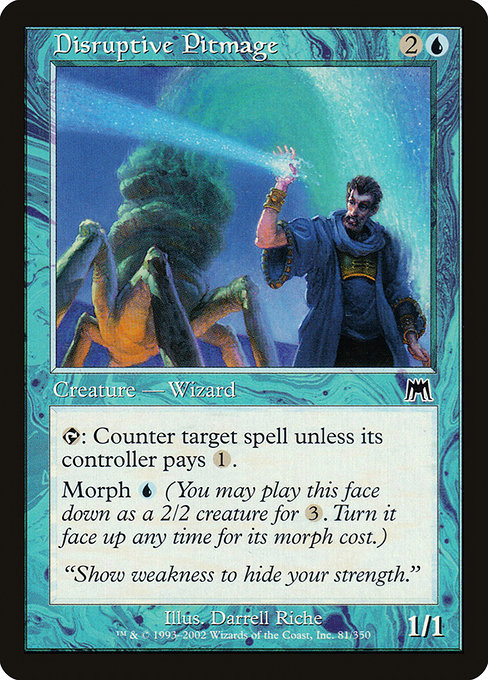
Image courtesy of Scryfall.com
Rarity, Perception, and the Quiet Power of Hidden Value
Magic: The Gathering has long trained us to chase the shiny, the flashy, the mythic. Yet some of the most intriguing psychological threads run through cards that sit in the mid-range of rarity—the commons and uncommons that quietly shape our decks and our expectations. Disruptive Pitmage, a blue common from the Onslaught era released in 2002, is a perfect lens for exploring how perception of rarity can diverge from printed rarity. It’s not just about mana cost or creature stats; it’s about how information, timing, and nostalgia tug at our brains like a well-timed counterspell 🧙♂️🔥.
On the surface, Disruptive Pitmage is a modest 1/1 for {2}{U} with a useful wrinkle: its activated ability taps to counter a spell unless the opponent pays {1}. That effect, while powerful in the right tempo-heavy blue deck, sits inside a creature that’s a common rarity. The color, the mana cost, and the timing all contribute to a perception that it should be easily accessible, immediately replaceable, and therefore less exciting. Yet the card’s design invites a different read. Morph, the ability to play it face down as a 2/2 and turn it face up for {U}, adds a layer of hidden information to the battlefield. In a way, it’s the classic “show weakness to hide your strength” mantra encoded in both flavor text and mechanics 🧠💎.
Hidden information as the spark of rarity psychology
Morph is more than a quirky mechanic; it’s a philosophical hook. When you cast Disruptive Pitmage face down, you’re declaring, “Let’s see what happens.” The surprise isn't just about casting a counterspell—it's about the metagame texture you’re reading in real time. Opponents must track not only the visible threat on the board but also the possibility that a buried 2/2 might flip into a spell-countering nuisance. That tension—between the face-down threat and the potential reveal—creates cognitive friction. Our brains are wired to assign value to uncertainty, and morph heightens uncertainty in a way that belies the card’s unassuming rarity. It’s a tiny psychological fireworks show, tucked inside a blue common 🎨⚔️.
“Show weakness to hide your strength.” — Disruptive Pitmage
The flavor text anchors this idea, nudging us to consider that rarity isn’t just a scarcity signal; it’s a narrative cue. The quote encourages players to read a card’s surface modesty as a clue about deeper capabilities. In practice, the card trades on timing and information: a well-placed tap can disrupt an opponent’s plan, and the morph reveal can tilt the tempo in ways that feel rarer and more deliberate than a higher-rarity spell with a simpler effect.
Blue tempo, counterplay, and the aesthetics of surprise
Blue has always thrived on tempo—the slow creep of protection, the quick sting of a well-timed counter, the mental gymnastics of predicting an opponent’s sequence. Disruptive Pitmage embodies that ethos in compact form. It punishes overconfidence by threatening counterplay just as the morph reveal looms on the horizon. Even at common rarity, the card projects a sense of inevitability: you can imagine a turn where you tap to stall a key spell, then flip the Pitmage to keep the pressure going. The art of telling a story with scarcity—creating drama around a common card—feeds a unique nostalgia for early-2000s design and the echo of sealed-deck adventures stored in card cabinets and long-forgotten binders 🧙♂️💎.
The economics of rarity vs. perceived power
Print rarity isn’t always a perfect compass for value or utility. Disruptive Pitmage’s actual market signal sits in the modest price range for a non-foil common (roughly a few dimes) with a foil bump when collectors chase an aesthetic that catches their eye—price data shows something like a few tenths of a dollar for non-foil and closer to a dollar-and-a-half for foil versions. The card’s real-world price stands in contrast to the aura of rarity that players sometimes chase. This dissonance is precisely where psychology thrives: a card designed for clever timing can feel dramatically more exciting than its label would imply, especially when a collector’s mind is primed to prize hidden potential and old-school flavor ✨🧠.
Disruptive Pitmage originates from Onslaught, a set steeped in the early 2000s flavor of blue control and information warfare. The set type—expansion—paired with a creature that’s both a spell counter and a metamorphic trick reinforces how a card’s context informs our sense of rarity. The same phone-in-the-pocket thrill you get from a long-forgotten arcane card returns in a modern collector’s mind when you reconnect with a piece of history that still feels relevant in the right deckbuilding moment 🔥🎲.
Design choices that ripple through time
From a design perspective, placing a functional counterspell capability inside a common creature underscores how rarity can be a marketing and memory construct, not a hard ceiling on potential. Morph as a concept invites creativity, letting players blend bluff, tempo, and surprise into a single card slot. That combination—a low-cost, low-variance card that becomes unexpectedly potent through timing and revelation—helps explain why some commons can “feel” rarer than their printed status. It’s a reminder that rarity is a social signal as much as a mechanical one: players project power and scarcity onto the card based on their experiences, their decks, and their favorite formats 🧙♂️⚔️.
For collectors and players who love the tactile thrill of discovery, Disruptive Pitmage is a gentle nudge that value isn’t always a numeric ceiling. Sometimes it’s about the story you build around a card, the moments you remember when you draw it, and the subtle, almost cinematic turn when the morph lands and a counterspell hits home.
Phone Grip Click-On Adjustable Mobile HolderMore from our network
- https://wiki.digital-vault.xyz/wiki/post/pokemon-tcg-stats-spiritomb-card-id-swsh9-089/
- https://blog.digital-vault.xyz/blog/post/leveraging-predictive-analytics-for-continuous-product-improvement/
- https://articles.zero-static.xyz/blog/post/journey-server-performance-and-stability-guide-for-players/
- https://blog.digital-vault.xyz/blog/post/graveyard-busybody-top-commanders-for-graveyard-synergy/
- https://crypto-acolytes.xyz/blog/post/nft-stats-superbaseddsolmail-from-solmail-id-collection/
Disruptive Pitmage
{T}: Counter target spell unless its controller pays {1}.
Morph {U} (You may cast this card face down as a 2/2 creature for {3}. Turn it face up any time for its morph cost.)
ID: 5b0d9c2f-356c-4f27-8560-8ffceadac31c
Oracle ID: c7a60f81-f7cb-4fd7-b422-963290964069
Multiverse IDs: 39527
TCGPlayer ID: 10451
Cardmarket ID: 1712
Colors: U
Color Identity: U
Keywords: Morph
Rarity: Common
Released: 2002-10-07
Artist: Darrell Riche
Frame: 1997
Border: black
EDHRec Rank: 16201
Penny Rank: 11049
Set: Onslaught (ons)
Collector #: 81
Legalities
- Standard — not_legal
- Future — not_legal
- Historic — not_legal
- Timeless — not_legal
- Gladiator — not_legal
- Pioneer — not_legal
- Modern — not_legal
- Legacy — legal
- Pauper — legal
- Vintage — legal
- Penny — legal
- Commander — legal
- Oathbreaker — legal
- Standardbrawl — not_legal
- Brawl — not_legal
- Alchemy — not_legal
- Paupercommander — legal
- Duel — legal
- Oldschool — not_legal
- Premodern — legal
- Predh — legal
Prices
- USD: 0.15
- USD_FOIL: 1.45
- EUR: 0.15
- EUR_FOIL: 0.67
- TIX: 0.04
More from our network
- https://crypto-acolytes.xyz/blog/post/negative-parallax-reveals-a-hot-blue-giant-at-two-point-five-kiloparsecs/
- https://wiki.digital-vault.xyz/wiki/post/pokemon-tcg-stats-mightyena-card-id-ex8-12/
- https://wiki.digital-vault.xyz/wiki/post/pokemon-tcg-stats-tepig-card-id-sm12-31/
- https://crypto-acolytes.xyz/blog/post/nft-stats-haxz-1635-from-haxz-collection/
- https://blog.crypto-articles.xyz/blog/post/nft-data-memeverse-478-from-memeverse-collection-on-magiceden/