
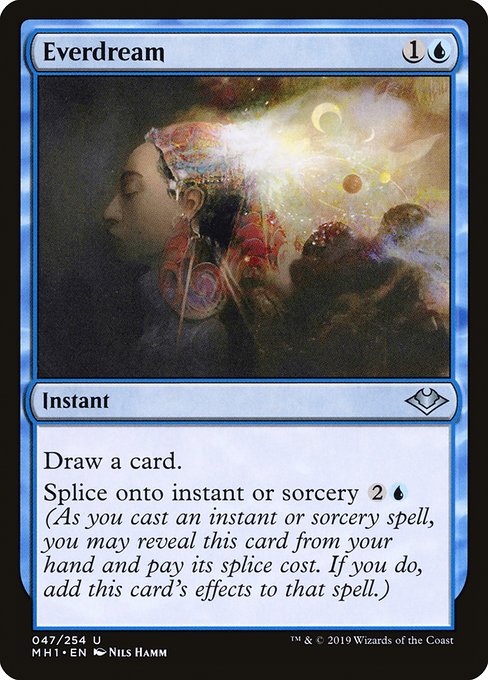
Image courtesy of Scryfall.com
Predictive Data and Everdream: A Blueprint for Better Deckbuilding
In the age of data-driven decision making, the art of building a deck has started to look a lot less like guesswork and a lot more like a science experiment. MTG deckbuilding tools powered by predictive data are turning fuzzy intuition into quantifiable expectations. Take Everdream, a blue instant from Modern Horizons 1 (MH1). Its elegant simplicity—{1}{U} to draw a card—hides a surprisingly rich space for predictive analysis. When you pair that basic draw with the splice ability—“Splice onto instant or sorcery {2}{U}” and add Everdream’s effects to the target spell—you unlock a spectrum of synergy that predictive models can chase: tempo, card advantage, and spell-modulation density all in one package 🧙♂️🔥.
Blue control lists have long mined card draw as a precious resource, but predictive deckbuilders go a step further. They quantify how many more cards you can expect to draw if you splice Everdream onto a handful of cantrips or removal spells, and they compare that to the opportunity cost of spending {2}{U} on splice versus reserving that mana for a standalone spell. The result is a more nuanced, repeatable process for evaluating draw engines in realtime, especially when the metagame is shifting with new data from online markets and deck-sharing communities. Everdream’s splice cost and its ability to steal a moment of extra card draw—from a blue spell you were already casting—offers a clean, testable data point for these tools to latch onto 🧠🔮.
Modern Horizons introduced a batch of clever design space for predictive analysis. Everdream is a perfect example: it’s an uncommon instant (set MH1, rarity uncommon) with a relatively modest manacost of {1}{U} that sustains card advantage, while its splice cost of {2}{U} invites you to think in terms of layered spells. The card’s balance—draw a card now, with potential to “splice in” more effect to the next spell—creates a predictable marginal value curve. When a deckbuilder’s engine simulates thousands of draws and spell sequences, Everdream tends to show up as a reliable engine for incremental value, especially in decks built around cantrips and cheap cantrips-plus-draw combos. And if you’re chasing late-game inevitability, the ability to splice into a larger spell for a blue-heavy push makes this card a natural anchor for predictive decks that value tempo plus options 🎲🎨.
From Data to Deck: How Predictive Tools Use Everdream
What makes predictive deckbuilding so compelling is its ability to translate card text into measurable outcomes. Everdream’s two-part identity—instant-speed draw plus splice—gives the tool a clear decision tree. If the engine casts Everdream on turn one or two, it nets a card immediately. If it later uses Everdream as a splice on a critical spell, it can amplify that spell’s impact by adding the draw mid-flight. The net gain depends on the current hand, the top of the library, and the chances of finding answers or threats in the near term. Predictive models assign probabilities to those outcomes and translate them into expected value, helping builders decide when the marginal gain justifies the mana investment and when to reserve splice-later options for more favorable windows 🧭💎.
Beyond raw EV, predictive data also highlights synergy with other spells that benefit from repeated draws. In a blue shell loaded with cantrips like Opt, Serum Visions, and Stitched? Not quite—Everdream doesn’t stitch itself into a creature or land; it stitches into another spell, which can dramatically alter the plan. The data reveals scenarios where splicing Everdream into a cheap cantrip-laden spell stack can yield a compressed tempo line: draw more, filter more, and deploy threats faster than you could without the splice. The more you rely on repeatable, low-cost cantrips, the more Everdream becomes a reliable engine piece for predictive decks that prize consistency and late-game reach ⚔️🎯.
“In a world where data models are your co-pilot, Everdream is the kind of orderly, predictable map you want in blue. It’s not flashy on its own, but its synergy with predictive spells is where the magic happens.”
For designers and fans, the beauty of Everdream within predictive tools is the transparency it brings. The card’s rules text is compact and machine-friendly: draw a card; splice onto instant or sorcery for {2}{U} to inherit the spell’s effect. That succinctness makes it an excellent test case for how a deckbuilding tool handles additive effects that occur within another spell’s resolution. The result is more reliable guidance: if your dataset shows a high probability of hitting a crucial late-game draw after a successful splice, the tool will nudge you toward that route with confidence. And in a format where knowledge is power, predictive data helps you optimize not just for wins, but for consistent, elegant play 🧙♂️✨.
Design, Culture, and The Value of Predictive Play
Beyond raw strategy, this approach honors MTG’s long-running design ethos: simple cards with deep, emergent potential. Everdream’s minimal mana cost and its splice mechanic exemplify the kind of modular design that scales beautifully with data-driven playtesting. When a deckbuilder’s analytics map out how often a splice-ed spell will be cast and what that means for the game’s tempo, color pie, and resource curves, it opens doors to new archetypes and more refined tuning. It also makes the game feel more approachable: you can explain why Everdream appears in a curve-friendly blue deck because the data shows a reliable uptick in draw efficiency when paired with certain cantrip-heavy lines. The result? A more thoughtful, intentional MTG community where play patterns are celebrated and explored with curiosity 🧩🎨.
Neon Gaming Mouse Pad 9x7 Custom Neoprene Stitched EdgesMore from our network
- https://blog.crypto-articles.xyz/blog/post/nft-data-1217-from-pandu-pandas-collection-on-magiceden/
- https://blog.zero-static.xyz/blog/post/how-braid-shaped-gaming-culture-and-indie-development/
- https://blog.crypto-articles.xyz/blog/post/nft-data-george-plays-clash-royale-701-from-gpcr-nft-collection-collection-on-magiceden/
- https://blog.crypto-articles.xyz/blog/post/nft-data-slyfella-40-from-slyfella-collection-on-magiceden/
- https://crypto-acolytes.xyz/blog/post/nft-stats-star-duster-84-from-star-duster-collection/
Everdream
Draw a card.
Splice onto instant or sorcery {2}{U} (As you cast an instant or sorcery spell, you may reveal this card from your hand and pay its splice cost. If you do, add this card's effects to that spell.)
ID: e744c42c-6bcc-42c0-9346-102b8368c377
Oracle ID: 5b17d3c5-6085-416e-9afd-8ed0639ae7d2
Multiverse IDs: 463996
TCGPlayer ID: 191577
Cardmarket ID: 375444
Colors: U
Color Identity: U
Keywords: Splice
Rarity: Uncommon
Released: 2019-06-14
Artist: Nils Hamm
Frame: 2015
Border: black
EDHRec Rank: 19389
Penny Rank: 8014
Set: Modern Horizons (mh1)
Collector #: 47
Legalities
- Standard — not_legal
- Future — not_legal
- Historic — not_legal
- Timeless — not_legal
- Gladiator — not_legal
- Pioneer — not_legal
- Modern — legal
- Legacy — legal
- Pauper — not_legal
- Vintage — legal
- Penny — not_legal
- Commander — legal
- Oathbreaker — legal
- Standardbrawl — not_legal
- Brawl — not_legal
- Alchemy — not_legal
- Paupercommander — not_legal
- Duel — legal
- Oldschool — not_legal
- Premodern — not_legal
- Predh — not_legal
Prices
- USD: 0.10
- USD_FOIL: 0.41
- EUR: 0.12
- EUR_FOIL: 0.40
- TIX: 0.03
More from our network
- https://crypto-acolytes.xyz/blog/post/nft-stats-planet-kaiju-6421-from-planet-kaiju-collection/
- https://wiki.digital-vault.xyz/wiki/post/pokemon-tcg-stats-simisage-card-id-sm3-13/
- https://crypto-acolytes.xyz/blog/post/nft-stats-garathos-shattered-269-from-risen-collection/
- https://crypto-acolytes.xyz/blog/post/nft-stats-planet-kaiju-1606-from-planet-kaiju-collection/
- https://crypto-acolytes.xyz/blog/post/nft-stats-lion-of-liquania-955-from-lions-of-liquania-collection/