

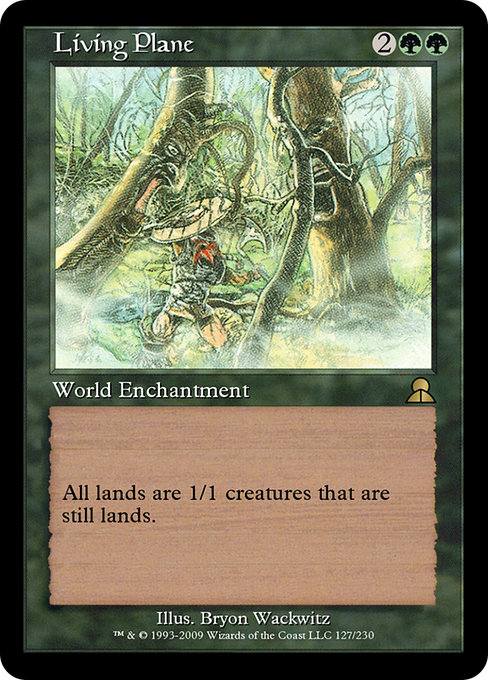
Image courtesy of Scryfall.com
Engagement Across Archetypes in a Land-Centric World
Magic: The Gathering has always rewarded players who read the room—who understand not just their own deck, but how every archetype interacts with every other at the table. When a Green World Enchantment lands on the battlefield, it isn’t just a rules blip; it recalibrates player incentives and encourages a fresh spectrum of engagement. Living Plane, a rare card from Masters Edition III released in 2009, does exactly that by turning lands into 1/1 creatures while preserving their land-ness. The result is a playground where ramp, defense, creature-based strategies, and even political negotiation collide in unexpected ways. 🧙♂️🔥💎
Look at the card’s essential facets: costed at 2GG, it’s green through and through, a color identity that primes it for ramp-and-sustain strategies. Its type, World Enchantment, signals a global effect—a card that touches every player’s board state. In ME3, a set steeped in nostalgia and reprints, Living Plane’s rarity is rare, and its design anchors a broader conversation about how archetypes adapt when the very landscape of the game mutates. When lands become creatures, the line between “lands” and “creatures” blurs in a way that makes even the most seasoned players pause and reassess who benefits from a given swing or a stall out. ⚔️🎨
Card snapshot: Living Plane
- Mana cost: {2}{G}{G}
- Type: World Enchantment
- Rarity: Rare
- Set: Masters Edition III (me3)
- Oracle text: All lands are 1/1 creatures that are still lands.
- Colors: Green
- Legalities: Commander, Duel, Vintage, etc. (Me3 print)
- Artist: Bryon Wackwitz
“All lands are 1/1 creatures that are still lands.” It’s the kind of rule twist that makes players rethink tempo, value, and the ever-present tension between board presence and battlefield efficiency. 🪄”
From a gameplay perspective, the card’s effect transforms typical green archetypes in several ways. The ramp deck, already oriented toward accelerating mana to cast big threats, now contends with a board where every land can contribute to combat. That’s a double-edged sword: it adds pressure and board presence, yet it can complicate ordinary combat math when your own lands swing at you from the other side of the table. Green’s traditional strengths—creatures, stompy plays, and mana-fixing—become intertwined with a new, kinetic element: land-based bodies that threaten to overwhelm with vanilla stat lines. 🧙♂️🔥
Consider the range of archetypes at play across a multi-player table. If you lean into big mana—think Primeval Titan or Dragons with a late-game board state—Living Plane can accelerate or hamper your plans depending on how other players value “land drop + swing” versus “land removal + board control.” Control players may seize the moment to pivot from a plan that relies on stalling to one that leverages tempo and attrition with a wider selection of targets on the board. Aggro builds that typically rely on rapid Reckless Rush may suddenly find themselves trading 1/1 lands for early inevitable blockers, buying time for new threats to emerge. And tribal or creature-focused archetypes, which often rely on synergies between their creature types and other permanents, must consider the new identity of lands as reliable, recurring attackers. The result? Deft social negotiation becomes as valuable as topdeck mastery. 🎲
Strategy-wise, the best engagement approach is adaptability. Deck builders can lean into ways to leverage the moment when the lands become creatures—without losing the lands’ fundamental utility. Cards that untap or protect lands, or that reward land-centric strategies in other ways, can become unexpectedly synergistic. A table that celebrates dynamic shifts—where players pivot from one game plan to another mid-game—tends to produce the most memorable moments and sustained engagement. In this sense, Living Plane is less a single-play gamble and more a mirror for how players respond to evolving game states. 🧙♂️
Design-wise, this card stands as a reminder of the elegance of green’s resilience and its capacity to generate rich, emergent gameplay. The artwork by Bryon Wackwitz, the ME3 print, and the reprint history all contribute to a collector’s conversation about value and nostalgia. In a format where reprints and oddities can become talking points at casual gatherings or in-depth tournaments, Living Plane’s presence at the table signals a moment when everyone recalibrates their expectations and their threats. The art’s earthy tones and the concept’s audacious twist align to celebrate the wild, unpredictable charm of MTG’s sandbox. 🧩💎
Neon Magsafe Card Holder Phone CaseMore from our network
- https://wiki.digital-vault.xyz/wiki/post/pokemon-tcg-stats-exploud-card-id-bw8-107/
- https://crypto-acolytes.xyz/blog/post/roofing-with-chipped-anvils-in-minecraft-120-guide/
- https://crypto-acolytes.xyz/blog/post/nft-stats-bagtardio-362-from-bagtardio-collection/
- https://crypto-acolytes.xyz/blog/post/nft-stats-hero-411-from-soul-gate-heroes-collection/
- https://blog.crypto-articles.xyz/blog/post/nft-data-monkey-biz-1079-from-monkey-business-collection-on-magiceden/
Living Plane
All lands are 1/1 creatures that are still lands.
ID: 0b944310-3170-4b57-95e0-2b78a3b50f95
Oracle ID: 30e99293-3212-4e3f-b543-b1c7c416575d
Multiverse IDs: 201207
Colors: G
Color Identity: G
Keywords:
Rarity: Rare
Released: 2009-09-07
Artist: Bryon Wackwitz
Frame: 1997
Border: black
EDHRec Rank: 16323
Set: Masters Edition III (me3)
Collector #: 127
Legalities
- Standard — not_legal
- Future — not_legal
- Historic — not_legal
- Timeless — not_legal
- Gladiator — not_legal
- Pioneer — not_legal
- Modern — not_legal
- Legacy — legal
- Pauper — not_legal
- Vintage — legal
- Penny — not_legal
- Commander — legal
- Oathbreaker — legal
- Standardbrawl — not_legal
- Brawl — not_legal
- Alchemy — not_legal
- Paupercommander — not_legal
- Duel — legal
- Oldschool — not_legal
- Premodern — not_legal
- Predh — legal
Prices
- TIX: 0.03
More from our network
- https://blog.crypto-articles.xyz/blog/post/nft-data-mifgen497-from-mifella-genesis-collection-on-magiceden/
- https://articles.digital-vault.xyz/blog/post/fallout-2-timeline-breakdown-from-vault-13-to-the-wasteland/
- https://crypto-acolytes.xyz/blog/post/why-milotic-nostalgia-drives-collector-purchases-in-pokemon-tcg/
- https://blog.crypto-articles.xyz/blog/post/nft-data-sheepmood-18-from-sheepmood-official-collection-collection-on-magiceden/
- https://blog.digital-vault.xyz/blog/post/sunken-palace-reprints-economic-lifecycle-for-mtg-collectors/