
Image courtesy of TCGdex.net
How game references appear in this card’s artwork
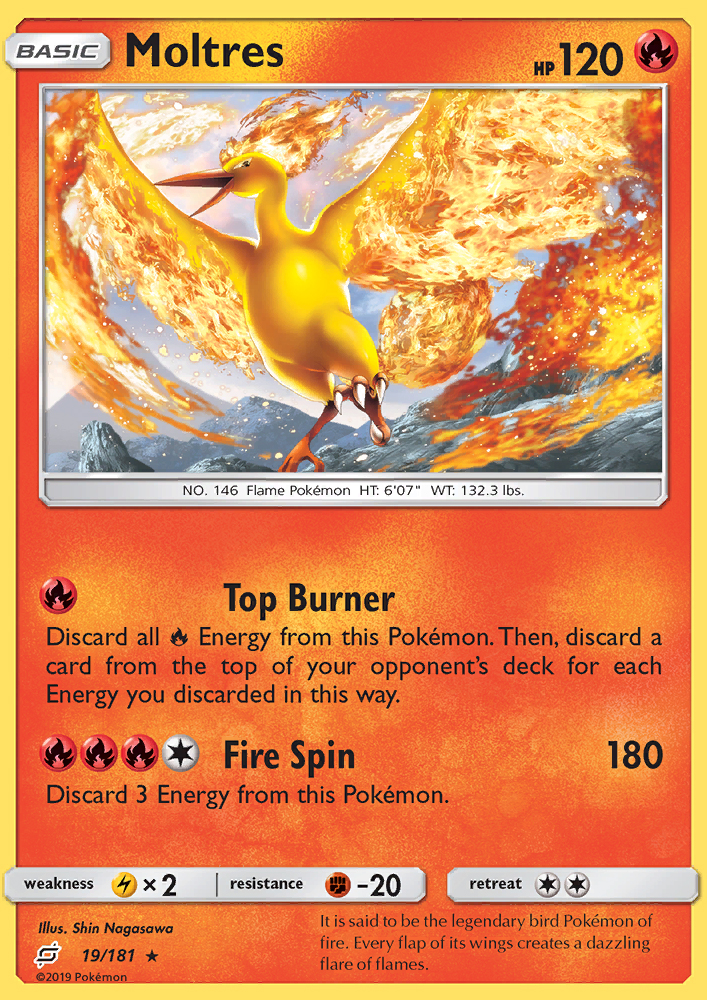
In the Pokémon Trading Card Game, artwork is more than pretty imagery—it’s a layered conversation with the game’s mechanics, history, and a artist’s storytelling voice. The Moltres card from the Team Up set (SM9-19), illustrated by Shin Nagasawa, invites fans to look beyond the blazing plumage and soak in visual cues that echo the card’s strategic choices. This basic Fire-type fighter presents a vivid encounter where art and gameplay meet, inviting both players and collectors to spot subtle nods to energy costs, deck manipulation, and the collaborative spirit that Team Up celebrates. ⚡🔥
The Team Up expansion is known for its energetic, cinematic scenes that emphasize teamwork and synergy among Pokémon and Trainers. Nagasawa’s Moltres leverages a dynamic pose and a tapestry of embers that feel like they’re marching through a battlefield of fire and strategy. The background composition often acts like a visual shorthand for the card’s resource economy: the way flames swirl and coalesce mirrors how energy is spent and replenished during a match. In this illustration, you can sense the tension between offense and resource management—the very core of the card’s two-move toolkit.
Decoding the fire motif and energy symbolism
The first attack, Top Burner, has a one-energy cost (Fire) and a punishing effect: discard all Fire Energy from Moltres, then mill the opponent’s deck for each Energy discarded. The artwork’s intense, spiraling flames visually represent that “burn” of energy—embers cascading like a metronome ticking down the game state. The fierce heat surrounding Moltres also hints at the strategic risk-reward dynamic of this move: you’re trading energy for potential card advantage, using the top card of your opponent’s deck as a lever to tilt the late game. The second attack, Fire Spin, demands three Fire Energy plus a Colorless, and delivers 180 damage while requiring Moltres to discard three Energy. In the painting, you can perceive a superheated vortex—the kind of visual cue the eye interprets as a high-energy, high-impact move that comes with a cost. These visual motifs are not accidental; they align with the card’s mechanical heart and remind players why energy management matters in real play. 🔥
From a collector’s lens, the fire motif also anchors the card in its rarity and usage window. As a Rare Basic Fire-type from Team Up, Moltres SM9-19 sits at the intersection of iconic fire power and strategic depth. The art underscores not only Moltres’ status as a legendary-level battler in the broader lore but also its role in a deck that negotiates tempo—burning through energy to disrupt an opponent’s strategy while dishing out serious damage when the moment is right. The visual intensity mirrors the mechanical intensity—a deliberate match between what you see and what you do on the table. 🎴💎
Symbolic nods to the set, mechanics, and evolution
The Team Up set brought a new era of “Tag Team” and cooperative play, and Nagasawa’s Moltres is a prime example of how an artwork can echo that ethos. The card is a Basic Moltres with 120 HP, not evolving from another Pokémon in this instance, which is reinforced by its raw, standalone presence in the frame. The Pokémon’s Fire typing and its Lightning-type weakness (×2) are visually amplified by the warm, electric-hued glow that threads through the image—the kind of color coding fans learn to read at a glance. The -20 Fighting resistance subtly nods to a broader battlefield where Moltres faces diverse threats, even within a single set’s environment. The illustration’s energy ribbons and edge lighting evoke the sense that Moltres is not just fighting—it’s commanding a controlled burn of resources to shape the outcome of the battle. This marriage of art and game rules is a hallmark of Shin Nagasawa’s approach, where a single image communicates a stack of gameplay implications. 🎨🎮
Illustrator spotlight: Shin Nagasawa’s visual storytelling
Nagasawa’s work on this Moltres captures a balance of power and poise. The composition uses bold lines and saturated heat colors that draw the viewer’s eye to the heart of the action, while the surrounding space breathes with the energy costs that define the card’s use in a match. Through careful linework and luminous fire, Nagasawa conveys both the immediate impact of Fire Spin and the strategic calculus behind Top Burner. This is art that rewards close looking—fans who notice the subtle halo around Moltres may also appreciate how the card’s frame and color choices emphasize the creature’s flame-based identity. The result is a piece that feels both timeless and deeply integrated into the tactical vocabulary of the game. 🔥🎴
Gameplay takeaway: art-informed strategy
- Top Burner and deck disruption: The artwork’s emphasis on blazing energy mirrors a deck-disruption strategy—fuel your own energy while stripping away cards from the opponent’s deck. In practice, you’re balancing energy use with tempo, aiming to gain advantage as you whittle away at your foe’s options.
- Fire Spin’s heavy price: The fiery spiral in the image echoes a high-energy, high-payoff approach. You’re paying a heavy energy cost to unleash a powerful 180-damage attack, so building a consistent Fire Energy line plus support is key.
In Team Up, synergy matters. Moltres’ role, whether standing alone or as part of a broader Fire-type lineup, hinges on how you leverage support Pokémon and Trainer actions—art and text together remind you that teamwork isn’t just on the card name; it’s in how you play the energy economy. ⚡
Collector insights and market context
As a Rare Basic Moltres from the Team Up subset, this card holds a particular appeal for players seeking a sturdy fire option and for collectors chasing holofoil variants. The pricing landscape from late 2025 shows modestly active interest. CardMarket’s data places the standard (non-holo) average around €2.94, with holo variants nudging higher—around €3.23 on average, and holo market trends showing a broader spread depending on condition and print run. On the U.S. market, TCGPlayer’s holofoil values range from a few dollars to near $10 for standout copies, underscoring how condition and presentation influence value. In practice, a polished holo Moltres from Team Up remains an accessible but desirable target for open- or close-deck collectors who love the heat of Fire-type strategy and the art that accompanies it. These dynamics reflect broader patterns in the Team Up era, where iconic legendaries and colorful foil finishes often command premium spots in collections. 🔥💎
For fans who appreciate the tactile joy of premium collectibles, the card’s aura pairs nicely with premium accessories—like a slim, glossy Lexan/polycarbonate phone case—offered by modern accessories retailers. If you’re browsing for something that echoes the intensity of a Team Up Fire-type battler, this Moltres is a sturdy centerpiece with a story that fans can trace from the card’s moves to the artwork’s heat and back into your gameplay decisions.
Slim iPhone 16 Phone Case – Glossy Lexan PolycarbonateMore from our network
Moltres
Set: Team Up | Card ID: sm9-19
Card Overview
- Category: Pokemon
- HP: 120
- Type: Fire
- Stage: Basic
- Dex ID: 146
- Rarity: Rare
- Regulation Mark: —
- Retreat Cost: 2
- Legal (Standard): No
- Legal (Expanded): Yes
Description
Attacks
| Name | Cost | Damage |
|---|---|---|
| Top Burner | Fire | |
| Fire Spin | Fire, Fire, Fire, Colorless | 180 |
Pricing (Cardmarket)
- Average: €2.94
- Low: €0.2
- Trend: €3.12
- 7-Day Avg: €2.72
- 30-Day Avg: €2.94
Support Our Decentralized Network
Donate 💠More from our network
- https://articles.digital-vault.xyz/blog/post/dark-prismarine-for-elegant-aesthetic-builds/
- https://blog.crypto-articles.xyz/blog/post/nft-data-monkey-biz-1709-from-monkey-business-collection-on-magiceden/
- https://crypto-acolytes.xyz/blog/post/nft-stats-whale-4384-from-entropy-acolytes-collection/
- https://wiki.digital-vault.xyz/wiki/post/pokemon-tcg-stats-farfetchd-card-id-dp3-49/
- https://blog.zero-static.xyz/blog/post/eco-conscious-packaging-for-responsible-delivery-of-clear-silicone-phone-cases/