

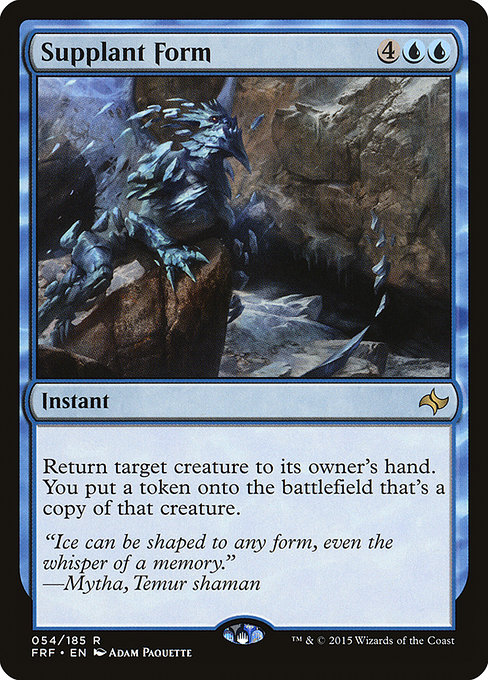
Image courtesy of Scryfall.com
Analytics, Odds, and Supplant Form: Modeling Deck Outcomes
Blue control and tempo decks have long measured the game in turns, not just turns won. Supplant Form, a rare Fate Reforged instant with a six-mana investment, invites players to think in probabilistic terms about the battlefield. Return target creature to its owner's hand, then create a token that's a copy of that creature. In practice, you’re trading tempo for a dual payoff: you remove a threatening threat and place a fresh, potentially game-changing attacker on your side of the board. It’s not just a disruption spell—it’s a pivot toward inevitability when you model its outcomes with care. 🧙♂️🔥💎
For analytics-minded players, the right approach is to frame Supplant Form within a probabilistic deck-outcome model. Define a state space that captures: the board presence of both players, the remaining library cards that matter (draws, counterspells, removal), and the number of live threats on each side. The action space includes the decision to cast Supplant Form at specific moments, depending on what the opponent has on board and what you hold in hand. A Monte Carlo simulation—thousands of trials with random but bounded draws—helps quantify two core questions: how often does Supplant Form translate into tangible advantage by turn six or turn eight, and what is the downstream impact if the copied creature still dies to removal or bounce? ⚔️🎲
“Ice can be shaped to any form, even the whisper of a memory.” — flavor text on Supplant Form reminds us that adaptability is magic’s core virtue. In analytics terms, adaptability is your model’s edge—your ability to recast the battlefield mid-game often outpaces raw rawcard power.
In a practical modeling workflow, here are key steps to consider when you’re evaluating Supplant Form within a deck-building exercise:
- Define target outcomes: win by sudden pressure, stabilize and win via card advantage, or lock in a single overwhelming board state with multiple token copies. Each outcome requires a different weighting in your model.
- Parameterize the deck’s draw probability: estimate how often you see Supplant Form by the midgame, and how often you have enough mana to cast it when you need it. The 4UU cost (cmc 6) demands a reliable mana base or mana acceleration—think of how your model accounts for land drops, cantrips, and ritual-like draw engines.
- Model interaction with opponent’s disruption: how often does your opponent counter or remove the copied token? In your simulations, assign a probability to removal spells and consider how many copies of the target creature you’d realistically fear.
- Account for token interaction: a token copy inherits the target creature’s abilities. If that creature has built-in clone-worthy or clone-like effects, your model should capture the compounding value of multiple copies—especially in decks that can refill or reuse the spell counter or bounce suite.
- Scenario trees: create a few representative lines—early game stall, midgame threats, and late-game grind. For each line, measure the expected life total delta, the number of meaningful plays enabled by Supplant Form, and the likelihood of overcoming an opponent’s clock-forward plan.
From a design standpoint, Supplant Form shines as a lens into how blue cards can tilt the odds. Its rare-status foil on occasion hints at a powerful, high-variance payoff: you’re tossing a costly spell that pays off with a single, well-timed moment when your opponent’s best behemoth is temporarily untouchable to them but vulnerable to your next attack. In your modeling, you can quantify that volatility—the kind of edge that separates a good control shell from a great one. And yes, the card’s color identity (blue) means you’re thinking in terms of permission, bounce, and options, not brute force. The math behind its play patterns rewards players who plan for the worst while hoping for the best. 🎨🧠
Practically, consider Supplant Form in a deck that already runs a suite of countermagic and bounce effects. You can force a tempo swing by removing a blocker or threat, then immediately presenting a clone that threatens lethal damage or trades favorably. The strategic payoff becomes more visible when you model probability distributions: what is the expected number of favorable trades achieved by turn seven? How often does the copied creature survive long enough to deliver value? In many matchups, this is a layered, game-long negotiation—where the card quietly pushes the outcome from “in doubt” to “in your favor” in a handful of critical moments. 🧙♂️🔥
For players who like concrete examples, an event-based scenario helps. Suppose you’re facing a midrange deck that stabilizes around six to seven mana, with a dangerous single creature on board. Casting Supplant Form to bounce that threat on turn seven and spawn a token copy on your side gives you an additional attacker who scales with your opponent’s own resources. If you can protect the token with a follow-up counter or a bounce-back plan, you’ve created a dynamic where your opponent’s removal becomes less effective and your own pressure grows. The beauty of this approach is that the metric you care about most—“does Supplant Form improve my win odds?”—is directly supported by the model’s results. 🔥🎲
As with any analytics-driven approach to MTG, the goal is not to reduce the game to numbers alone but to illuminate lines you can practice and feel confident executing in real play. Supplant Form invites earnestly creative play: you can use it to remove a problem while creating a flexible, clone-like threat that dodges your opponent’s immediate answers. The card’s flavor and design align with modern blue archetypes that prize tempo, permission, and inevitability—the kind of deck-building puzzle that reward players who enjoy the thrill of probabilistic mastery. 💎⚔️
More from our network
- https://blog.crypto-articles.xyz/blog/post/nft-data-mifgen1217-from-mifella-genesis-collection-on-magiceden/
- https://crypto-acolytes.xyz/blog/post/nft-stats-china-snow-leopard-commandos-from-noyfb-black-ops-badge-collection-collection/
- https://blog.zero-static.xyz/blog/post/defend-the-rider-multicolor-interactions-and-mtg-strategy/
- https://articles.zero-static.xyz/blog/post/un-sets-lore-the-story-behind-seek-bolass-counsel/
- https://articles.digital-vault.xyz/blog/post/best-civilization-vi-builds-and-loadouts-for-victory/
Supplant Form
Return target creature to its owner's hand. You create a token that's a copy of that creature.
ID: 3df927c0-9aa9-450b-ab2a-ae12c5489d57
Oracle ID: 7e49f689-996a-477e-a327-32b69fbc0d85
Multiverse IDs: 391933
TCGPlayer ID: 95281
Cardmarket ID: 271509
Colors: U
Color Identity: U
Keywords:
Rarity: Rare
Released: 2015-01-23
Artist: Adam Paquette
Frame: 2015
Border: black
EDHRec Rank: 12145
Penny Rank: 10935
Set: Fate Reforged (frf)
Collector #: 54
Legalities
- Standard — not_legal
- Future — not_legal
- Historic — not_legal
- Timeless — not_legal
- Gladiator — not_legal
- Pioneer — legal
- Modern — legal
- Legacy — legal
- Pauper — not_legal
- Vintage — legal
- Penny — legal
- Commander — legal
- Oathbreaker — legal
- Standardbrawl — not_legal
- Brawl — not_legal
- Alchemy — not_legal
- Paupercommander — not_legal
- Duel — legal
- Oldschool — not_legal
- Premodern — not_legal
- Predh — not_legal
Prices
- USD: 0.63
- USD_FOIL: 0.86
- EUR: 0.41
- EUR_FOIL: 0.99
- TIX: 0.02
More from our network
- https://blog.crypto-articles.xyz/blog/post/chiseled-copper-for-minecraft-adventure-maps/
- https://crypto-acolytes.xyz/blog/post/nft-stats-retardio-traits-s1-seer-shades-from-retardio-traits-collection/
- https://blog.crypto-articles.xyz/blog/post/seel-and-water-type-cards-evolution-of-pokemon-tcg-abilities/
- https://crypto-acolytes.xyz/blog/post/educational-pc-games-that-improve-critical-thinking/
- https://crypto-acolytes.xyz/blog/post/nft-stats-bullbears-868-from-bullbears-collection/