
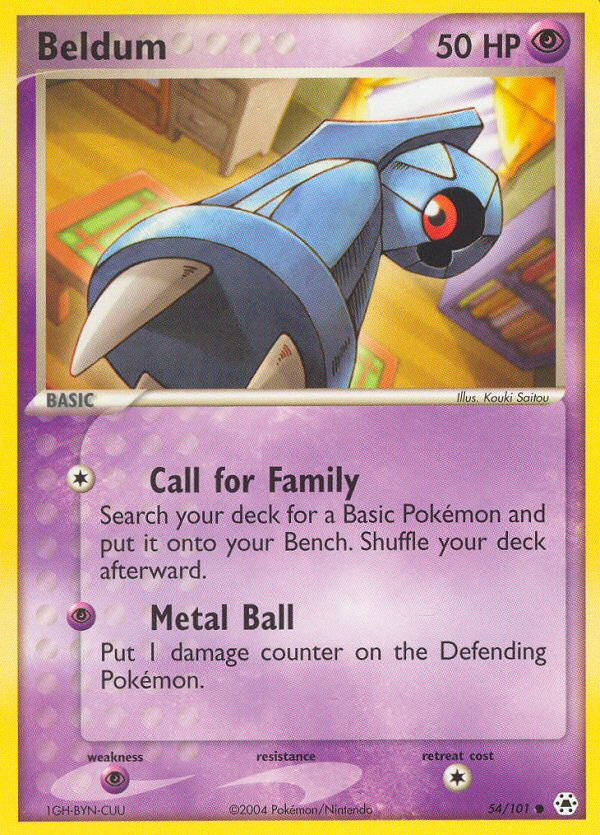
Image courtesy of TCGdex.net
Strategic Guide: Extracting Maximum Damage from Beldum in the Hidden Legends Era
For many players, a simple Basic Pokémon with two modest attacks feels underwhelming. And yet, Beldum from the Hidden Legends set (ex5-54) is a perfect case study in how to leverage a small starter into sustained damage pressure across a match. With 50 HP and a Psychic type, this Common rarity card offers a very particular kind of value: it’s a durable bench engine and a stepping stone to bigger, more punishing threats. The illustrator Kouki Saitou gifts Beldum with a distinct, cool presence on the card, reminding us that even the humblest Pokémon can become a cornerstone of a well-taught strategy. ⚡🔥
At first glance, Beldum’s two attacks tell a story: Call for Family and Metal Ball. Call for Family is a classic setup move: search your deck for a Basic Pokémon and place it onto your Bench, then shuffle. It’s not about immediate damage, but about board presence and tempo. In a world of rapid deck thinning and prize card pressure, having a reliable way to populate the bench means you can accelerate into the next phase of your plan—whether that’s bringing in a sturdier attacker, a support Pokémon, or a pivot that keeps your opponent guessing. Metagross fans will recognize this approach as a gateway to power spikes later in the game. Metang and Metagross, the evolving line, deliver real damage output once you land the evolutions—so every Call for Family you play nudges you toward those payoff turns. 🎴
Metal Ball, the second attack, costs a Psychic energy and places a single damage counter on the Defending Pokémon. In practical terms, that’s 10 damage. It’s modest on its own, but it’s the glue that keeps pressure on while you assemble your higher-damage threats. The real trick is stacking those counters in a way that your opponent cannot answer quickly enough, and pairing Beldum with evolved threats that can take over the late game. Think of Metal Ball as the disciplined poke of a larger plan: a steady drip of momentum that wears down your opponent while you fetch the big finish. As a player, you’ll want to time those counters to coincide with the moment you can push through a knockout with Metagross’ bigger, harder-hitting attacks. 💎
One of the most important strategic considerations with Beldum is vulnerability. Beldum is Psychic, and its weakness is Psychic ×2. That means your opponent’s Psychic attackers will hit harder against your Beldum if you expose it as the active Pokémon without support. To maximize damage while mitigating risk, you want to keep Beldum on the bench whenever possible and rotate it into the active slot only when you’re ready to begin your finish sequence or when you need to apply a precise 10-damage nudge while preserving your bench for the later evolutions. This is the defining tension of this card: slow and steady damage on the one hand, big payoff on the evolving line’s turns on the other. 🔄
Deck-building implications aside from raw attacks fancy a little more nuance. Because Call for Family fetches a Basic Pokémon from your deck, you can tailor your bench to include a range of options that synergize with a late-game finish. A well-curated bench might feature a basic attacker that can deliver swift damage, plus a few techs that help you recover after a hit. The hidden beauty of Beldum’s role is that you don’t need to overcommit to a single plan; you’re laying groundwork for a robust, evolving strategy that can pivot as your opponent responds. When you eventually drop Metang or Metagross, you’ll often find the combined pressure of higher HP and stronger attacks eclipses the early 10-damage poke you started with. 🚀
Collectors should also appreciate the card’s place in history. Beldum ex5-54 hails from Hidden Legends, a set that’s adored for its nostalgia and distinctive artwork. The card’s print run includes both normal and holo variants, and the holo-shine is especially sought after by collectors who want a vivid reminder of the early 2000s era of Pokémon TCG design. The card’s rarity is listed as Common, making it an accessible entry point for new players who want to study deck-building fundamentals without a heavy investment. In today’s market, non-holo copies tend to be budget-friendly (often under a dollar in online markets), while holo versions can command a premium—especially if you’re chasing the Kouki Saitou-illustrated foil. This blend of play value and collectibility makes Beldum an appealing centerpiece for a budget-conscious, nostalgia-driven deck. 🪙
From a market perspective, the pricing data underscores the varying values between prints. Non-holo copies have traded in the low cents to under a dollar range, with mid-range prices hovering around a few tenths of a dollar. Holo variants command noticeably higher figures, often in the single-digit USD range, reflecting both rarity and visual appeal. Card-market dynamics are sensitive to condition, print run, and demand for Hidden Legends staples. For players who value both playability and a touch of retro elegance, Beldum’s price profile presents a practical and charming investment. 🔎💬
“The power of Beldum isn’t in a single knockout—it's in enabling a plan that evolves into something far bigger.”
Practical Tips to Turn Beldum into a Damage Engine
- Early bench setup: Use Call for Family to guarantee you have at least one Basic Pokémon on the bench by turn 2. This gives you future evolutions to rely on while you chip away at the Defending Pokémon with Metal Ball.
- Staging for the payoff: Think ahead to Metagross or similar attackers in your deck. Once you draw or search for the evolution line, your bench becomes a launchpad for a much stronger offensive rhythm.
- Protect the plan: Don’t expose Beldum to easy early KO risks. Use bench-preserving techniques and rely on your evolving threats to deliver the big hits, then sweep with larger attackers that can close out the game.
- Balance damage and tempo: The 10-damage-per-Metal-Ball poke is useful for pressuring the Defending Pokémon while you set up. Align your turns so that the moment you have a powerful attacker ready, you can translate those 10-damage counters into a knockout with support from your bench.
- Matchups and weaknesses: In Psychic-dominated metas, expect reverse trades if you rely solely on Beldum. You’ll want a plan to switch into your stronger attackers before your Beldum loses its unfavorable edge. ⚡
For players who enjoy a thoughtful, tempo-driven approach, Beldum offers a compact sandbox to test deck-building principles. It’s a reminder that in the Pokémon TCG, raw numbers aren’t everything—timing, board state, and the promise of a future evolve-and-slam payoff can turn a humble Basic into a game-winning asset. And with the Hidden Legends lineage in your binder, you’re reminding yourself of a golden era where art, strategy, and collection all intersect—perfect for fans who love the tactile feel of a well-loved holo. 🎨🎮
Phone Stand for Smartphones – Sleek Desk & Travel AccessoryMore from our network
- https://wiki.digital-vault.xyz/wiki/post/pokemon-tcg-stats-darkness-energy-card-id-dp3-129/
- https://wiki.digital-vault.xyz/wiki/post/pokemon-tcg-stats-latios-gx-card-id-sm11-78/
- https://blog.digital-vault.xyz/blog/post/texture-in-visual-minimalism-how-surface-details-shape-perception/
- https://crypto-acolytes.xyz/blog/post/nft-stats-debros-78-from-debros-collection/
- https://blog.crypto-articles.xyz/blog/post/nft-data-bagio713-from-bagio-collection-on-magiceden/
Beldum
Set: Hidden Legends | Card ID: ex5-54
Card Overview
- Category: Pokemon
- HP: 50
- Type: Psychic
- Stage: Basic
- Dex ID: 374
- Rarity: Common
- Regulation Mark: —
- Retreat Cost:
- Legal (Standard): No
- Legal (Expanded): No
Description
Attacks
| Name | Cost | Damage |
|---|---|---|
| Call for Family | Colorless | |
| Metal Ball | Psychic |
Pricing (Cardmarket)
- Average: €0.76
- Low: €0.02
- Trend: €0.67
- 7-Day Avg: €0.71
- 30-Day Avg: €0.62
Support Our Decentralized Network
Donate 💠More from our network
- https://wiki.digital-vault.xyz/wiki/post/pokemon-tcg-stats-darkness-energy-card-id-dp3-129/
- https://wiki.digital-vault.xyz/wiki/post/pokemon-tcg-stats-latios-gx-card-id-sm11-78/
- https://blog.digital-vault.xyz/blog/post/texture-in-visual-minimalism-how-surface-details-shape-perception/
- https://crypto-acolytes.xyz/blog/post/nft-stats-debros-78-from-debros-collection/
- https://blog.crypto-articles.xyz/blog/post/nft-data-bagio713-from-bagio-collection-on-magiceden/