
Image courtesy of Scryfall.com
Mana Curve Mastery: The Phyrexian Delver Equation
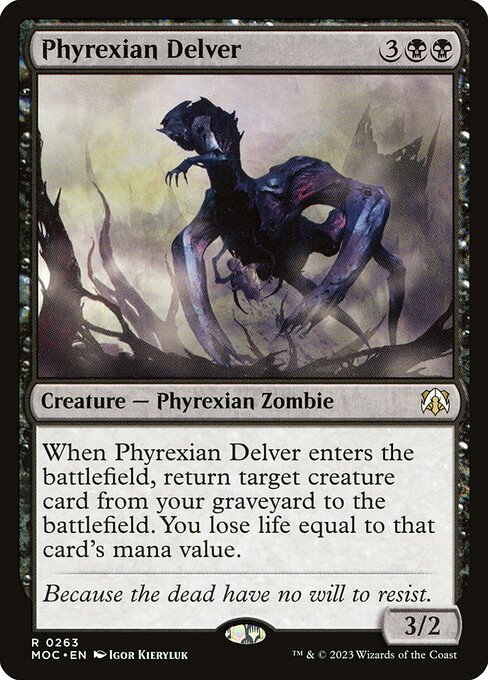
In the world of EDH and casual drop-ins, mana curve is everything. It’s the spine that supports your top-end threats, your multi-card combos, and the occasional reach for inevitability when the game refuses to end. Enter Phyrexian Delver, a rare creature from March of the Machine Commander that is as deliciously crunchy as a midnight snack for mana-sculpting players. This black-beating zombie brings a built-in reanimation engine to the battlefield, but it asks you to weigh life as a resource with the same reverence you give to card draw and combat tricks 🧙♂️🔥💎.
Phyrexian Delver is a 3/2 creature with a hefty price tag of 3 generic and 2 black mana ({3}{B}{B}), for a total converted mana cost of five. That alone forces you to consider how you’ll hit the right mana curve—how you’ll accumulate enough black sources to reliably cast it by turns 4 or 5, and how you’ll sequence plays so that you’re not just paying life for nothing. Its etb trigger is a classic Reanimator-style engine: when it enters, you return target creature card from your graveyard to the battlefield, and you lose life equal to that card’s mana value. The flavor text—“Because the dead have no will to resist.”—drips with the dark charm that Phyrexia loves to wear at the table 🧙♂️⚔️.
Why this card fits a mana-curve-driven strategy
Delver’s power lies in its two-part design: a solid body on rate, and a potent, curve-flattening ability that can leapfrog you into the midgame. If you’re building a deck that wants to outvalue opponents with a single, well-timed reanimation play, Phyrexian Delver acts as both a midrange creature and a value engine. The plan is simple on the surface: establish a graveyard archetype—fill it with targets—and then drop Delver to fetch a value creature back, paying life equal to the retrieved card’s mana value. The bigger the target you’re willing to pay for, the more you threaten to swing the life total against you, but the payoff can be spectacular with the right follow-up threats on the battlefield 💥.
From a mana-curve perspective, Delver rewards careful sequencing. You want to have a path to five mana comfortably, with black mana sources accessible earlier than later. That means your mana base should include reliable black sources or mana rocks that accelerate you into the range where you can cast Delver on or near turn five, and then immediately cash in your graveyard fuel for a threatening arrival. The nitty-gritty is balancing early disruption or ramp with the late-game inevitability that a reanimated threat can provide. It’s a dance: you push the curve up, ensure you don’t spike yourself on life, and keep the board pressure intact after the Delver resolves 🪄🎲.
Strategies to optimize the curve with Phyrexian Delver
- Target selection matters. When Delver ETBs, you’ll want a creature in your graveyard whose mana value aligns with your willingness to pay life. If your life total is healthy and you’re facing a board that needs a swing, reanimate a midrange behemoth or a utility threat that changes the game on entry. If you’re tight on life, gravitate toward smaller value creatures you can recoup safely later in the game.
- Tiered curve planning. Build your curve so that by the time you cast Delver, you already have three or four black sources on board (or in-hand to play with mana-sinks). The payoff isn’t just a single creature; it’s a chain of value that perpetuates itself through additional reanimation triggers, recursion recursion, and pressure on opponents who must answer multiple threats in the same turn cycle.
- Graveyard enablers. Include cards that fill your graveyard efficiently, so you have flexible targets for Delver. Think of cheap discard outlets, recursion enablers, and ways to protect graveyard gems from disruption. A well-tuned graveyard is a win condition in itself, and Delver helps you cash in on that economy when the moment is right 🧠💎.
- Life as a resource, not a trap. Phyrexian Delver invites a risk-reward calculus. In commander, your starting life total is 40, which gives you some runway to experiment with paying life for immediate impact. Build around life-synergistic cards if you want to lean into the theme, but always keep a plan B if life totals dry up and you’re staring at a worst-case board state ⚔️.
- Supportive ramp and black-centric shells. Ramps like black mana rocks or dual lands that produce consistent black mana help you hit the critical turn where Delver shines. A well-rounded ramp package ensures you aren’t left staring at five mana sources on turn six with nothing to do but wait for the late-game draw engines.
In practice, a well-tuned Delver plan might look like this: you stabilize the board on the early turns, set up graveyard acceleration, and then resolve Phyrexian Delver on or just after turn five. You then reanimate a creature that immediately reshapes the battlefield—perhaps a flying threat, or a creature with enter-the-battlefield utility that hoses opponents or accelerates your own plan. The life loss becomes a feature, not a bug, when weighed against the guaranteed value of a reanimated threat and the potential for back-to-back recursions on subsequent turns 🎨.
Art, flavor, and the design sense behind the engine
The artwork by Igor Kieryluk captures the relentless, creeping menace that defines Phyrexia. The eerie composition of bone and black oil mirrors the card’s function: bend life as a resource to bend the battlefield in your favor. The black mana identity is a clear throughline—delve into the graveyard, tug a creature back, and watch as the Phyrexian whisper seals the deal with a single, brutal bite. Collectors will also notice the card’s place in a Commander-focused set, which often emphasizes legendary-era reprints and design space that makes graveyard shenanigans both legal and thematic for multi-player games 🧙♂️💎.
Budget-conscious players can still enjoy the Delver’s vibe by focusing on value targets and safe life management. For collectors and casuals alike, it’s a reminder that mana curve isn’t a dry math problem; it’s a living, breathing engine that invites creative deckbuilding, bold plays, and plenty of table-talk about when to pull the trigger on that life-payer reanimation.
Slim Glossy Phone Case for iPhone 16More from our network
- https://wiki.digital-vault.xyz/wiki/post/pokemon-tcg-stats-pawmot-card-id-p-a-054/
- https://blog.digital-vault.xyz/blog/post/using-embeddings-to-cluster-similar-mtg-cards-intimidation-campaign/
- https://blog.rusty-articles.xyz/blog/post/how-pikachu-fits-into-energy-acceleration-decks-for-the-pokemon-tcg/
- https://wiki.digital-vault.xyz/wiki/post/pokemon-tcg-stats-blaziken-card-id-ex13-20/
- https://crypto-acolytes.xyz/blog/post/nft-stats-heavenware-773-from-heavenware-collection/
Phyrexian Delver
When this creature enters, return target creature card from your graveyard to the battlefield. You lose life equal to that card's mana value.
ID: 86f6f3e9-b594-49da-b0af-75a672590da1
Oracle ID: a13cbac0-4c76-4970-b61e-5f4e020ee95c
Multiverse IDs: 612511
TCGPlayer ID: 491315
Cardmarket ID: 705782
Colors: B
Color Identity: B
Keywords:
Rarity: Rare
Released: 2023-04-21
Artist: Igor Kieryluk
Frame: 2015
Border: black
EDHRec Rank: 3374
Set: March of the Machine Commander (moc)
Collector #: 263
Legalities
- Standard — not_legal
- Future — not_legal
- Historic — not_legal
- Timeless — not_legal
- Gladiator — not_legal
- Pioneer — not_legal
- Modern — not_legal
- Legacy — legal
- Pauper — not_legal
- Vintage — legal
- Penny — not_legal
- Commander — legal
- Oathbreaker — legal
- Standardbrawl — not_legal
- Brawl — not_legal
- Alchemy — not_legal
- Paupercommander — not_legal
- Duel — legal
- Oldschool — not_legal
- Premodern — legal
- Predh — legal
Prices
- USD: 0.52
- EUR: 0.39
- TIX: 0.86
More from our network
- https://blog.crypto-articles.xyz/blog/post/nft-data-llap-6-from-dhealth-live-long-and-prosper-series-collection-on-magiceden/
- https://blog.digital-vault.xyz/blog/post/legends-connected-to-magus-of-the-librarys-draw-power/
- https://crypto-acolytes.xyz/blog/post/nft-stats-xp-810-from-xp-collection/
- https://blog.crypto-articles.xyz/blog/post/nft-data-tokabyo-141-from-tokabyo-collection-on-magiceden/
- https://blog.digital-vault.xyz/blog/post/the-science-behind-trending-digital-downloads/