
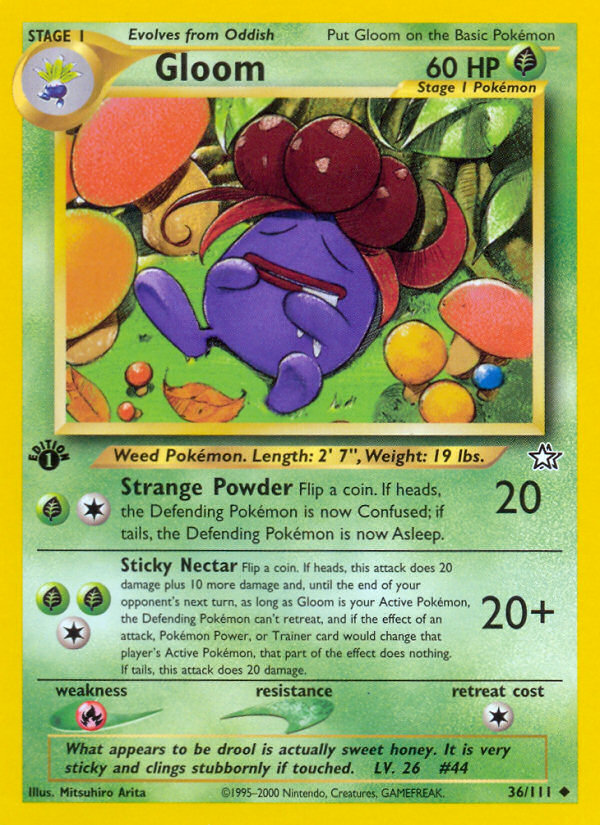
Image courtesy of TCGdex.net
Gloom in Neo Genesis: Sequencing Its Attacks for Maximum Control
In the bustling world of the Neo Genesis era, Gloom stands as a curious medley of charm and tactical depth. This Stage 1 Grass-type Pokémon, with a modest 60 HP, evolves from Oddish and carries the artistic signature of Mitsuhiro Arita. While its rarity sits at Uncommon, Gloom’s real value emerges in how its two distinct attacks interact with coin flips, energy requirements, and the way you sequence your plays. That combination—predictable on the surface, delightfully nuanced in practice—is what makes Gloom a favorite for players who love both the puzzle and the payoff of a well-timed set-up. ⚡🔥
At first glance, Gloom’s toolkit leans into disruption and control. Strange Powder costs Grass and Colorless energy and deals 20 damage, but the real hook is the coin flip: heads confuses the Defending Pokémon, tails puts it to sleep. The randomness adds a layer of risk management to your sequencing: you’re not just hitting for damage; you’re shaping the opponent’s next turns. Then comes Sticky Nectar, costing Grass, Grass, and Colorless for 20 damage, with a coin flip that can push your damage to 30 if you hit heads. And crucially, when Gloom is your Active Pokémon and you flip heads, the Defending Pokémon also cannot retreat for the duration of your opponent’s next turn—plus a powerful clause that blunts any effects that would forcibly swap or move the Active Pokémon. It’s the kind of effect that rewards deliberate timing and pressure. 🎴
Card at a glance
- Name: Gloom
- Set: Neo Genesis (First Edition stamp available in some variants)
- Card number: neo1-36
- Rarity: Uncommon
- HP: 60
- Type: Grass
- Stage: Stage 1 (evolves from Oddish)
- Attacks:
- Strange Powder — Grass, Colorless; 20 damage; Coin flip: heads Confused, tails Asleep
- Sticky Nectar — Grass, Grass, Colorless; 20 damage (20+ on heads with potential extra conditions)
- Weakness: Fire ×2
- Illustrator: Mitsuhiro Arita
- Pricing snapshot: Cardmarket avg EUR around 1.4; TCGPlayer (1st Edition) low around $1.69, mid $2.70, high up to $9.99; Unlimited low around $0.75, mid $1.54, high $2.59
Why sequencing matters: turning coin-flips into board advantage
Gloom’s value isn’t just in raw DPS; it’s the tempo of a match. The two attacks require different energy commitments and offer different forms of control. Strange Powder gives you a way to poke the opponent while attempting to disrupt their draw and action economy via sleep or confusion. However, relying on a single flip to lock down a game plan is risky, so you often pair it with Sticky Nectar to ladder into a stronger board state when you can guarantee a favorable coin flip. The “20+” modifier on heads makes Sticky Nectar a potential two-shot or near-finish tool once you’ve set up the necessary energy and bench presence. The added constraint—“the Defending Pokémon can’t retreat and certain effects do nothing”—is a powerful limiter that punishes a retreat-heavy, energy-aggro opponent who relies on moving between Pokemon. 🧩
From a gameplay perspective, the sequencing hinges on your setup pace. Since Gloom is a Stage 1 evolution, you’ll typically want an Oddish out on your bench first, then use your turn to evolve into Gloom. Once Gloom is up and you’ve attached at least one Grass energy (and a Colorless energy for Strange Powder), you’re ready to apply the Powder, then press your Sticky Nectar window when you can spare the energy to equip a second Grass and a Colorless. The order matters: starting with Strange Powder lets you threaten a quick disruption, while readying Sticky Nectar with a favorable coin flip turns into sustained aggression and a field-locking effect that can swing the momentum in your favor. The risk-reward dance is precisely what makes Neo Genesis-era Gloom a joy to pilot. ⚡
Against fast, heavy-retreat decks, Gloom’s Sticky Nectar quantum lock can be a shield as well as a sword. If you can land heads on Sticky Nectar and keep Gloom active, you can deny your opponent the opportunity to swap to a more favorable target—especially when you’ve stacked a little energy and your opponent is trying to retreat a weakened Active. But remember: if the coin flips go tails, you’ll still push 20 damage, which can be meaningful when you’re chipping away at a fragile opponent’s HP total and pressing a two-turn plan. The key is to read the board state: do you want to threaten sleep and disruption now, or do you want the immediate 30-damage tempo and the retreat-lock later? Both lines are legitimate, and the best choice often depends on your energy availability and what’s on your bench. 🎨
Practical play sequence: a sample flow
Turn 1–2: Build your engine with Oddish on the bench and Gloom ready to evolve. If you draw into a Grass energy, you can accelerate your board by evolving to Gloom on your second turn and attaching energy to support the first attack. The moment you’ve got a clean energy cost paid for Strange Powder, you unleash it to apply the coin-flip pressure. If you flip heads, you’ve disrupted the Defending Pokémon with Confusion or Sleep, buying you a crucial turn of control. 🔥
Mid-game: If you’ve managed to attach a second Grass energy, you’re primed for Sticky Nectar when the moment is right. Heads on Sticky Nectar not only pushes your damage to 30 but also imposes a retreat lock that can stop a desperate switch from your opponent. Use that to stage a second attack or to force a retreat into a more favorable matchup. If the flip goes tails, you still have 20 reliable damage to chip away while you set up for the next sequence. The real win condition is aligning energy, coin outcomes, and your bench layout so that you’re pressuring with both disruption and steady damage. 🪄
Matchups and metagame notes: Gloom’s Grass typing grants you an advantage against Water types and some dual-types in the era, but you’ll want to respect Fire weaknesses. In practice, you’ll lean on your bench to weather early hits while you press your coin-flip plan. The trainer and energy balance are your levers: more Rescue or Item utilities can accelerate your setup, while more Energy attachments speed the two-attack tempo you need to pull off Sticky Nectar’s full potential. The reward is a flexible, tempo-rich game plan that rewards careful sequencing as much as raw luck. 💎
Collector insights: value, collectibility, and trends
Neo Genesis holds a special place in the collection ecosystem. Gloom’s Unofficial status as an uncommon from the early days of the Base-inspired era keeps it within reach for many players, while first-edition prints can fetch a premium for collectors who want that crisp stamp and the iconic Mitsuhiro Arita artwork. The card’s value is nuanced: unlimited prints are accessible for casual players, while 1st Edition copies remain aspirational for collectors chasing the nostalgia of the Neo Genesis line. The pricing snapshot tells a story of modest yet resilient value, with Cardmarket tracking around EUR 1.4 on average and TCgPlayer posting a range that is both practical for playing and collectible in older printings. As of late 2025, you’ll see 1st Edition copies hovering higher, with mid-to-high prices on the rare side for pristine examples, especially those with the iconic Arita art. For players building decks, Gloom is a cost-effective engine piece that can deliver meaningful disruption and damage without breaking the bank, while for collectors, it’s a doorway into the early 00s TCG aesthetic. 🔍
Whether you’re chasing nostalgia or crafting a strategy that leans into coin-flip chaos, Gloom’s two-pronged approach to attack sequencing invites you to think a step ahead. It’s a testament to the elegance of the Neo Genesis era: simple energy costs and a two-attack moveset can unlock a surprising amount of strategic depth when you sequence with intention and a little luck. 🎴
Neoprene Mouse Pad Round/Rectangular Non-SlipMore from our network
More from our network
- https://blog.digital-vault.xyz/blog/post/designing-scalable-architecture-from-day-one/
- https://blog.crypto-articles.xyz/blog/post/nft-data-happcat-075-from-happcat-on-drip-collection-on-magiceden/
- https://blog.zero-static.xyz/blog/post/statistical-power-compared-butcher-of-the-horde-and-similar-cards/
- https://blog.rusty-articles.xyz/blog/post/metal-saucer-and-evolution-mechanics-in-pokemon-tcg/
- https://blog.crypto-articles.xyz/blog/post/nft-data-puppilator-swirl-mask-2-from-puppilator-empowerment-females-collection-on-magiceden/
Gloom
Set: Neo Genesis | Card ID: neo1-36
Card Overview
- Category: Pokemon
- HP: 60
- Type: Grass
- Stage: Stage1
- Evolves From: Oddish
- Dex ID: 44
- Rarity: Uncommon
- Regulation Mark: —
- Retreat Cost:
- Legal (Standard): No
- Legal (Expanded): No
Description
Attacks
| Name | Cost | Damage |
|---|---|---|
| Strange Powder | Grass, Colorless | 20 |
| Sticky Nectar | Grass, Grass, Colorless | 20+ |
Pricing (Cardmarket)
- Average: €1.4
- Low: €0.05
- Trend: €1.85
- 7-Day Avg: €1.48
- 30-Day Avg: €1.42
Support Our Decentralized Network
Donate 💠More from our network
- https://blog.digital-vault.xyz/blog/post/designing-scalable-architecture-from-day-one/
- https://blog.crypto-articles.xyz/blog/post/nft-data-happcat-075-from-happcat-on-drip-collection-on-magiceden/
- https://blog.zero-static.xyz/blog/post/statistical-power-compared-butcher-of-the-horde-and-similar-cards/
- https://blog.rusty-articles.xyz/blog/post/metal-saucer-and-evolution-mechanics-in-pokemon-tcg/
- https://blog.crypto-articles.xyz/blog/post/nft-data-puppilator-swirl-mask-2-from-puppilator-empowerment-females-collection-on-magiceden/