
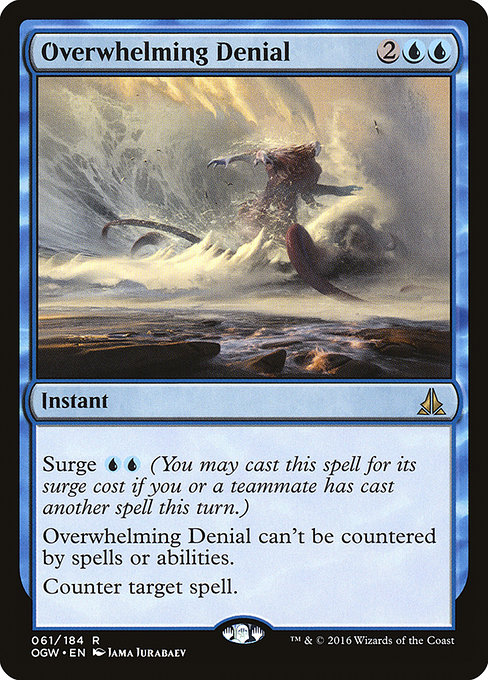
Image courtesy of Scryfall.com
Smart Deck Optimization with ML and Blue Control Magic
If you’re anything like me, you’ve spent countless nights staring at MTG card data and wondering how to translate a torrent of numbers into sharper decision making at the table. Machine learning isn’t here to replace your gut; it’s here to illuminate the edges of your decision space, surfacing subtle synergies you might miss in a jam-packed card pool 🧙♂️. When you pair data-driven insight with the tactile thrill of a well-timed spell, you get a recipe for decks that feel both precise and alive — a true blend of science and sorcery 🔬🎲.
Take, for example, Overwhelming Denial, a blue instant from Oath of the Gatewatch (OGW). Its mana cost is {2}{U}{U}, a respectable four-mana commitment that sits comfortably in a control tempo shell. The card’s most distinctive feature is its Surge ability: you may cast it for its surge cost {U}{U} if you or a teammate has cast another spell this turn. And when you finally cast it, this spell can’t be countered, and it counters target spell. That combination—surge-enabled tempo with an uncounterable resolution—gives blue decks a reliable late-turn tempo swing that can flip the odds in a tense matchup 🔮⚔️.
From a design perspective, that text is a goldmine for ML feature engineering. The card blends a concrete cost (CMC 4), a color identity (blue), and a dynamic gating mechanic (Surge) with a binary property (un-counterable) and a direct action (counter target spell). A model can encode these aspects as both static features (cost, color, rarity) and dynamic ones (whether Surge was paid this turn, the current spell density in hand and graveyard, opponent's likely targets). The rarity flag (rare) also informs supply-side considerations for deck-building—how often a player might encounter or need this exact tool in a given metagame 📈💎.
So how would you put this into practice? A practical ML workflow might start with a dataset of thousands of constructed games, where each card is represented by its canonical features plus contextual game-state signals: current mana available, spell pace this turn, number of blue cards drawn, presence of other counterspells, and opponent archetypes. A supervised model could predict win rate deltas when including Overwhelming Denial in various blue-control configurations. A reinforcement-learning agent could then learn optimal timing for Surge plays, balancing the risk of holding up countermagic against the tempo swing of landing a decisive denial when it’s least telegraphed 🧙♀️🎲.
In the context of deck optimization, Overwhelming Denial is a perfect test case for the nuance between tempo and control. The surge cost creates a threshold dynamic: you must stack the deck with enough non-surge blue spells to unlock the cheaper surge path, while still preserving enough raw denial power to stop critical threats. A model might reveal that in certain meta-games, the optimal play is to sequence two or three lower-cost blue spells first, then unleash Surge when the opponent has committed their own answers, maximizing the odds that your own spell resolves uncountered. It’s the kind of insight that rewards both meticulous planning and bold mid-game improvisation 🧠⚡.
From a gameplay perspective, Overwhelming Denial embodies the elegance of counterplay. You can’t miscast it as a late-game misfire—its ability to counter a spell remains authoritative even in the face of broader counterspells or stifling effects. And the surge mechanic nudges you toward a collaborative tempo: if you’re piloting a duo or team-format strategy, the “you or a teammate” clause encourages partnership with other players to unlock the surge is a shared game plan. This is the kind of synergy ML models are great at recognizing—patterns that repeat across decks and metagames, even when the specific cards evolve with each set expansion 🧙♂️🔥.
Beyond the math and mechanics, there’s magic in the way Overwhelming Denial was drawn and framed. Jama Jurabaev’s art alongside the OGW frame tells a story of arcane pressure building behind a glassy shield. The card’s blue aura, the teetering balance of spells and threats, and the possibility of a surge-powered counterstrike all echo the cultural tension in modern MTG between instant responses and carefully timed plays. It’s a reminder that a well-designed card isn’t just a line of text; it’s a lever you can pull in any given game state, with room for improvisation and drama 🧭🎨.
To readers who are building their own ML-assisted drafting or deck-building workflow, the most actionable takeaway is to treat card features as first-class citizens in your models. A structural approach—combining static attributes (color, cost, rarity) with rule-based signals (Surge presence, uncounterable property)—tends to outperform ad-hoc, hand-tuned features. And if you’re ever tempted to shortcut complex data work, remember: the joy of MTG often lies in the fine margins—where a single Surge spell can catalyze a circuit-breaker turn and tilt the entire game. That’s the kind of insight that keeps both the lab coats and the dice happy 🧪🎲.
Gaming Mouse Pad Neoprene 9x7 - Stitched EdgesMore from our network
- https://crypto-acolytes.xyz/blog/post/nft-stats-meta-muse-1299-from-meta-muses-collection/
- https://crypto-acolytes.xyz/blog/post/nft-stats-slapsolmail-from-solmail-id-collection/
- https://blog.digital-vault.xyz/blog/post/how-to-build-a-high-performance-remote-product-team/
- https://blog.digital-vault.xyz/blog/post/distant-blue-beacon-illuminates-the-color-magnitude-diagram/
- https://blog.crypto-articles.xyz/blog/post/key-takeaways-from-virginia-giuffres-memoir-for-readers/
Overwhelming Denial
Surge {U}{U} (You may cast this spell for its surge cost if you or a teammate has cast another spell this turn.)
This spell can't be countered.
Counter target spell.
ID: 33ff1000-1a4e-43f6-aa02-1dbe9fac6901
Oracle ID: 45aa8bdb-54da-4069-bd6c-c63396154464
Multiverse IDs: 407571
TCGPlayer ID: 110872
Cardmarket ID: 287293
Colors: U
Color Identity: U
Keywords: Surge
Rarity: Rare
Released: 2016-01-22
Artist: Jama Jurabaev
Frame: 2015
Border: black
EDHRec Rank: 15132
Penny Rank: 3201
Set: Oath of the Gatewatch (ogw)
Collector #: 61
Legalities
- Standard — not_legal
- Future — not_legal
- Historic — not_legal
- Timeless — not_legal
- Gladiator — not_legal
- Pioneer — legal
- Modern — legal
- Legacy — legal
- Pauper — not_legal
- Vintage — legal
- Penny — legal
- Commander — legal
- Oathbreaker — legal
- Standardbrawl — not_legal
- Brawl — not_legal
- Alchemy — not_legal
- Paupercommander — not_legal
- Duel — legal
- Oldschool — not_legal
- Premodern — not_legal
- Predh — not_legal
Prices
- USD: 0.23
- USD_FOIL: 0.47
- EUR: 0.19
- EUR_FOIL: 0.35
- TIX: 0.02
More from our network
- https://wiki.digital-vault.xyz/wiki/post/pokemon-tcg-stats-spell-tag-card-id-sm8-190/
- https://blog.digital-vault.xyz/blog/post/graphing-vibravas-stats-across-pokemon-generations/
- https://wiki.digital-vault.xyz/wiki/post/minecraft-block-stats-melon/
- https://articles.zero-static.xyz/blog/post/a-incriminate-deck-tech-meets-influencer-buzz/
- https://blog.crypto-articles.xyz/blog/post/nft-data-blessed-celestios-742-from-blessed-celestio-collection-on-magiceden/