

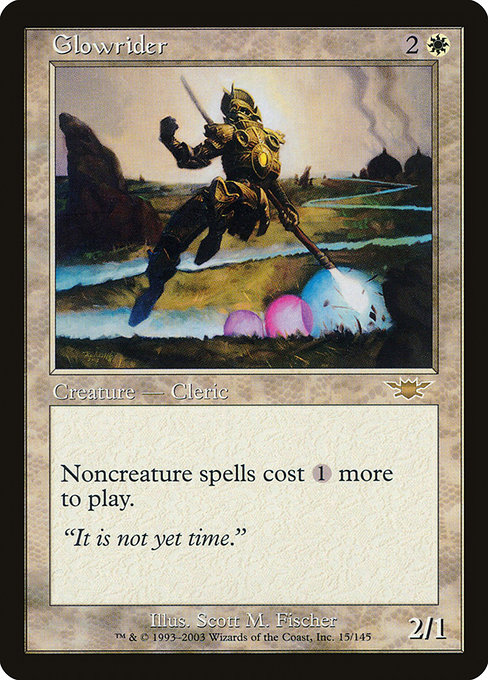
Image courtesy of Scryfall.com
Clustering by Mana Cost: Glowrider as a Taxing Case Study
In the vast matrix of Magic: The Gathering, mana costs are more than just numbers—they’re the fingerprints of tempo, planning, and risk. When you invite Glowrider into the mix, you’re inviting a built-in cost escalator for the noncreature portion of your opponent’s stack. This 2W White creature from Legions (a Rare from 2003) sits at a modest 3-mana CMC, a 2/1 chassis forged for a purpose: “Noncreature spells cost {1} more to cast.” The impact isn’t just on a single spell; it reshapes the entire cost landscape of the game, nudging the distribution of what gets cast when 🧙♂️🔥. A machine-learning lens on mana cost clustering loves Glowrider because it creates a natural, testable shift in the feature space: every noncreature spell’s effective cost increments by one, tilting the class balance in data-driven decks toward higher-cost iterations.
Glowrider at a glance
- Mana cost: {2}{W} (CMC 3)
- Type: Creature — Human Cleric
- Power/Toughness: 2/1
- Text: Noncreature spells cost {1} more to cast.
- Set/Rarity: Legions (Lgn), Rare
- Flavor text: "It is not yet time."
- Artwork: Scott M. Fischer
Legions was the era where Wizards of the Coast experimented with aggressive, mechanic-rich designs, and Glowrider stands as a clean, elegant tax. In formats where noncreature spells dominate the stack—Legacy, Vintage, and certain commander circles—the tax is tangible. A single glow-wrapping line of text can turn a familiar game into a test of resource budgeting: how many spells can you cast before you’re forced to pivot, redraw, or rebuild your plan entirely? The card’s rarity and age also feed into collector curiosity; foil copies fetch higher premiums, a reminder that even a simple tax drafters once overlooked can become a relic worth treasuring 🧠💎.
“Noncreature spells cost {1} more to cast.” That tax reshapes the deck, the tempo, and the math you carry into every trade—a quiet reminder that timing is the ultimate currency ⚔️.
From a gameplay perspective, Glowrider invites a specific kind of strategic calculus. White decks that lean on disruption, removal, or card draw often rely on efficient low-cost lines to stabilize the board. Glowrider redefines what “efficient” looks like when your own noncreature spells also face a bump in cost. Players can exploit this by leaning into a heavier creature presence early—packing threats that pressure the opponent before their spells fully stack—and by favoring low-cost or oddball but impactful effects that still land within the new cost curve. In formats where taxes stack (think various white tax creatures and heterogeneous disruption), Glowrider becomes a shared obstacle—the kind of glue that binds together a control-lite board with a tax-driven tempo plan 🎨⚔️.
For ML-minded strategists, it’s a reminder that constraints can be data-rich opportunities. If you’re modeling deck performance, Glowrider’s effect is a natural variable that shifts the distribution of noncreature spell costs upward by one band. You can simulate two populations: decks with Glowrider and decks without. By comparing the cluster centers, you reveal how a single card can reorganize a deck’s core archetype—not by adding more spells, but by altering which ones actually come online on curve. In practical terms, that means your ML pipeline should account for whether the dataset includes decks with tax effects, because the presence or absence of Glowrider-like cards changes the feature importance of cost-based attributes and timing windows 🧠🎲.
From an aesthetic and lore angle, Glowrider embodies a paradox: a healer and guardian who also enforces a price on magic. The priestly vibe of the creature, combined with the restraint-laden flavor text, mirrors the idea that sometimes the best defense is not to overwhelm, but to demand more from your opponent’s toolkit. The art reinforces that patient, steady approach, a contrast to the flashier spells that often steal the spotlight in modern sets. It’s a piece that resonates with nostalgia while still offering a surprisingly modern kind of deck-building discipline 🧙♂️🎨.
Price snapshots and market interest align with its status as a vintage-leaning collectible. As of the present data, Glowrider sits in a tier where a regular copy is affordable for casual collectors, yet foil versions carry a premium—the kind of dynamic that keeps older rares alive in the conversation and the display case. If you’re chasing that “older magic” vibe, Glowrider is a compelling centerpiece to explore, especially for players who relish tax mechanics and the nuanced dance of noncreature spell timing 💎.
In short, Glowrider isn’t just a quaint throwback; it’s a practical case study in how a single effect can ripple through both gameplay and analysis. The card invites you to think in two dimensions: the tactile, mana-based decisions of real games, and the data-driven shifts that curves and clusters reveal when you model a world where every spell’s cost has a slightly longer fuse. And yes, there’s always room for a well-timed, patient draw that lets you swing with a 2/1 while your opponent peels back the curtain on a more expensive punch 🧙♂️💥.
Clear Silicone Phone Case Slim Durable with Open PortsMore from our network
- https://blog.zero-static.xyz/blog/post/zebstrika-inclusion-rate-across-deck-archetypes-in-pokemon-tcg/
- https://wiki.digital-vault.xyz/wiki/post/pokemon-tcg-stats-ferroseed-card-id-sv105w-068/
- https://crypto-acolytes.xyz/blog/post/hanging-lanterns-in-farm-builds-for-bright-lighting/
- https://blog.zero-static.xyz/blog/post/how-nostalgia-waves-are-shaping-gnarled-sage-prices/
- https://blog.crypto-articles.xyz/blog/post/nft-data-bagio978-from-bagio-collection-on-magiceden/
Glowrider
Noncreature spells cost {1} more to cast.
ID: 9ad94e39-0aac-46bb-a7f2-bd88c537cb9c
Oracle ID: aaf825b0-af0f-47a0-8b00-85f0614cef5d
Multiverse IDs: 42073
TCGPlayer ID: 10706
Cardmarket ID: 1996
Colors: W
Color Identity: W
Keywords:
Rarity: Rare
Released: 2003-02-03
Artist: Scott M. Fischer
Frame: 1997
Border: black
EDHRec Rank: 13266
Penny Rank: 543
Set: Legions (lgn)
Collector #: 15
Legalities
- Standard — not_legal
- Future — not_legal
- Historic — not_legal
- Timeless — not_legal
- Gladiator — not_legal
- Pioneer — not_legal
- Modern — not_legal
- Legacy — legal
- Pauper — not_legal
- Vintage — legal
- Penny — not_legal
- Commander — legal
- Oathbreaker — legal
- Standardbrawl — not_legal
- Brawl — not_legal
- Alchemy — not_legal
- Paupercommander — not_legal
- Duel — legal
- Oldschool — not_legal
- Premodern — legal
- Predh — legal
Prices
- USD: 1.42
- USD_FOIL: 18.89
- EUR: 1.89
- EUR_FOIL: 12.46
- TIX: 0.22
More from our network
- https://wiki.digital-vault.xyz/wiki/post/pokemon-tcg-stats-exeggcute-card-id-sm4-4/
- https://blog.crypto-articles.xyz/blog/post/nft-data-george-plays-clash-royale-845-from-gpcr-nft-collection-collection-on-magiceden/
- https://blog.crypto-articles.xyz/blog/post/nft-data-27-from-pumpats-collection-on-magiceden/
- https://wiki.digital-vault.xyz/wiki/post/pokemon-tcg-stats-night-teleporter-card-id-pl3-138/
- https://blog.digital-vault.xyz/blog/post/3d-map-of-a-blue-white-star-94k-ly-away-near-octans/