
Image courtesy of Scryfall.com
Meta Design Patterns Across MTG Un-Sets
Un-sets have always been the playground where Wizards tests the edges of card design, player interaction, and the very idea of what “fun” can mean in a strategic game. They lean into humor, self-awareness, and moments of delightful chaos that casual players feast on and then quietly adopt into standard play. This article uses a recent blue instant anchored by a familiar trope—deck manipulation and choice—to illuminate how Un-set-inspired patterns quietly shape mainstream design. 🧙♂️🔥💎
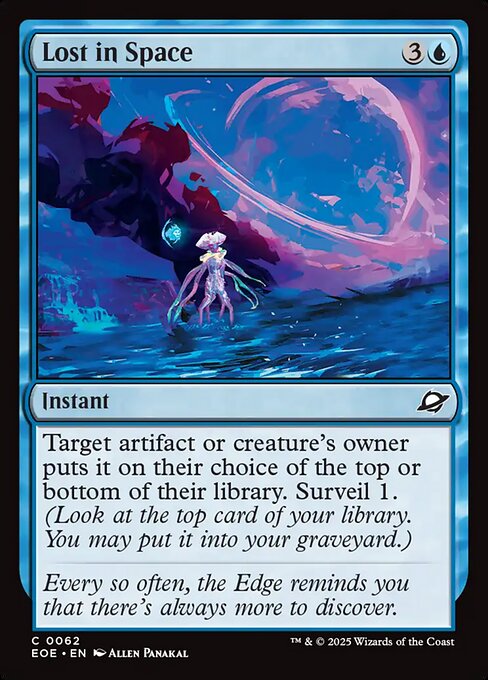
Consider a blue instant with mana cost {3}{U}, a modest Surveil kicker, and a clever library interaction. Lost in Space, from Edge of Eternities, offers: “Target artifact or creature's owner puts it on their choice of the top or bottom of their library. Surveil 1.” The card’s color identity is blue, and its rarity is common, yet its mechanic philosophy feels familiar to Un-set design DNA: give players meaningful choices, subvert assumptions, and reward planning over brute force. The flavor text—“Every so often, the Edge reminds you that there's always more to discover.”—reads like a wink between designers and players, a reminder that discovery is as much the journey as the result. This tone—playful, insightful, and a little mischievous—has rippled through sets that came after, even when the cards themselves live in more traditional shells. 🎨
Surveil is the quiet cousin of Scry, a mechanic that appears in various forms across sets and even in Un-Sets as a nod to information control. By letting you look at the top card and then decide its fate (graveyard or library), these designs reward deliberate sequencing, not just raw power. Lost in Space bundles that with a targeted pivot—top or bottom—giving both players a moment of agency in the mid-game drag race. ⚔️
From a design perspective, there are several meta-patterns that Un-Sets helped normalize and proliferate, and Lost in Space is a neat case study for a few of them:
- Top-deck manipulation as a core tempo tool — The choice to place a card on the top or bottom of the library surfaces a strategic layer that rewards forethought. It’s not just drawing a card; it’s shaping what you’ll draw next. In many Un-set-inspired designs, this kind of subtle library manipulation becomes a standard pedal to the meta’s speed—fast, slow, or somewhere in between. 🧭
- Keyword economy with flexible outcomes — Surveil 1 is modest in its raw power, but its long-term value lies in consistent, incremental advantage. Un-sets famously experimented with low-cost spells that bend the odds without overwhelming the board, and Lost in Space shows how a tiny, well-tuned effect can stay relevant across formats—from casual Commander tables to more competitive EDH builds. 🔎
- Flavor-forward design that respects player imagination — The Edge of Eternities set carries a flavor that invites discovery, mirroring the Un-set ethos of playful, adventurous storytelling. Flavor text and art direction reinforce the idea that MTG’s multiverse is a place where wonder meets strategy, and that’s a key pillar of why Un-sets influence mainstream sets. 🧙♂️
- Accessible but clever play patterns — A common card like this demonstrates how designers balance accessibility (simple mana cost, clear board impact) with clever interaction (library manipulation that’s not purely draw-based). The result is a card that new players can grasp quickly, yet older players appreciate for its micro-decisions and synergies. 💡
- Artistic and mechanical coherence across eras — Lost in Space sits in a modern-2015 frame, with Allen Panakal’s art that blends crisp linework with a sense of motion and mystery. This coherence between art, mechanics, and flavor is precisely the corridor through which Un-set-inspired patterns travel into broader design language, guiding future set directions. 🎨
In practical terms for players building around blue control or tempo shells, Lost in Space offers a clean avenue to probe deck-thinning strategies and graveyard synergy. You cast it to pull a needed answer or to set up the top for a future threat, while surveilling to populate your graveyard with relevant cards for later spells or reanimations. The card’s availability in both foil and non-foil prints makes it approachable for collectors and casual players alike, a hallmark of why Un-set design threads remain relevant in mainstream product cycles. 💎
As a design case study, Lost in Space demonstrates how Un-Set-inspired patterns have echoed outward: the emphasis on choice, the celebration of clever interactions, and the bridging of humor with real strategic value. For fans, it’s a reminder that the funniest ideas can also be the most functionally enduring. When you sit down at the table, you’re not just playing a card—you’re engaging with a design lineage that invites curiosity, experimentation, and a little nerdy satisfaction. 🧙♂️🎲
Design patterns at a glance
- Top/front-deck manipulation that respects both players’ agency
- Low-curve, approachable spells with room for nuanced play
- Informative but playful flavor that hints at bigger ideas
- Cross-format viability that supports casual fun and competitive curiosity
- Artwork and frame choices that echo a broader design conversation across sets
For collectors and deck-builders alike, the card’s Edge of Eternities identity ties into a larger conversation about design patterns that began in the playful margins of MTG’s past and moved into its mainstream future. The balance of value, flavor, and function makes blue’s presence in Un-sets more than a joke—it’s a blueprint for how to blend wit with wisdom in a way that resonates across decades. 🧙♂️🔥
Curious readers may want to keep an eye on how these motifs continue to surface in new sets, including those that marry old-school charm with modern mechanical ambition. The patchwork of Surveil-like effects, deck-shaping options, and blue’s quintessential tempo toolkit promises more surprises—some obvious, some delightfully under-the-radar. And who knows? The next Un-set-inspired card might teach us a subtle lesson about discovering more than we expected, exactly where the Edge invites us to look. 🎨
Non-Slip Gaming Mouse Pad (Anti-Fray Edges, 9.5x8in)More from our network
Lost in Space
Target artifact or creature's owner puts it on their choice of the top or bottom of their library. Surveil 1. (Look at the top card of your library. You may put it into your graveyard.)
ID: 6d9d7979-97af-4c85-86f5-1b3704f74e8b
Oracle ID: cec95b9f-9d1e-4988-befe-d0c9e20e428d
TCGPlayer ID: 644583
Cardmarket ID: 836787
Colors: U
Color Identity: U
Keywords: Surveil
Rarity: Common
Released: 2025-08-01
Artist: Allen Panakal
Frame: 2015
Border: black
EDHRec Rank: 23111
Set: Edge of Eternities (eoe)
Collector #: 62
Legalities
- Standard — legal
- Future — legal
- Historic — legal
- Timeless — legal
- Gladiator — legal
- Pioneer — legal
- Modern — legal
- Legacy — legal
- Pauper — legal
- Vintage — legal
- Penny — not_legal
- Commander — legal
- Oathbreaker — legal
- Standardbrawl — legal
- Brawl — legal
- Alchemy — legal
- Paupercommander — legal
- Duel — legal
- Oldschool — not_legal
- Premodern — not_legal
- Predh — not_legal
Prices
- USD: 0.02
- USD_FOIL: 0.04
- EUR: 0.02
- EUR_FOIL: 0.03
- TIX: 0.03
More from our network
- https://articles.zero-static.xyz/blog/post/gorilla-titan-silver-border-community-analysis/
- https://blog.crypto-articles.xyz/blog/post/nft-data-yzmari-shattered-495-from-risen-collection-on-magiceden/
- https://crypto-acolytes.xyz/blog/post/nft-stats-heavy-liquid-graphic-756-from-heavy-liquid-graphic-collection/
- https://articles.digital-vault.xyz/blog/post/fans-praise-this-illustrators-diglett-card-art-style/
- https://wiki.digital-vault.xyz/wiki/post/pokemon-tcg-stats-magmar-card-id-sm115-10/