
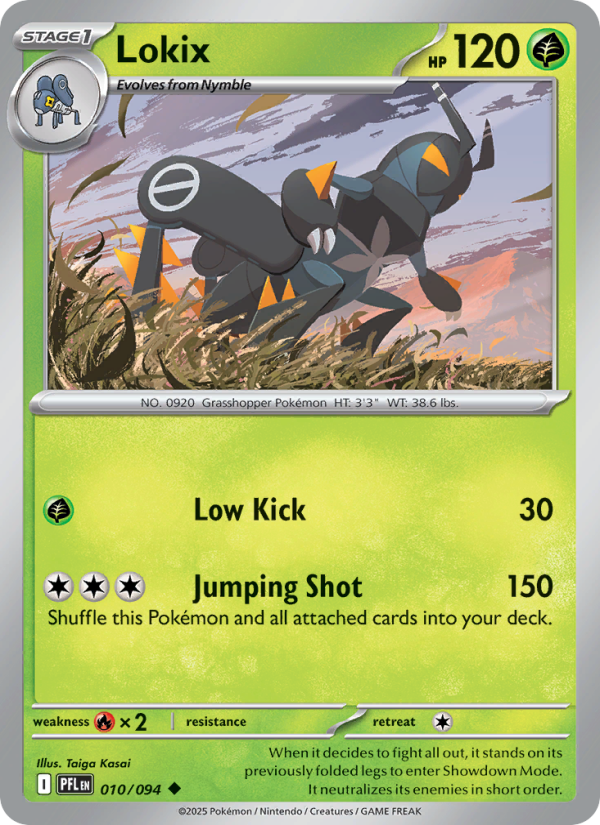
Image courtesy of TCGdex.net
Lokix’s Quiet Reign: Why Grass-Type Fans Rally Around This Stage 1 Powerhouse
In the Scarlet & Violet era, trainers chase a balance between speed, power, and strategic disruption. Lokix, a Grass-type Pokémon card from the Phantasmal Flames set, has emerged as a fan-favorite because it blends nimble offense with a surprising tempo swing. At 120 HP and classified as a Stage 1 Grass Pokémon, Lokix sits at a pivotal spot in many decks: not the tank, not the pure glass cannon, but a sturdy midrange choice that rewards thoughtful sequencing and deck thinning. Its presence in the field feels like a wink to longtime collectors while delivering real play in Standard formats marked by dynamic bench games and late-game shuffles ⚡🔥.
Designer-curious players love Lokix for its two distinct attacks. The first, Low Kick, costs a single Grass Energy and lands a neat 30 damage—simple, reliable poke that keeps early tempo on your side. But it’s Lokix’s second move that sparks real excitement: Jumping Shot. For the cost of three Colorless Energy, you deal a hefty 150 damage and, more intriguingly, you shuffle Lokix and all attached cards back into your deck. That last line is a clockwork mechanic—your board can reset, your opponent has fewer obvious reads on your next turn, and yet your deck remains intact with your important tools still in reach. It’s the kind of clause that invites clever plays around energy attachment, retreat management, and timing, turning Lokix into a fog of tempo that can swing a game from quiet to chaotic in a single sequence 🎨🎮.
From a design perspective, Lokix embodies some classic Pokémon TCG storytelling: a nimble predator that leverages the chaos of the battlefield to reassert control. The card’s Stage 1 lineage and its Grass typing place it in a long-running tradition of ground-drenched, nature-driven strategies that favor careful resource management. While the card data doesn’t list an illustrator, the artwork across the Phantasmal Flames line tends to emphasize sharp lines, vivid foliage, and a sense of kinetic energy—perfectly matching Lokix’s quick strikes and deck-shuffling finale. For players and collectors, this balance of art and function is part of what makes Lokix feel iconic rather than merely good additives to a build. (Note: illustrator credits aren’t provided in the data, so we celebrate the design without attributing a specific name here.) ✨
Strategic Play: Building Around Jumping Shot
- Tempo control: Jumping Shot’s 150 damage is enough to threaten mid- to late-game knockouts, but the real payoff is the disruption of opponent plans. Shuffling both Lokix and attached cards into the deck resets status conditions and removes the immediate risk of losing those key tools to a removal effect. Skilled players time this reset to nullify an opponent’s prized setup on the very turn they threaten victory.
- Energy management: With a three-Colorless energy cost for Jumping Shot, Lokix thrives in decks that can accelerate energy or recycle energy efficiently. Players often pair Lokix with supportive Identity Pokémon or Trainer cards that help draw into energy or flatten the climb from 1 to 3 Colorless energies across a few turns.
- Bench presence and retreat: Lokix’s Retreat cost of 1 keeps it reasonably mobile. You’re not locked in once you drop Lokix; you can reposition when the timing is right to leverage the next attacker or to bait an overextension from your opponent.
- Line synergy: As a Stage 1 Grass Pokémon, Lokix can slot into broader Grass‑leaning lines that feature evolution staples and other midrange attackers. Its HP of 120 gives you staying power on the bench while you set up for a Jumping Shot finisher when the moment is right.
In the Scarlet & Violet meta landscape, Lokix demonstrates the appeal of flexible offense that can evolve into a reshaped board state with a single card play. The combination of solid early pressure (Low Kick) and a decisive late‑game push (Jumping Shot) lets players tilt the match in their favor even when the early game isn’t a pure knockout. The card’s standard legality—Regulation Mark I—keeps it within the familiar rotation of most competitive decks today, while its Uncommon rarity ensures it’s accessible to collectors who want a strong, affordable piece for their midrange Grass strategies 🪴💎.
Collecting Lokix: Variants, Value, and Print History
Lokix exists in several print variants, including normal, reverse, and holo forms. Those print options—especially the holo version—add spice to your binder and often spark premium interest among players who value aesthetics as part of a card’s story. In terms of market data, Lokix’s pricing sits in a friendly range for budget-conscious collectors. CardMarket data (EUR) shows an average around 0.10 EUR for standard copies, with holo variants nudging higher—roughly 0.06–0.09 EUR for recent prints depending on market demand and supply. For casual collectors, Lokix remains an approachable centerpiece for a Grass-focused deck, while also serving as a tangible reminder of the Phantasmal Flames set’s design language and intent. Prices can shift with new sets or pop‑up demand, but Lokix’s Uncommon status and robust play potential keep it relevant in both collection and competition 🧩🎴.
Artwork, rarity, and the fun of chasing holo foils are part of Lokix’s enduring appeal. While the data doesn’t always include every illustrator credit, the overall presentation—glossy or matte finishes, vivid greens, and dynamic action—invites collectors to seek out the best print that matches their personal taste. This blend of playability and visual appeal is exactly what fans remember when they think back on the Phantasmal Flames line and its impact on the Scarlet & Violet era. If you’re assembling a deck that values tempo, survivability, and a surprise finisher, Lokix offers a compelling path to a win while giving you a story to tell on the sleeve and in the binder 🔥🎴.
Putting Lokix in Your Deck Stack
For players exploring new directions in the current Standard format, Lokix is a reminder that tempo and disruption are often the best allies. Prioritize early damage with Low Kick to threaten two-to-three shot pressure, then time Jumping Shot to catch your opponent off-guard just when their setup breathes life. The deck you craft around Lokix should reward efficient energy acceleration, careful retreat decisions, and the ability to sustain draws so you can reach the three-colorless threshold without stalling. If you’re chasing a compact, flexible Grass attacker that can flip the game with a single turn, Lokix earns its place in the hall of iconic cards from the Phantasmal Flames chapter 🔥💎.
Slim Phone Case for iPhone 16More from our network
Lokix
Set: Phantasmal Flames | Card ID: me02-010
Card Overview
- Category: Pokemon
- HP: 120
- Type: Grass
- Stage: Stage1
- Dex ID:
- Rarity: Uncommon
- Regulation Mark: I
- Retreat Cost: 1
- Legal (Standard): Yes
- Legal (Expanded): No
Description
Attacks
| Name | Cost | Damage |
|---|---|---|
| Low Kick | Grass | 30 |
| Jumping Shot | Colorless, Colorless, Colorless | 150 |
Pricing (Cardmarket)
- Average: €0.1
- Low: €0.02
- Trend: €0.03
- 7-Day Avg: €0.04
- 30-Day Avg: €0.04
Support Our Decentralized Network
Donate 💠More from our network
- https://blog.zero-static.xyz/blog/post/exploring-sai-of-the-shinobi-borderless-and-showcase-variants-evolution/
- https://blog.zero-static.xyz/blog/post/needle-drop-tracing-its-print-history-across-mtg-expansions/
- https://crypto-acolytes.xyz/blog/post/venturing-through-the-scariest-forests-in-gaming/
- https://blog.zero-static.xyz/blog/post/dawnwing-marshal-balancing-white-card-complexity-for-casual-players/
- https://crypto-acolytes.xyz/blog/post/the-same-old-gag-378-the-same-old-gag-nft-stats/