
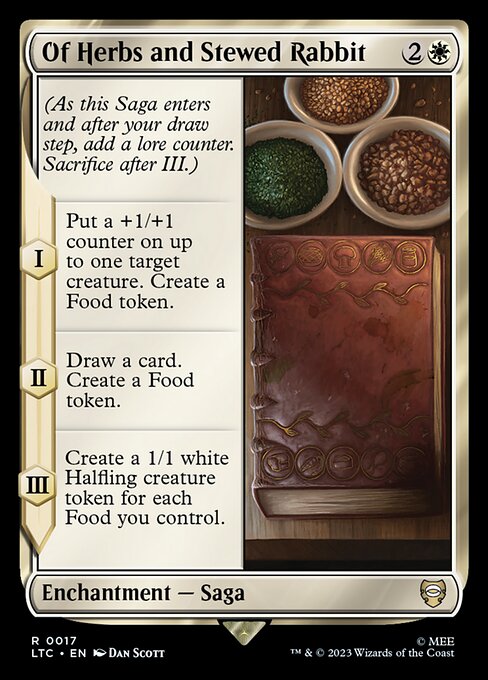
Image courtesy of Scryfall.com
Mythic Feasts, Halfling Legends, and the Saga’s Power
In the grand tapestry of Magic: The Gathering, there are few moments as satisfyingly thematic as a Saga that nourishes both board and legend. Of Herbs and Stewed Rabbit arrives as a white enchantment with a three-act structure, a nod to the old stories where a single dish could spark a fellowship, and a single line of mana could spark a long-term board state. This card’s flavor is all about communal feasts, loyal companions, and the quiet power of hospitality 🧙♂️🔥. Each lore counter you accumulate transforms a simple kitchen ritual into a budding army of Halfling allies, all while you draw, buff, and season your way to victory. It’s a quintessentially Middle-earth moment, wrapped up in a clean, white package that rewards teamwork and incremental advantage ⚔️🎲.
The Saga mechanic itself—a permanent that enters, gains counters each time you draw a card, and ultimately sacrifices—feels like a story arc you can physically timeline through on the battlefield. I (your first act) adds a +1/+1 counter to a chosen creature and sprinkles in a Food token. The II (second act) keeps the momentum by drawing a card and creating another Food token. And the III finale then floods the board with life in the form of a flurry of 1/1 Halfling creatures for each Food you control. It’s old-school storycraft, modernly packaged, and it rewards you for ramping into a thick, flavorful dinner party rather than a quick, punchy kill shot 🧭💎.
“In Middle-earth, a good feast is as mighty as a march, and a well-fed company is a better shield.”
The card’s mana cost of {2}{W} keeps it approachable, while its rarity as a rare from the Tales of Middle-earth Commander set signals that it’s built for longer, more thoughtful games. The white color identity is a natural home for this blending of defense, creature generation, and card draw—white often champions order and communal strength, and the Food token mechanic is a delightful echo of the sustenance and provisioning that hobbits and their friends prize so highly in the lore. The flavor text of the set blends Tolkien’s world with Magic’s design ethos, offering a tabletop legend that invites players to cook up a plan, not just cast a spell 🔥🎨.
Legends, Food, and the Art of the Table
What makes this card sing is the narrative thread it weaves between “legend” and “larder.” The I encounter—placing a +1/+1 counter on a creature and creating a Food token—feels like a village elder blessing a champion before a coming season of trials. The II step—drawing a card and producing another Food token—fits the trope of gathering knowledge and rations before a journey. By the time you reach III, you’re measuring your board by the number of Food tokens you’ve gathered, and then multiplying your Halfling troops accordingly. The result is a cascade of tiny legends—each a token, each a potential ally—that recalls famous culinary and heroic legends from both the lore and our own kitchen table conversations 🧙♂️💎.
Meanwhile, the “Food” token itself is a clever cultural wink—an edible stand-in for nourishment and life as a resource. In many formats, Food tokens synergize with lifegain, mana, or creature creation, turning a simple buffet into a battlefield advantage. Here, Food tokens become a permission slip for your board to grow into a bustling cohort of Halflings, each one a tiny veteran of the feast, ready to defend the camp or join the growing army in the late game. It’s a narrative trick that works on-table and in the fan’s memory—the story of a dinner that didn’t end with plates, but with a legion ⚔️🧂.
Deckbuilding Through the Lens of Legends
For commander players, this Saga shines in environments where you can maximize Food token production and leverage the resulting Halfling swarm. You’ll want to curate a white-focused strategy around token generation, recursion, and buffing effects. Cards that fetch or create Food tokens, or that reuse Food tokens for additional value, pair beautifully with the III’s “for each Food you control” payoff. Include effects that increase +1/+1 counters or provide protection for your growing army, so your first-era buff translates into second- and third-wave pressure. The narrative here isn’t just about winning; it’s about telling a table-long story of a feast that becomes a fearless fellowship. And yes, you’ll want to lean into commander synergies that celebrate longevity and board presence 🧙♂️🔥.
From a game-design perspective, Of Herbs and Stewed Rabbit is a neat example of how a three-part mechanic can feel cohesive yet modular. The first part is immediate board impact; the second adds card advantage; the third flips a quiet kitchen into a bustling hall of heroes. It’s a reminder that white’s strength often lies not in the greatest single effect, but in the power of a plan that evolves over turns, turning a cozy dinner into an enduring advantage. And while your opponents might panic at the sight of a swelling Halfling brigade, you can remind them that this is, in the end, a story about friendship, community, and a legendary stew that outlives the cook 🧂⚔️.
Value, Collectibility, and the Price of Lore
As a rare from a Commander-centric set, Of Herbs and Stewed Rabbit sits in an interesting space for collectors. Its nonfoil print status and the card’s role in a flavorful, lore-rich flavor line make it a sought-after piece for fans of both Tolkien-inspired Magic and the broader Food token ecosystem that’s become a staple of casual and commander play. It might not fetch staggering prices, but its value comes from the story it tells at your table and the practical synergy it offers in midrange white Commander builds. The strength is in how it scales with the board and how easily it can slot into a variety of white-led builds that love to outlast their rivals through steady resource generation and a parade of cute, heroic Halflings 🧙♂️💎.
More from our network
- https://blog.rusty-articles.xyz/blog/post/paldean-student-and-stadium-cards-scarlet-violet-strategy/
- https://blog.crypto-articles.xyz/blog/post/nft-data-mebananas58-from-monkeyseatbananas-collection-on-magiceden/
- https://blog.crypto-articles.xyz/blog/post/nft-data-cub-2299-from-pixelcubs-collection-on-magiceden/
- https://blog.crypto-articles.xyz/blog/post/nft-data-x0-87-from-x0-collection-on-magiceden/
- https://blog.crypto-articles.xyz/blog/post/pokemon-mamoswine-card-investment-strategies-for-collectors/
Of Herbs and Stewed Rabbit
(As this Saga enters and after your draw step, add a lore counter. Sacrifice after III.)
I — Put a +1/+1 counter on up to one target creature. Create a Food token.
II — Draw a card. Create a Food token.
III — Create a 1/1 white Halfling creature token for each Food you control.
ID: c58623cb-8b49-470c-9622-dd6e09d47599
Oracle ID: 2efb908f-d069-4041-930b-5c1ccec00db2
Multiverse IDs: 620703
TCGPlayer ID: 499796
Cardmarket ID: 717177
Colors: W
Color Identity: W
Keywords: Food
Rarity: Rare
Released: 2023-06-23
Artist: Dan Murayama Scott
Frame: 2015
Border: black
EDHRec Rank: 4278
Set: Tales of Middle-earth Commander (ltc)
Collector #: 17
Legalities
- Standard — not_legal
- Future — not_legal
- Historic — not_legal
- Timeless — not_legal
- Gladiator — not_legal
- Pioneer — not_legal
- Modern — not_legal
- Legacy — legal
- Pauper — not_legal
- Vintage — legal
- Penny — not_legal
- Commander — legal
- Oathbreaker — legal
- Standardbrawl — not_legal
- Brawl — not_legal
- Alchemy — not_legal
- Paupercommander — not_legal
- Duel — legal
- Oldschool — not_legal
- Premodern — not_legal
- Predh — not_legal
Prices
- USD: 0.26
- EUR: 0.89
- TIX: 4.33
More from our network
- https://wiki.digital-vault.xyz/wiki/post/pokemon-tcg-stats-popplio-card-id-2017sm-4/
- https://crypto-acolytes.xyz/blog/post/nft-stats-george-plays-clash-royale-epic-197-from-gpcr-nft-collection-collection/
- https://wiki.digital-vault.xyz/wiki/post/pokemon-tcg-stats-elgyem-card-id-bw3-55/
- https://wiki.digital-vault.xyz/wiki/post/pokemon-tcg-stats-fletchinder-card-id-xy11-95/
- https://crypto-acolytes.xyz/blog/post/nft-stats-golden-boy-247-from-golden-boy-collection/