
Image courtesy of TCGdex.net
Unpacking Lass: A Rare Base Set Trainer That Shapes Tempo in Aggro and Control
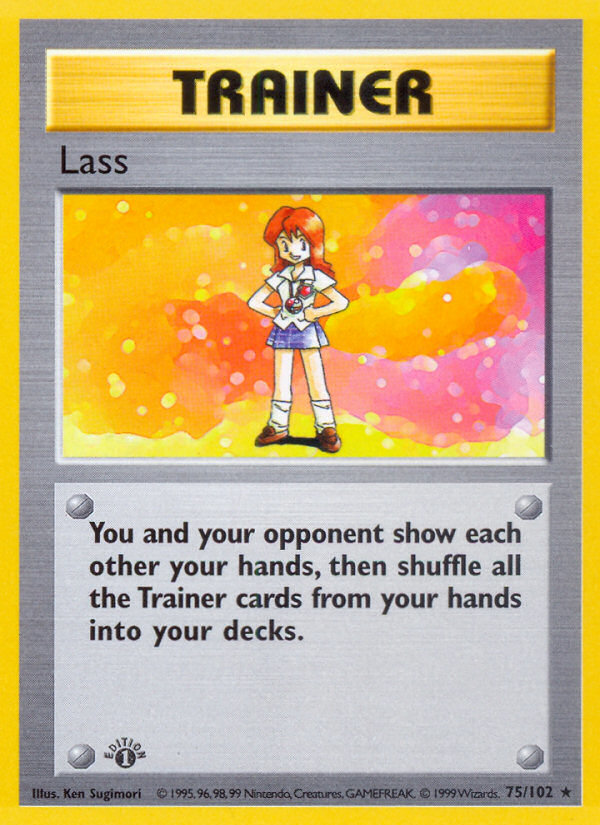
For longtime Trainers in the Pokémon TCG, Lass stands as a nostalgic reminder of how even a single Supporter-turned-Trainer card could bend the flow of a match. Illustrated by the legendary Ken Sugimori and hailing from the original Base Set, Lass is a rare entry that modern players still study for its historical impact and potential in various deck archetypes ⚡. While not a Pokémon with HP or a flashy attack, its role as a Trainer card places it squarely in the discussion of how to optimize turn order, resource access, and mind games at the table.
Base Set Lass sits in a time capsule of the game’s early design, where Trainers could redefine your options on every turn. The card’s rarity—listed as Rare—and its place in the iconic Base Set (base1) speak to collector interest as well as competitive curiosity. The set’s breadth (official 102 cards; total 102) and Lass’s first-edition presence with classic “shadowless” or stamp variants add a layer of collectability that resonates with vintage players and new fans chasing a touch of retro flair 🎴. The price thread, wiggling between accessible on the low end and surprising spikes on the high end, reflects both nostalgia and the enduring appeal of Base Set staples. CardMarket data pegs the average around €3.17 with occasional dips, while TCGPlayer’s USD view centers around a market price of roughly $2.65 for commonly graded copies — a reminder that even “old-school” Trainers can hold a door open to budget-friendly play as well as collectability for the long haul 💎.
What Lass Brings to Aggro Decks
Aggro decks in the white-hot corners of Pokémon TCG history rely on speed, tempo, and the ability to pressure opponents before they can stabilize. Lass, as a Trainer card, contributes to that tempo in a few nuanced ways that authors and players still discuss today. Though the exact text isn’t reproduced here, the card’s role as a classic Base Set Trainer typically centers on immediate utility—shaping the draw step, impacting what your opponent can execute, and accelerating your path to momentum battles. In practical terms, a Lass-like effect helps an aggressive lineup by smoothing early turns, thinning the deck, or forcing your opponent to rethink their early-game plan. That kind of toolbox is priceless when you’re trying to push through with rapid damage while your opponent is still assembling a defense 🔥.
In a vintage metagame sense, Lass pairs well with fast single-line pressure—think small, efficient Basic Pokémon and rapid upgrades that convert early turns into quick KO threats. The card’s rarity and image in Base Set also remind players that aggressive lists from this era often balanced raw speed with the occasional disruption to curb an opponent’s optimal opening draw. For collectors and players alike, Lass embodies that thrill of a well-timed Trainer card turning a tense early game into a sprint to the finish 🏁.
Control Deck Synergy: Keeping the Board state in Check
Control decks love any tool that buys time, forces hand adjustments, or reorders the opponent’s options. Lass’s classic place in the Trainer catalogue aligns with that philosophy by enabling smarter resource management and deck manipulation. A well-timed Lass can slow an opponent’s momentum, disrupt key lines of play, and extend the game long enough for a control player to weave in a winning plan. In practical terms, this means Lass contributes to the “slow the tempo, win the late game” dynamic that control lists strive for, all while paying homage to the game’s earliest era of card design. The stability of Base Set’s card pool—where Lass sits among other enduring Trainer cards—also helps modern players appreciate how early mechanics still influence contemporary deck-building intuition 💡.
From an accessibility angle, Lass’s Base Set status makes it a compelling focus for reprint debates and reimagined archetypes. Even if you’re not reconstructing a precisely historical list, understanding Lass’s function encourages you to think about how a single Trainer can shape two very different strategies: a fast, punishing approach in aggro and a measured, option-rich plan in control. It’s a reminder that Trainers aren’t just support; they’re the metronomes that set the pace for your entire game ⚡🎴.
Art, Lore, and the Hand of Ken Sugimori
Ken Sugimori’s work on Lass anchors the card in a timeless aesthetic. Sugimori’s line work and color choices capture a moment when the base game was defining its visual identity, and Lass stands as a gateway card—not flashy, but instantly recognizable to anyone who grew up with the original print run. The Base Set art has become a shorthand for fans: a reminder of the early days when Trainers were the heartbeat of the game, shaping the entire match through choice and timing rather than pure power. This artistic lineage adds another layer to Lass’s appeal, pairing nostalgia with a playable concept that still resonates in how players think about card flow 🖼️.
Market Value Trends: A Vintage North Star
For collectors, Lass is more than a utility card; it’s a piece of a living history. The price picture mirrors that: steady interest with occasional upticks around anniversaries, box openings, or curated vintage events. CardMarket’s EUR averages hover around 3 euros in recent data, with analogs in the US market on TCGPlayer showing an average around the mid-dollar range for typical copies, and higher values for notable printing variants or near-mint condition. The rarity and era contribute to a valuation that’s accessible to players who are building pristine collections and to collectors seeking a classic, well-preserved example of a Base Set Trainer 🧭.
Collecting, Grading, and Variants
Aside from the base card’s rarity, Lass exists in several variants—first edition, holo, and various non-holo prints—each carrying its own nuance for grading and display. For the amateur and the seasoned collector alike, the thrill isn’t just owning a Lass—it’s appreciating the card’s place in the broader tapestry of Base Set’s 102-card roster and recognizing how a single Trainer card helped shape strategies across generations. Whether you’re seeking a pristine loose copy for play or a coveted graded piece for the showcase shelf, Lass represents a reliable anchor in any nostalgic lineup 💎.
As you build or study an aggro or control deck, the lesson Lass teaches is timeless: a well-chosen Trainer can steer the game’s tempo just as surely as any Pokémon’s power. The interplay between speed, disruption, and long-term planning is a throughline that makes the Base Set era endlessly relevant for players who adore strategy, history, and a dash of artful nostalgia 🎮.
To explore more about the product that accompanies this nostalgic journey, check out the linked item below and imagine how a modern twist on a retro card could inspire contemporary play in a casual or competitive setting. The old-school charm is alive and well, and Lass reminds us that great timing can be as decisive as great power.
Slim Glossy Phone Case for iPhone 16 - Durable Lexan
More from our network
Lass
Set: Base Set | Card ID: base1-75
Card Overview
- Category: Trainer
- HP:
- Type:
- Stage:
- Dex ID:
- Rarity: Rare
- Regulation Mark: —
- Retreat Cost:
- Legal (Standard): No
- Legal (Expanded): No
Description
Pricing (Cardmarket)
- Average: €3.17
- Low: €0.15
- Trend: €2.55
- 7-Day Avg: €3.03
- 30-Day Avg: €3.19
Support Our Decentralized Network
Donate 💠More from our network
- https://blog.digital-vault.xyz/blog/post/carinas-distant-blue-white-star-and-the-luminosity-question/
- https://articles.digital-vault.xyz/blog/post/uncovering-hidden-secrets-and-easter-eggs-in-mario-party-2/
- https://wiki.digital-vault.xyz/wiki/post/pokemon-tcg-stats-lillies-ribombee-card-id-sv09-067/
- https://crypto-acolytes.xyz/blog/post/nft-stats-poketardio-571-from-poketardio-collection/
- https://wiki.digital-vault.xyz/wiki/post/pokemon-tcg-stats-bills-transfer-card-id-sv035-156/