
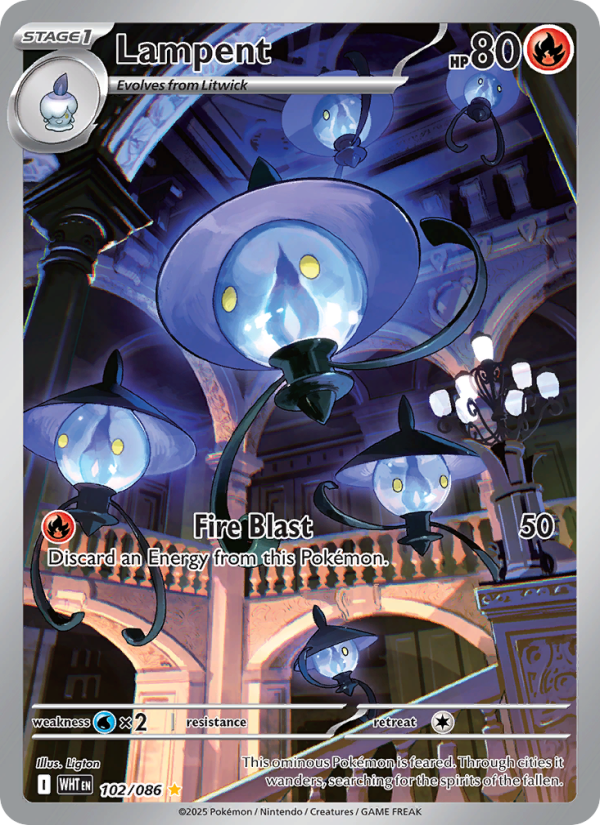
Image courtesy of TCGdex.net
Reprint Cycles and Competitive Dynamics: Lampent in Focus
Reloading old favorites into new print runs is a hallmark of the Pokémon TCG’s evolving metagame. When a card resurfaces through a reprint cycle, it doesn’t just reappear as a nostalgic option; it can reshape deck archetypes, drive new budget strategies, and nudge prices into a new zone of accessibility. Lampent, a Fire-type Stage 1 evolving from Litwick in the White Flare collection (sv10.5w), embodies how a mid-range pull from a prior era can ripple through both competitive viability and collector interest. This particular reprint cycle—captured in the 102nd slot of sv10.5w with illustrated rarity—offers a crisp lens on how players balance risk, energy management, and timing in a format that prizes flexibility as much as raw power.
From a data-driven standpoint, Lampent’s package is compact but meaningful. With 80 HP, it sits in the middle of typical Stage 1 lines, and its Fire typing aligns it with classic Sun/Moon-era or later Fire-support ecosystems that favor aggressive tempo and resource denial. Its single attack, Fire Blast, costs a Fire energy and reads: “Discard an Energy from this Pokémon.” The effect, while seemingly simple, creates a delicate dance of resource budgeting. You commit one energy to attack, and you must part with an energy from Lampent itself after resolving the hit. That creates a short window where Lampent can seed a broader plan—whether that’s feeding a Chandelure grow-out, accelerating damage pressure, or managing your bench to set up a decisive late-game swing. The retreat cost of 1 further reinforces the need to balance field presence with a compact energy economy, especially in a metagame that rewards rapid tempo shifts.
Reprints like Lampent’s in sv10.5w also illuminate how format eligibility shapes strategy. Lampent is legal in Standard and Expanded, with Regulation Mark I reflecting a period-accurate snapshot that encourages players to plan across multiple eras of play. In Standard circles, reprints often serve as entry points for newer players to experience staple mechanics without hunting down older print runs; in Expanded, they can support longer-term archetypes by renewing access to key components of a deck’s engine. For Lampent, that means more players can experiment with a Fire-centered list that pits burning pressure against defensive pivots, without being forced to chase down scarce prior prints. As a result, Lampent’s reappearance can subtly tilt the competitive balance toward decks that leverage efficient energy use and a calculated risk of discarding from a central attacker.
Collectors aren’t left out of the conversation. The sv10.5w print family includes holo, normal, and reverse variants, all carrying the “Illustration rare” designation. The rarity status matters not only for grading potential but for how players perceive the card’s long-term value as reprints drag more copies into circulation. The market data attached to Lampent’s print in White Flare—where the CardMarket average sits around 7.34 EUR and dangles between a low of 4 EUR and a recent trend approaching 6.92 EUR—illustrates a nuanced dynamic. A reprint often stabilizes supply, nudging prices downward for casual collectors while still maintaining interest among players who want reliable, playable copies. The absence of holo price specifics in every market snapshot doesn’t erase the broader signal: Lampent remains accessible enough to sustain decks that rely on its energy-discard mechanic, while still carrying a trace of rarity that can help it stand out in a card drawer or a tournament bag.
Beyond numbers, the art and lore surrounding Lampent contribute to its ongoing appeal. As a Fire-type spirit Pokémon that evolves from Litwick, Lampent embodies a transitional phase within a family that many players have come to love. A reprint cycle often re-establishes the card's presence in players’ minds, reminding them of the evocative visuals and the thematic arc that Lampent represents—fueling both nostalgia and strategic curiosity. When a card returns to print, it’s not merely a stat line; it’s a prompt to revisit how a line in a deck can function as an accelerant, a tempo tool, or a mid-game break point that reshapes risk assessment on the fly. ⚡🔥
Strategically, a Lampent reprint invites a few practical approaches for modern players. First, consider Lampent as a modular engine in Fire-aligned decks. The need to discard an energy after Fire Blast can be mitigated by pairing it with support cards that help you manage energy flow—whether that’s accelerating attachment, thinning the deck to hit the right energy types, or leveraging a bench-based plan for later-stage evolution into more powerful Fire lines. Second, Lampent’s presence broadens access to the Litwick-Lampent-Chandelure progression, a classic path that rewards careful sequencing: Litwick setups a luminous entry point, Lampent stabilizes your early game with a burn-and-rotate tempo, and Chandelure can deliver intensified late-game pressure. Reprints make this ladder more approachable, especially for players who want to test a spicy Fire strategy without investing in scarce print runs from the past. 🔥🎴
From a meta-management perspective, reprint cycles tend to soften one-off spikes in demand for a card by increasing supply while sometimes dampening the price highs reached by collectors chasing pristine, earlier printings. For Lampent, the combination of its Stage 1 status and the energy-discard mechanic creates a “reasonable power, meaningful risk” profile that remains attractive for budget decks and mid-tier competitive lists. It also serves as a reminder to players that reprint cycles are not merely about nostalgia; they’re about refreshing play options and injecting new pacing into the metagame. When Lampent pops back into standard rotation due to a reprint, you’ll likely see players experiment with tempo-rich lines that leverage the card’s ability without leaning too heavily on single-play wins. The result is a healthier, more dynamic pool from which both new and veteran players can draw.
As we track these cycles, it’s worth staying aware of the broader network of information and analysis—like the articles linked in the “More from our network” section below—that explore how constraints, cycles, and pricing interact in a real-world TCG economy. Lampent’s reprint is a microcosm of that larger phenomenon: a simple card with a strong if restrained attack can influence deck architecture, price expectations, and the stories players tell about their collections. And in a hobby where every card can spark a new strategy, Lampent’s flame continues to burn bright in the hands of those who know how to wield it. 💎🎮
Neon foot-shaped mouse pad with ergonomic memory foam wrist restMore from our network
- https://wiki.digital-vault.xyz/wiki/post/pokemon-tcg-stats-snubbull-card-id-a4-088/
- https://articles.zero-static.xyz/blog/post/why-constraints-elevate-dragons-herald-deckbuilding/
- https://blog.crypto-articles.xyz/blog/post/nft-data-kan-5908-from-kode-kan-collection-on-magiceden/
- https://articles.digital-vault.xyz/blog/post/how-alolan-marowak-balances-randomness-and-consistency-in-the-pokemon-tcg/
- https://crypto-acolytes.xyz/blog/post/nft-stats-darkness-105-from-dark-collection/
Lampent
Set: White Flare | Card ID: sv10.5w-102
Card Overview
- Category: Pokemon
- HP: 80
- Type: Fire
- Stage: Stage1
- Evolves From: Litwick
- Dex ID: 608
- Rarity: Illustration rare
- Regulation Mark: I
- Retreat Cost: 1
- Legal (Standard): Yes
- Legal (Expanded): Yes
Description
Attacks
| Name | Cost | Damage |
|---|---|---|
| Fire Blast | Fire | 50 |
Pricing (Cardmarket)
- Average: €7.34
- Low: €4
- Trend: €6.92
- 7-Day Avg: €6.99
- 30-Day Avg: €7.32
Support Our Decentralized Network
Donate 💠More from our network
- https://wiki.digital-vault.xyz/wiki/post/pokemon-tcg-stats-snubbull-card-id-a4-088/
- https://articles.zero-static.xyz/blog/post/why-constraints-elevate-dragons-herald-deckbuilding/
- https://blog.crypto-articles.xyz/blog/post/nft-data-kan-5908-from-kode-kan-collection-on-magiceden/
- https://articles.digital-vault.xyz/blog/post/how-alolan-marowak-balances-randomness-and-consistency-in-the-pokemon-tcg/
- https://crypto-acolytes.xyz/blog/post/nft-stats-darkness-105-from-dark-collection/