
Image courtesy of TCGdex.net
Kiawe Win Rate Explained: How This Celestial Guardians Supporter Finds Its Footing
In the world of the Pokémon TCG, trainers who bend the flow of energy can tilt the odds for a single turn—either to seize victory or to plant the seeds for a longer, more punishing late-game push. Kiawe, a two-star holo Trainer from Celestial Guardians (A3), is exactly that kind of card: a potent energy accelerant wrapped in a high-stakes cost. Designed by Hideki Ishikawa, Kiawe doesn’t damage or draw; it accelerates the Fire-energy engine for a dramatic payoff on a future turn. That tension—big payoff, immediate turn-ending cost—helps explain why this card can post spikes in win rate under the right conditions and slump when the format or deck discipline doesn’t line up. ⚡🔥
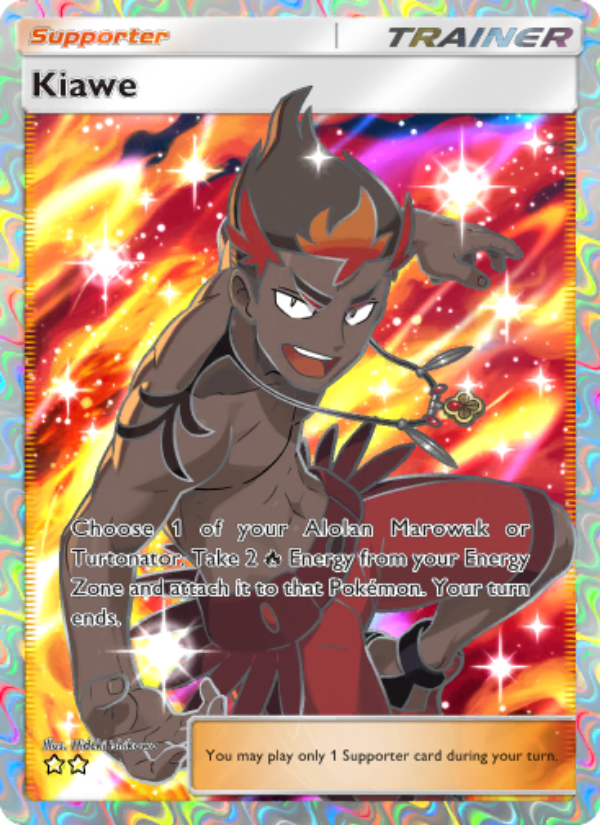
To understand its win-rate story, it helps to start with the card’s precise text: “Choose 1 of your Alolan Marowak or Turtonator. Take 2 {R} Energy from your Energy Zone and attach it to that Pokémon. Your turn ends.” This is a pure energy acceleration effect aimed at two Fire-friendly archetypes: Alolan Marowak and Turtonator. The emphasis on moving two Fire-energy cards (the {R} symbol here stands for Fire) from the Energy Zone to a chosen attacker makes Kiawe a strategic bridge between setup and payoff. It’s not a simple damage boost; it’s a deliberate, sometimes risky, acceleration that you must plan for in both turn sequencing and opponent disruption. 🎴
Who really benefits from Kiawe?
- Fire-leaning attackers get the biggest bang. Alolan Marowak and Turtonator have playlines that often hinge on rapid energy attachment to unleash a powerful attack or ability on the following turn. Kiawe’s two-energy transfer can be the difference between standing up to a heavy-hitting retaliation and getting overwhelmed. In decks that already lean into fast-fire pressure, Kiawe acts as the boost button that can tilt a game’s momentum in a single, dramatic swing. 🔥
- Turn management and tempo can be a double-edged sword. The text explicitly ends your turn, which means you’re trading immediate offense for a forced tempo shift. In the right setup—when you anticipate the opponent’s reply and can rebound quickly—Kiawe accelerates the energy economy so your next move hits hard, often early in the next turn cycle. In more conservative metagames, that turn-ending cost may feel too steep, reducing Kiawe’s adoption and thus its win-rate footprint. ⚡
- Format legality matters a great deal. Kiawe’s card data shows it’s not legal in Standard or Expanded formats. That alone sharply limits its day-to-day win-rate footprint in official events, because many players can’t include it in their preferred builds. Casual play or legacy formats may still see it shine, but competitive analysts must regard its formal viability as constrained. This is a crucial variable when evaluating its overall performance trend. 🎮
From a collector’s lens, the holo print and the distinctive art by Hideki Ishikawa add to Kiawe’s desirability. The Celestial Guardians set (A3) nests a broad roster of Trainers and Fire-types, and Kiawe’s Two Star rarity positions it as a hopeful target for collectors who chase both playability and foil aesthetics. In markets that value foil-reactive cards and set-native nostalgia, Kiawe’s appeal often outpaces its practical tournament viability, especially for folks who enjoy building thematic Fire-based decks around Marowak or Turtonator. 💎
Practical deck-building guidance and win-rate levers
When you’re constructing a Kiawe-powered Fire strategy, consider the following levers that influence win-rate outcomes:
- Energy acceleration timing: Since you must attach two Fire energies from the Energy Zone to a target, you want to maximize the odds that your next turn hits a devastating attack. Build around setups that can reuse or refresh energy quickly, so the “extra two” don’t feel wasted if your opponent disrupts your plan. Timing is everything here. ⚡
- Target selection: The choice between Alolan Marowak and Turtonator isn’t random. Depending on the rest of your lineup, Marowak might threaten with a Ghost or Fire synergy while Turtonator can deliver heavy Fire blasts with favorable energy costs. Your deck’s core plan should always revolve around creating a situation where the empowered target is about to unleash a decisive hit on the next turn. 🎴
- Disruption and recovery: Because Kiawe ends your turn, your ability to respond to post-kickback plays matters. Include cards that help you recover or protect your energy acceleration window—things that refill, draw, or mitigate the risk of being knocked out while you prepare the big move. A calm, controlled tempo often beats a desperation sprint. 🔥
- Holo advantage vs. price performance: The holo version’s shine may tilt casual-play decisions toward Kiawe acquisitions, but in formal play, its showcase value is separate from its play value. If you’re chasing wins in sanctioned events, the card’s legality matters more than its beauty. 💎
“Kiawe isn’t about sheer aggression; it’s about precision energy engineering. When you pull it off on the right turn, the payoff feels like a well-timed crescendo—fire, energy, and momentum all aligning.”
For collectors and enthusiasts, it’s worth noting that the card’s local flavor—its set, its rarity, the foil option, and the illustration—adds to its ongoing value in personal collections and trade discourse. The card’s heavier emphasis on energy acceleration makes it a historical curiosity as well as a practical toolkit for anyone exploring Fire-centric archetypes in Celestial Guardians. 🎨
Seeing the bigger picture: why Kiawe can surge or sink in win-rate contexts
The bottom line is simple but powerful: Kiawe’s potential to spike a win-rate is directly tied to whether you can leverage two critical factors—format legality and deck coherence. In Standard or Expanded events, you won’t see Kiawe making official appearances, which means its measurable impact on modern competitive win rates is largely academic or nostalgic. In casual environments or retro meta explorations that allow such cards, a well-crafted Marowak- or Turtonator-centered plan can produce dramatic, memorable matches where Kiawe’s energy sprint is the star turn. When framed this way, Kiawe becomes less of a blunt instrument and more of a deliberate, tempo-shaping instrument—one that, when timed correctly, can rewrite the expected outcome of a single, pivotal round. ⚡🎴
Phone Click-On Grip Durable Polycarbonate KickstandMore from our network
- https://blog.digital-vault.xyz/blog/post/unveiling-mega-tyranitar-pokedex-clues-and-hidden-meanings/
- https://wiki.digital-vault.xyz/wiki/post/pokemon-tcg-stats-here-comes-team-rocket-card-id-base5-15/
- https://wiki.digital-vault.xyz/wiki/post/pokemon-tcg-stats-treecko-card-id-2021swsh-3/
- https://articles.digital-vault.xyz/blog/post/relive-humankinds-top-moments-in-franchise-history/
- https://wiki.digital-vault.xyz/wiki/post/pokemon-tcg-stats-darkness-energy-card-id-dp1-129/
Kiawe
Set: Celestial Guardians | Card ID: A3-192
Card Overview
- Category: Trainer
- HP:
- Type:
- Stage:
- Dex ID:
- Rarity: Two Star
- Regulation Mark: —
- Retreat Cost:
- Legal (Standard): No
- Legal (Expanded): No
Description
Support Our Decentralized Network
Donate 💠More from our network
- https://blog.digital-vault.xyz/blog/post/unveiling-mega-tyranitar-pokedex-clues-and-hidden-meanings/
- https://wiki.digital-vault.xyz/wiki/post/pokemon-tcg-stats-here-comes-team-rocket-card-id-base5-15/
- https://wiki.digital-vault.xyz/wiki/post/pokemon-tcg-stats-treecko-card-id-2021swsh-3/
- https://articles.digital-vault.xyz/blog/post/relive-humankinds-top-moments-in-franchise-history/
- https://wiki.digital-vault.xyz/wiki/post/pokemon-tcg-stats-darkness-energy-card-id-dp1-129/