
Image courtesy of TCGdex.net
Kadabra’s Card Design: Shaped by Constraints in the Early Pokémon TCG
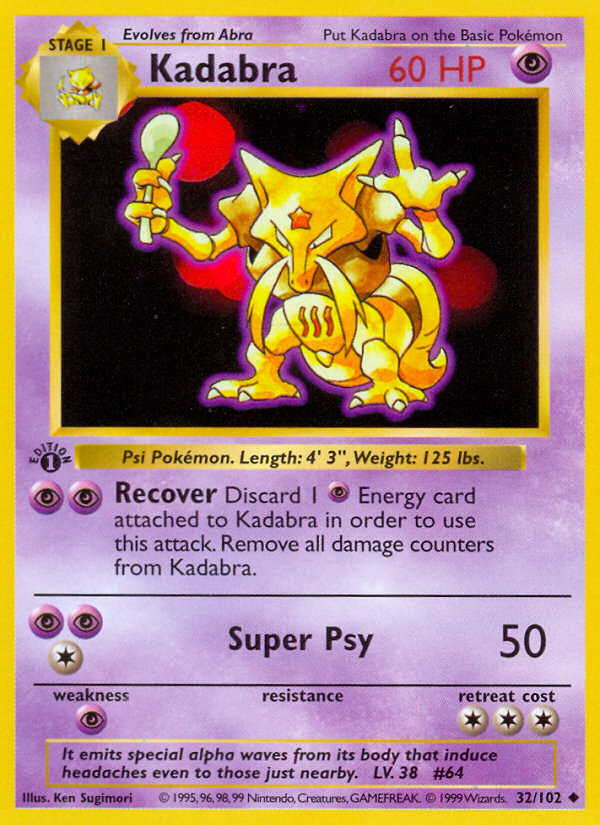
When you crack open a Base Set booster and lay out Kadabra beside Abra, you’re not just peering into a single creature’s psyche — you’re also peering into the design philosophy of Pokémon’s earliest card era. Kadabra (Base Set, 32/102) stands as a tactile lesson in how a handful of technical constraints can sculpt both the play experience and the collector’s story around a single Pokémon. Crafted by Ken Sugimori, Kadabra’s art hints at mental mastery, but the card’s mechanics reveal the tightrope walk designers faced in that era: stay engaging, stay balanced, and stay within the hardware of the time. ⚡🔥
First, Kadabra is a Stage 1 evolution, right after Abra. In the late 1990s, card designers worked under strict constraints: lower HP totals, a handful of reliable moves, and a curated energy economy meant to keep games rolling without complicated rulings. Kadabra sits at 60 HP, a number that feels modest yet purposeful for its era. It’s enough to survive a few turns under the pressure of the evolving metagame, but not so sturdy that a single misplay can never be punished. That balance invites players to think about retreat costs, energy attachment pacing, and timing for evolving — a classic tension that remains central to competitive play even as the game has evolved. 🎴
Kadabra’s two attacks illustrate how constraints guided the power ceiling. The first attack, Recover, costs Psychic ×2 and requires discarding one Energy attached to Kadabra to heal, removing all damage counters. In the context of Base Set, healing a creature was not a given premium mechanic; Kadabra’s recoverable health breaks the mold just enough to be interesting without breaking the pace. The cost-to-benefit ratio forces a careful energy plan: you must invest two Psychic energies to begin the process, then decide whether to strip energy to wipe away damage counters. It’s a design choice that rewards timing and resource management—two core competencies for players in the early days of the TCG. The second attack, Super Psy, costs Psychic ×2 plus Colorless, dealing 50 damage. That’s a respectable payoff for three energy, especially when you consider Kadabra’s role in a simple energy curve where players are building into stronger evolutions later on. The two-attack structure mirrors the era’s tendency toward straightforward, memorable hooks rather than complex combos—an accessible entry point for new players while still offering depth for veterans who prize planning ahead for Alakazam’s arrival. 💎
The very idea of an “Evolution” in Kadabra’s base card is itself a constraint-driven design choice. Abra is a pocket-sized psycher, and Kadabra is its stepping-stone — a bridge toward the more formidable Alakazam. In Base Set, many first-stage evolutions carried HP, attack costs, and damage outputs calibrated to keep early matches brisk and approachable. Kadabra’s stage-based progression also shaped trading dynamics and deck construction: players were motivated to find Abra, attempt the evolution, and then rely on Kadabra to stabilize a mid-game tempo before the big finish with Alakazam. The “evolve from Abra” constraint creates a predictable growth arc, which helps both new players learn the rules and seasoned players plan long games around the evolving threat. The tactile rhythm of drawing, evolving, and responding each turn became a hallmark of the Base Set experience. 🧠
From an artistry and production standpoint, Kadabra’s presentation reflects the era’s design constraints as well. Ken Sugimori’s illustration channels Kadabra’s psychic prowess with clean, bold lines and a confident, compact silhouette. The Base Set Kadabra is not a holo foil or an oversized centerpiece; it’s a straightforward, collectible card with a clear identity that sits neatly within a 2- or 3-ring binder and a core set of rules. The rarity designation—Uncommon—played into the economic ecosystem of the time, balancing availability with desire. First Edition variants exist for the Base Set collection (as indicated by the “firstEdition” flag in some printings), adding a layer of mystique for collectors who chase those early printings. And because this card hails from the 1999–2000 copyright window, it represents a snapshot of the era’s printing practices, layout choices, and the tactile joy of flipping a card that feels sturdy in your hand. 🗺️
The Kadabra card also offers a window into the broader market cycle for vintage Pokémon cards. In modern markets, price guidance often reflects scarcity, condition, and the card’s place in the evolution family. For Kadabra, the Cardmarket data shows an average around 2.11 EUR, with a low floor near 0.02 EUR and meaningful volatility reflected in the seven- or thirty-day trend. TCGPlayer data suggests a typical market range around 1.39 USD for many copies, with standard listings frequently landing close to the mid-price band. Those numbers aren’t just price points; they map the long arc of nostalgia, the collector’s appetite for 1st edition or shadowless variants, and the enduring appeal of a classic Psychic-type staple from the earliest days of the TCG. For players who remember drafting in cramped basements and tournaments in gyms, Kadabra’s price signals the card’s enduring presence in the hobby’s memory bank. ⚡🎴
Beyond the table, Kadabra’s licensed status and its enduring identity—an emblem of the Base Set era—illustrate how design constraints can reinforce lore. The Psychic typing, the two-energy-attempt dance, and Kadabra’s role as the mid-game spine before Alakazam arrive on the scene—all create a story of growth, not just in power but in strategic patience. The card’s silhouette, the arc of its two-arena attack costs, and its vulnerability to Psychic opponents create a memory of early formats where the board was a canvas: you priced risk, you timed your evolution, and you hoped to survive just long enough to perform a decisive crescendo with your next big hit. In that sense, Kadabra isn’t merely a card; it’s a crafted moment in time when constraints fostered clever play and lasting nostalgia. 🔮
Neoprene Mouse Pad - Round/Rectangular Non-Slip Colorful Desk PadMore from our network
- https://blog.digital-vault.xyz/blog/post/temperature-shapes-the-spectrum-of-a-hot-blue-giant/
- https://blog.crypto-articles.xyz/blog/post/nft-data-clippy-966-from-clippy-collection-on-magiceden/
- https://transparent-paper.shop/blog/post/stable-diffusion-xl-prompt-neoclassical-neon-noir-light-trails-cyberpunk-monumental-sculpture-high-contrast/
- https://blog.rusty-articles.xyz/blog/post/keen-sense-master-enchantment-and-artifact-interactions/
- https://blog.crypto-articles.xyz/blog/post/nft-data-bonks-156-from-bonks-collection-on-magiceden/
Kadabra
Set: Base Set | Card ID: base1-32
Card Overview
- Category: Pokemon
- HP: 60
- Type: Psychic
- Stage: Stage1
- Evolves From: Abra
- Dex ID: 64
- Rarity: Uncommon
- Regulation Mark: —
- Retreat Cost:
- Legal (Standard): No
- Legal (Expanded): No
Description
Attacks
| Name | Cost | Damage |
|---|---|---|
| Recover | Psychic, Psychic | |
| Super Psy | Psychic, Psychic, Colorless | 50 |
Pricing (Cardmarket)
- Average: €2.11
- Low: €0.02
- Trend: €7.09
- 7-Day Avg: €6.25
- 30-Day Avg: €3.06
Support Our Decentralized Network
Donate 💠More from our network
- https://blog.digital-vault.xyz/blog/post/temperature-shapes-the-spectrum-of-a-hot-blue-giant/
- https://blog.crypto-articles.xyz/blog/post/nft-data-clippy-966-from-clippy-collection-on-magiceden/
- https://transparent-paper.shop/blog/post/stable-diffusion-xl-prompt-neoclassical-neon-noir-light-trails-cyberpunk-monumental-sculpture-high-contrast/
- https://blog.rusty-articles.xyz/blog/post/keen-sense-master-enchantment-and-artifact-interactions/
- https://blog.crypto-articles.xyz/blog/post/nft-data-bonks-156-from-bonks-collection-on-magiceden/