
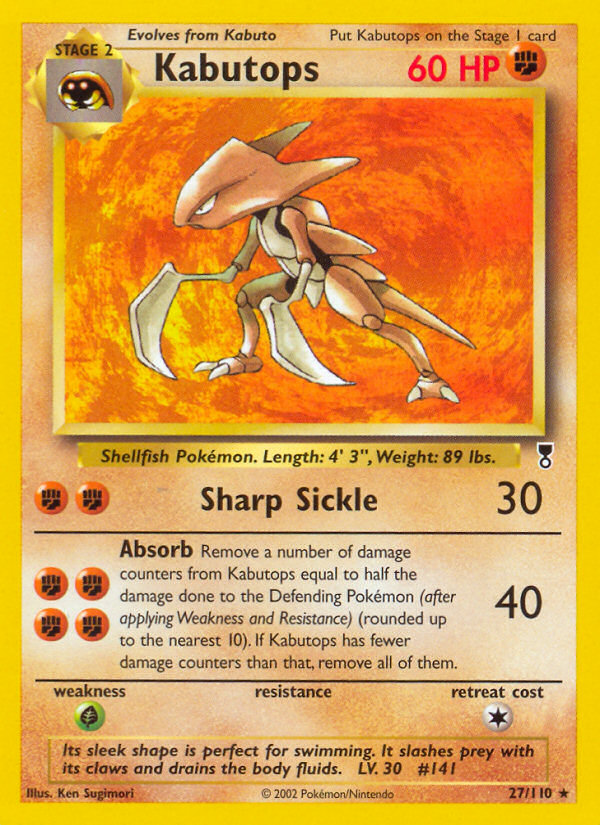
Image courtesy of TCGdex.net
Timeless Allure: Kabutops from Legendary Collection
Among the sea of reprints and reimaginings that fill the Pokémon TCG landscape, some cards endure not because they dominate in power but because they spark a shared memory. Kabutops from Legendary Collection is one of those cards. Its enduring appeal rests on a blend of nostalgia, artistic charm, and a design that speaks to the era when trainers first learned to balance risk and reward across a fossil-fueled deck. This is a card that invites collectors to celebrate both the franchise’s history and the tactile joy of vintage play—an artifact that looks as good on display as it does in a sleeve during a casual throwback game. ⚡🔥
First, the card’s place in history is clear: it’s a Rare Fighting-type Stage 2 Pokémon that evolves from Kabuto, part of the Legendary Collection, a set officially counting 110 cards. The artwork, credited to Ken Sugimori, captures Kabutops with its signature gleaming scythe blades and a poised, predator-ready stance. The Legendary Collection edition is known for its distinctive border and the reverence fans hold for these reprints—cards that evoke the original gym battles and early tournaments while offering a refreshed, glossed finish. The fact that this Kabutops exists in both a normal (non-holo) and a reverse-holo variant adds a subtle but meaningful dimension to its collectibility, appealing to both players and display-minded fans. The set symbol and the iconic Sugimori artistry make it instantly recognizable to anyone who cut their TCG teeth in the Fossil era. 🎴
Mechanically, Kabutops is a compact but thoughtful piece in vintage-style decks. With 60 HP and a Fighting-type identity, it leans into a Greener/Wooded weakness dynamic—Grass is its notable vulnerability, with a ×2 multiplier that heightens the risk against certain foes. Its two attacks reveal a classic design philosophy: attack versatility paired with resource-managed sustainability. Sharp Sickle costs two Fighting, delivering 30 damage—a quick, aggressive poke that can pressure opponents while setting up for larger plays. The follow-up, Absorb, is where the card’s cleverness shines: four Fighting energy for 40 damage, but with a built-in healing twist. The text states that you remove damage counters from Kabutops equal to half the damage dealt to the Defending Pokémon (rounded up to the nearest 10), with a safeguard that prevents removing more counters than Kabutops currently has. This creates teachable moments about timing, energy management, and the psychology of trading HP for momentum. It’s a design that rewards patient planning as well as bold bursts, a balance many players remember when they reflect on their earliest matchups. 🔥
From a collector’s lens, the card’s timelessness comes from both its rarity and its representation of a beloved era. The Legendary Collection is especially cherished for its triad of reprint style—cards that feel both familiar and newly polished. Kabutops’ rare print, paired with the possibility of a reverse holo variant, invites players to chase condition, alignment to the set symbol, and the nostalgic thrill of pulling a card that feels like it belongs in the very first fossil line many players discovered. The contrast between the normal (standard) print and the reverse holo variant also helps explain market dynamics: the latter commands a premium because it’s a scarce aesthetic variation within an already limited print run. Card pricing data reflects that contrast clearly, with the non-holo values typically sitting in the low-to-mid single digits, while the reverse holo version climbs into the tens and even higher for pristine specimens. In recent market snapshots, you’ll see non-holo Kabutops in the roughly $3–9 range, while reverse holos can fetch well into the $60–$200 territory on major platforms, with typical market prices hovering around the $95 mark for well-preserved examples. This disparity underscores why collectors prize the reverse variant as a keystone in many 2000s collections. 💎
What keeps this Kabutops timeless isn’t merely the numbers on a card back, but the narrative of its art and its place in the fossil lineage of the Pokémon universe. Ken Sugimori’s illustration captures a moment of poised menace—Kabutops’ slashing blades, the weight of fossilized history in every line, and a vibe that instantly says “classic.” Collectors who built their early binders around the slow, deliberate tempo of the original games remember Kabuto’s evolution. In Legendary Collection, Kabutops embodies a bridge between the first generation’s fossil era and the modern TCG’s increasingly complex mechanics, a bridge that remains visible in a single, striking card. This is why so many fans reserve space on their shelves for it: it’s not just a card to prize; it’s a memory, a taste of the formative years, and a testament to the enduring appeal of a well-crafted pocket monster. ⚡🎨
For those who curate with a more practical eye, there are several timeless cues to watch for when evaluating Kabutops returns in a collection. First, verify the variant: the set’s Legendary Collection reprint is often sold in both normal and reverse holo forms, so confirm the presence or absence of holo foiling in the card’s label and border finish. Secondly, study the card’s condition in relation to the set’s print run—110 cards total, with a handful of highly sought versions, makes condition a meaningful driver of value. Third, appreciate the provenance: this card’s value is reinforced by its artwork, its set pedigree, and the nostalgia that powers demand across both long-time fans and newer collectors who chase the “classic” aesthetic. The lure isn’t solely about current play viability, which is limited in modern formats, but about a lasting sense of identity and storytelling within the Pokémon saga. ⚡💎
Phone Case with Card Holder — Clear PolycarbonateMore from our network
- https://blog.crypto-articles.xyz/blog/post/nft-data-60-from-the-magnificent-seven-collection-on-magiceden/
- https://transparent-paper.shop/blog/post/stable-diffusion-xl-prompt-bio-mecha-mantis-idol-ornate-fililgii-liquid-chrome-mauve-and-greek-marble-white-neoclassical-sci-fi/
- https://crypto-acolytes.xyz/blog/post/color-magnitude-diagram-reveals-youth-of-a-hot-blue-star/
- https://transparent-paper.shop/blog/post/stable-diffusion-xl-prompt-pixel-art-islamic-geometric-art-medieval-fantasy-peeling-paint-texture-purple-and-gold-palette-ornate-tessellation/
- https://crypto-acolytes.xyz/blog/post/nuddies-795-nuddies-nft-stats/
Kabutops
Set: Legendary Collection | Card ID: lc-27
Card Overview
- Category: Pokemon
- HP: 60
- Type: Fighting
- Stage: Stage2
- Evolves From: Kabuto
- Dex ID: 141
- Rarity: Rare
- Regulation Mark: —
- Retreat Cost:
- Legal (Standard): No
- Legal (Expanded): No
Description
Attacks
| Name | Cost | Damage |
|---|---|---|
| Sharp Sickle | Fighting, Fighting | 30 |
| Absorb | Fighting, Fighting, Fighting, Fighting | 40 |
Pricing (Cardmarket)
- Average: €3.81
- Low: €0.7
- Trend: €5.15
- 7-Day Avg: €4.05
- 30-Day Avg: €4.24
Support Our Decentralized Network
Donate 💠More from our network
- https://blog.crypto-articles.xyz/blog/post/nft-data-60-from-the-magnificent-seven-collection-on-magiceden/
- https://transparent-paper.shop/blog/post/stable-diffusion-xl-prompt-bio-mecha-mantis-idol-ornate-filigree-liquid-chrome-mauve-and-greek-marble-white-neoclassical-sci-fi/
- https://crypto-acolytes.xyz/blog/post/color-magnitude-diagram-reveals-youth-of-a-hot-blue-star/
- https://transparent-paper.shop/blog/post/stable-diffusion-xl-prompt-pixel-art-islamic-geometric-art-medieval-fantasy-peeling-paint-texture-purple-and-gold-palette-ornate-tessellation/
- https://crypto-acolytes.xyz/blog/post/nuddies-795-nuddies-nft-stats/