

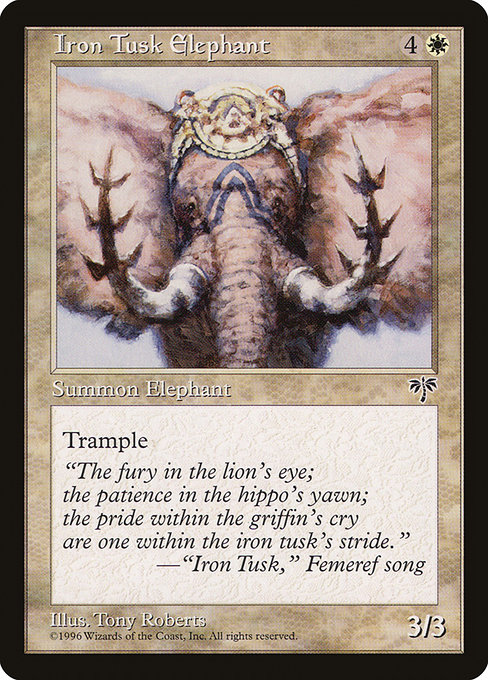
Image courtesy of Scryfall.com
Long-Term Value in MTG Finance: Iron Tusk Elephant as a Case Study
When we talk about MTG finance, the conversation often centers on high-dollar staples, chase foils, and the ever-looming risk of reprints. Yet some of the most instructive stories arrive from quieter corners of the card pool—uncommons and older printings that drift through casual play, cube drafts, or the odd Legacy list. Iron Tusk Elephant, a Mirage-era creature with a simple stat line and a single keyword, offers a surprisingly rich lens on how long-term value can accrue in ways that aren’t always obvious at first glance. 🧙♂️🔥💎
At first glance, this 5-mana white (4W) 3/3 with Trample looks like a pedestrian beater in a color that often leans toward efficiency and evasion. But the story behind Iron Tusk Elephant is less about raw power and more about print history, format breadth, and the quiet engines of demand that drive long-horizon value. The Mirage era—released in 1996—sits in a period when rarities and mechanics were still being explored at scale. A nonfoil, uncommon creature from that time is a snapshot of design trends, and those snapshots become relevant for collectors and players who love the tactile nostalgia of early Magic. 🧲
Card Snapshot: what makes Iron Tusk Elephant tick
- Name: Iron Tusk Elephant
- Set: Mirage (1996)
- Mana Cost: 4W
- Type: Creature — Elephant
- Power/Toughness: 3/3
- Rules Text: Trample
- Rarity: Uncommon
- Color: White
- Flavor Text: “The fury in the lion's eye; the patience in the hippo's yawn; the pride within the griffin's cry are one within the iron tusk's stride.” —"Iron Tusk," Femeref song
The card’s flavor text is more than decoration; it’s a microcosm of the Mirage era’s poetic ambition. Tony Roberts’ artwork (a hallmark of Mirage prestige) captures a stoic, ancient presence that evokes a sense of guarded power. For collectors, that flavor—paired with a distinctive black-border frame and a relatively scarce print run for an uncommon—adds a layer of narrative value that can seep into price appreciation over time. And yes, the aesthetic vibe matters: a well-preserved Iron Tusk Elephant can beas collectible as it is playable. 🎨⚔️
Why this matters for long-term value
The long view in MTG finance isn’t just about today’s demand; it’s about structural factors that persist across formats and across decades. Iron Tusk Elephant’s Mirage printing means it carries the nostalgia of early multiplayer-style design, where big, trample bodies were prized for their ability to pressure an opponent even when life totals were stubbornly high. The card’s current price—around $0.19 USD (with non-foil showing similar leverage in the low dollar range) and even lower in euros—reflects its status as a niche collectible and a casual-friendly pick. In other words, it’s not a marquee staple, but it’s a quiet anchor in a diverse portfolio of older prints. 🧭
Prime drivers for long-term value in this corner of the market include: - Format longevity: The card remains legal in Legacy and Vintage, and Commander lists occasionally splash older white creatures for their resilience, thematic appeal, or synergy with control and midrange shells. - Print risk and supply: Mirage is not a modern reprint machine, but it isn’t on the Reserve List either, which means Wizards could revisit the art or mechanics in a future set. That reprint risk tends to cap, rather than catapult, price trajectories, but it also creates a floor in price stability over time—especially for buyers who seek a historical angle rather than explosive gains. 🔍 - Playability in cubes and casuals: A white trampler with a sturdy body can anchor a green-white or white-centric cube deck’s beefy curve, keeping demand alive in non-competitive circles. - Aesthetic and storytelling value: The combined effect of art, flavor, and a well-aged card stock adds intangible value that many investors value alongside raw numbers. 🧩
In practice, a card like Iron Tusk Elephant teaches us to weigh both playability and provenance. While it’s not a modern-day flagship, it has a legible story and a clear niche that can support gradual appreciation as interest in Mirage-era magic continues to endure. And for players who prize a design that embodies the era’s flavor, this Elephant is more than a statistic—it’s a memory on a card. 🧙♂️
“The fury in the lion's eye; the patience in the hippo's yawn; the pride within the griffin's cry are one within the iron tusk's stride.”
— Iron Tusk
To bring a bit of real-world synergy into the discussion, consider protecting and displaying these pieces with a modern touch. Our Neon Card Holder Phone Case is a playful nod to collecting culture in the age of smartphones and tabletop gaming—a reminder that the hobby isn’t just about stock and stair-step prices, but about the shared joy of cards, stories, and friends gathered around the table. If you’re curious, you can check it out here:
Neon Card Holder Phone Case (MagSafe, Polycarbonate)
How to approach Iron Tusk Elephant in today’s MTG finance mindset
For collectors, this card is a reminder that value isn’t always tied to punchy competitive archetypes. In the long game, you’re looking at a tapestry of factors—format relevance, print history, and the collector’s pulse. If you’re assembling a personal collection with a timeline in mind, a Mirage uncommon like Iron Tusk Elephant has a modest cost barrier and a storied pedigree that can be rewarding when you revisit it years later. For players, it’s a neat, budget-friendly option that can slot into white creature-heavy lists in casual rotations, or serve as a nostalgia pick for those who remember Mirage's early days with fond affection. 🪙
The takeaway: in MTG finance, the most resilient narratives aren’t always the loudest. They are the ones that survive shifts in format, printing strategies, and player tastes. Iron Tusk Elephant embodies a quiet perseverance—the kind that can lead to steady, rather than sensational, value growth, while still delivering a satisfying, tactile connection to the game’s history. ⚖️
If you’re curious about more historical taps into MTG finance, these sources from our network offer a spectrum of data and storytelling around collectibles, markets, and nerdy nuance:
More from our network
Iron Tusk Elephant
Trample
ID: d7c8e952-f040-4e5b-88f3-f80ad4b3f2f1
Oracle ID: a299470a-72ea-4848-833b-dc894db7be15
Multiverse IDs: 3497
TCGPlayer ID: 5108
Cardmarket ID: 8277
Colors: W
Color Identity: W
Keywords: Trample
Rarity: Uncommon
Released: 1996-10-08
Artist: Tony Roberts
Frame: 1997
Border: black
EDHRec Rank: 29547
Set: Mirage (mir)
Collector #: 22
Legalities
- Standard — not_legal
- Future — not_legal
- Historic — not_legal
- Timeless — not_legal
- Gladiator — not_legal
- Pioneer — not_legal
- Modern — not_legal
- Legacy — legal
- Pauper — not_legal
- Vintage — legal
- Penny — not_legal
- Commander — legal
- Oathbreaker — legal
- Standardbrawl — not_legal
- Brawl — not_legal
- Alchemy — not_legal
- Paupercommander — not_legal
- Duel — legal
- Oldschool — not_legal
- Premodern — legal
- Predh — legal
Prices
- USD: 0.19
- EUR: 0.12
- TIX: 0.09
More from our network
- https://articles.digital-vault.xyz/blog/post/conductor-of-cacophony-when-to-prioritize-in-draft-picks/
- https://blog.zero-static.xyz/blog/post/sidisi-undead-vizier-card-typography-and-layout-deep-dive/
- https://blog.crypto-articles.xyz/blog/post/nft-data-malware-917-from-malware-relics-collection-on-magiceden/
- https://wiki.digital-vault.xyz/wiki/post/pokemon-tcg-stats-weavile-card-id-dp3-40/
- https://transparent-paper.shop/blog/post/distant-hot-star-radiates-tens-of-thousands-of-suns/