

Image courtesy of Scryfall.com
Exploring Spike Weaver: Art, Color Theory, and Counterplay
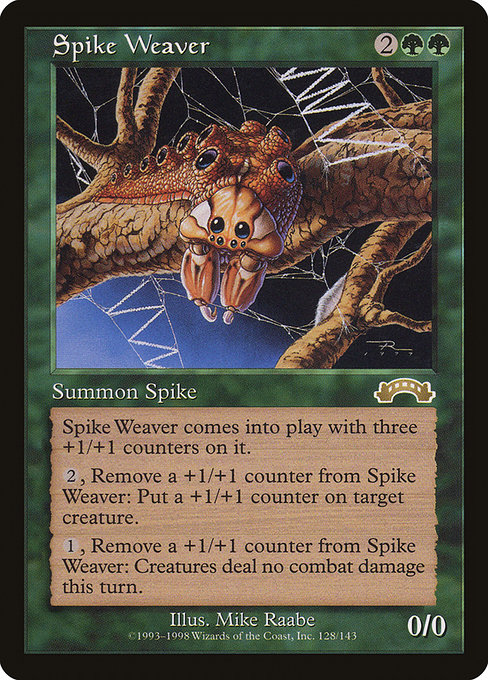
For green mana lovers and counter-obsessed strategists alike, Spike Weaver is a plant-nerve center of design and production that still sparks conversation decades after its Exodus debut. Created by Mike Raabe, this rare Spike sits comfortably in a black-bordered frame that screams late-90s MTG nostalgia while packing a modern beat of gameplay slickness. The card itself is a creature—Spike, not a sapling—with a mana cost of {2}{G}{G}, signaling that big green punch was supposed to come with a patient, growth-oriented tempo. And spike-tittering aside, the real engine here is the counter mechanic: Spike Weaver enters the battlefield with three +1/+1 counters and two activated abilities that hinge on removing those counters to fuel other effects. It’s a design that gifts green with both resilience and tempo in a single, elegant package 🧙♂️🔥.
Artistically, the piece captures a sense of living architecture—spike-like thorns entwined with verdant growth—embodying green's core themes: proliferation, natural armor, and transformative presses on the battlefield. The art’s composition suggests movement and regulation at once: you see a creature that looks ready to surge, but it’s also tethered, almost as if the counters are a visible form of the creature’s vitality. It’s a visual metaphor for how green can turn incremental gains into durable advantages. In a sense, Spike Weaver invites you to imagine not just what a creature can do on the turn it enters, but how it can set the stage for the rest of your board state as counters accumulate and are spent with surgical precision 🎨.
“The trick here is to make the counters feel tactile, like you’re manipulating the levers of growth,” says Raabe in a hypothetical interview about the Exodus era’s approach to green creatures. “The art should imply that every +1/+1 is earned, not granted, and every spend could flip the game in a heartbeat.”
From a production standpoint, Spike Weaver sits in Exodus’s early-peak era when Wizards of the Coast used painterly, hand-crafted art in a world of increasingly sophisticated color-separation printing. The card’s black frame and the comparatively restrained art direction reflect a period when the iconography of counters and growth was not just a mechanical idea but a thematic one. The illustration by Mike Raabe works within the 1997 frame style, leveraging bold greens and a confident silhouette to communicate “growth in place” as opposed to “growth in a vacuum.” It’s a reminder that in those days, the art often did double duty: evoking flavor while hinting at the card’s mechanical identity—entering with three +1/+1 counters, a literal supply of potential energy that players would tap into again and again ⚔️.
Mechanically, Spike Weaver’s two abilities both pivot on managing those counters. First, paying two mana and removing a +1/+1 counter to put a +1/+1 counter on a target creature rewards patient, tempo-positive play. This is Green’s classic “growth through investment” vibe: you pay some cost now to empower another creature (and, in the process, you can bolster your board’s overall resilience). It invites a broad spectrum of uses—from buffing a midrange beater to enabling a shy proliferate sequence later in the game. Second, paying one mana and removing a counter to prevent all combat damage this turn embodies a defensive utility that’s deceptively potent in the right shells. It’s not just a stall; it’s a strategic shield that translates a handful of counters into a window for your plans to unfold. This dual-path design—button-press growth or a one-turn shield—gives Spike Weaver surprising staying power in green-centric decks, especially when paired with other +1/+1-counter engines 🧙♂️💎.
In commander circles, Spike Weaver shines as a value-adding support creature in mono-green or multi-green builds. The card’s power level sits comfortably in the “swingy late-game threat” zone: your board grows block by block, and those counters become currency you can spend to accelerate your board state or to defensive purposes when needed. The rarity (rare) and Exodus’s era positioning also make it a collectible touchstone for players chasing the full green counterplay arc—from Naya-wide growth toул synergy with like-minded counter producers. For players who enjoy clean lines of play and the satisfaction of incremental improvements that accumulate into a late-game threat, Spike Weaver provides a classic blueprint: growth through careful spending, with just enough protection to stay sticky on the board 🔥🎲.
As a production artifact, Spike Weaver reminds us that design choices travel from pencil to print. The two-counter mechanic predates proliferate-heavy designs that would come later, yet it remains a robust example of how a single card can cradle multiple strategic lanes. The art’s sense of organic, almost architectural growth pairs beautifully with the green mana identity, and the mechanical text remains readable and punchy—a hallmark of Exodus-era clarity amid a rapidly expanding card ecosystem. If you’re a collector who appreciates the intersection of art, mechanics, and historical context, Spike Weaver is a compact case study in how a single creature can anchor a broader strategy while staying true to its designer’s vision 🧙♂️🎨.
For fans who want to see more of the same passion across the MTG multiverse, this card sits alongside other green powerhouses that emphasize growth counters and resilient defenses. It’s not just about what you can do on the turn you cast it; it’s about how the counter economy shapes your decisions in each phase, each combat step, and every time you tap for value. Spike Weaver invites a conversation about design intent, production realities, and the way a single illustration can carry a philosophy about how a card should be played—layer by layer, turn by turn, counter by counter 🔎💡.
Rugged Phone Case 2-Piece ShieldProduct linked for readers who enjoy a little Armor on the go—because MTG battles aren’t the only things getting ruged these days 🛡️📱
More from our network
- https://crypto-acolytes.xyz/blog/post/nft-stats-retardio-traits-s0-tired-blue-from-retardio-traits-collection/
- https://blog.rusty-articles.xyz/blog/post/hidden-details-in-war-elephants-mtg-illustration/
- https://blog.rusty-articles.xyz/blog/post/dross-scorpion-in-token-based-black-decks-strategies-and-synergies/
- https://crypto-acolytes.xyz/blog/post/nft-stats-bitcreep-83-from-the-bitcreeps-collection/
- https://blog.zero-static.xyz/blog/post/inferno-elemental-draws-non-mtg-collector-demand-for-mtg/
Spike Weaver
This creature enters with three +1/+1 counters on it.
{2}, Remove a +1/+1 counter from this creature: Put a +1/+1 counter on target creature.
{1}, Remove a +1/+1 counter from this creature: Prevent all combat damage that would be dealt this turn.
ID: 9c561a2a-91c6-4d4b-9f96-bffd43a00478
Oracle ID: 7776b2dd-5795-458d-81da-54fed22d5ee2
Multiverse IDs: 6152
TCGPlayer ID: 4414
Cardmarket ID: 9356
Colors: G
Color Identity: G
Keywords:
Rarity: Rare
Released: 1998-06-15
Artist: Mike Raabe
Frame: 1997
Border: black
EDHRec Rank: 9865
Set: Exodus (exo)
Collector #: 128
Legalities
- Standard — not_legal
- Future — not_legal
- Historic — not_legal
- Timeless — not_legal
- Gladiator — not_legal
- Pioneer — not_legal
- Modern — not_legal
- Legacy — legal
- Pauper — not_legal
- Vintage — legal
- Penny — not_legal
- Commander — legal
- Oathbreaker — legal
- Standardbrawl — not_legal
- Brawl — not_legal
- Alchemy — not_legal
- Paupercommander — not_legal
- Duel — legal
- Oldschool — not_legal
- Premodern — legal
- Predh — legal
Prices
- USD: 5.02
- EUR: 2.98
- TIX: 1.20
More from our network
- https://blog.digital-vault.xyz/blog/post/blue-hot-star-at-two-thousand-parsecs-illuminates-the-billion-star-catalog/
- https://wiki.digital-vault.xyz/wiki/post/pokemon-tcg-stats-blastoise-card-id-bw8-137/
- https://blog.crypto-articles.xyz/blog/post/nft-data-midevil-3654-from-midevils-collection-on-magiceden/
- https://blog.digital-vault.xyz/blog/post/tracking-bramblecrushs-silver-border-price-volatility/
- https://blog.digital-vault.xyz/blog/post/marshal-of-the-lost-modern-mtg-card-art-trends-revealed/