
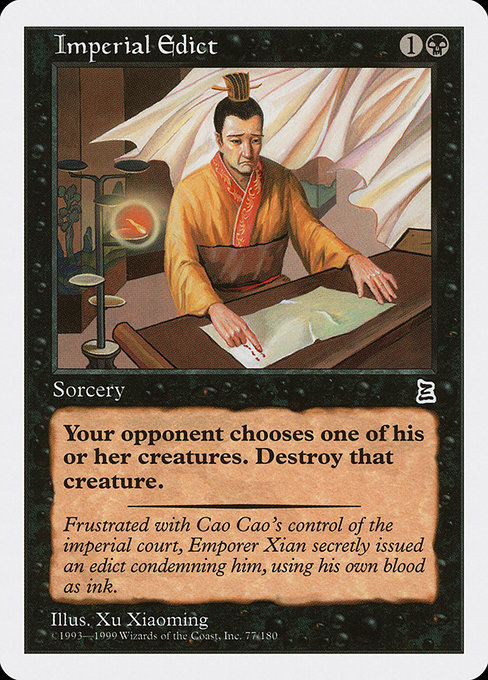
Image courtesy of Scryfall.com
Dark Edicts and the Battlefield’s Political Dance
In the grand tapestry of Magic lore, some spells are not just about saying “I win” with brute force; they sing a tune of negotiation, risk, and timing. Imperial Edict (Portal Three Kingdoms) is a lean, bite-sized lesson in board control. For a modest {1}{B} mana cost, you cast a sorcery that forces your opponent to decide a fate for their own army: “Target opponent chooses a creature they control. Destroy that creature.” It’s not flashy, but oh, is it flavorful 🧙♂️🔥💎. The spell teaches the player to anticipate reactions, read the room, and navigate the multi-way stakes of a shared battlefield.
Flavor text: “Frustrated with Cao Cao's control of the imperial court, Emperor Xian secretly issued an edict condemning him, using his own blood as ink.”
The card sits in Portal Three Kingdoms, a 1999 starter set that’s famous for stepping outside the usual fantasy frame and leaning into historical storytelling with Chinese lore. Imperial Edict is a common_black spell with a surprising punch: it gives the political side of a duel a foothold on a physical board. The art by Xu Xiaoming captures a tense moment of imperial decree, while the white border and era-appropriate typography remind collectors and players alike of a time when Magic was debating how far a sorcery could bend a matchup before it bent a player’s patience.
From a design perspective, the mechanic is refreshingly elegant. The spell doesn’t tell you which creature to destroy; it lets the controller of the board (the non-caster) decide which of their own creatures falls. That small amount of agency creates a dynamic where you’re trading knowledge of your opponent’s plans for a controlled outcome on the battlefield. It’s the kind of effect that shines in multiplayer formats, where players jockey for position and virtue signaling matters as much as removal itself ⚔️🎲.
Stat-wise, Imperial Edict is a two-mana card with a low risk and a high potential for political play. It’s legal in Commander and many eternal formats, a reminder that an ancient, common black spell can still influence modern playstyles long after its first printing. In terms of value, it’s not the flashiest pickup in a collection—priced in the couple-dollar range according to current data—but its memories, lore ties, and historical curiosity elevate it beyond mere numbers. For a nostalgia-driven table or a low-budget political deck, it’s a treasure 💎.
Strategically, you’ll want to think about timing and the social contract of your format. In a 3–4 player game, casting Imperial Edict on a turn when a rival’s board state looks particularly threatening can create a temporary window for you to navigate the battlefield’s shifting currents. Because the target opponent picks a creature they control, you’re inviting a negotiation with a fellow player who may try to lean on you later for favors or protection. The card rewards social pressure, but it also invites back-and-forth trading—after all, forcing someone to sacrifice a key blocker or a mana generator can be worth a temporary liability if you can exploit the moment that follows 🧙♂️🔥.
When drafting or building around this spell, think about synergy with black’s suite of removal, hand disruption, and graveyard interactions. If you pair Imperial Edict with effects that punish overcommitment—say, mass removal or drain effects—you can shepherd the board into a state where the opponent’s creature choice becomes a point of leverage you can capitalize on later. It’s also a nice study in tempo: you pay a small price to flatten a plan that looked dangerous on your opponent’s next turn, all while preserving your own life total and board presence for the long game. And because your opponents know you can influence which creature dies, you can anticipate their choices and adjust your plan mid-game with a smile and a wink 🧙♂️⚔️.
For collectors and history buffs, Imperial Edict is a window into Portal Three Kingdoms’ unique flavor. The set’s art direction, flavor text, and its position as a bridge between classic Magic aesthetics and historical storytelling offer a distinctive flavor profile that fans remember fondly. The card’s low rarity doesn’t diminish its storytelling power; it enhances it by making every copy feel like a rare find that carries a moment from a past set into today’s long-running narrative. In a world of mythic rares and flashy combos, a small, well-placed Edict can still teach a player how to read the room and influence the round without shouting from the rooftops 🎨🎲.
For players curious about the broader magic of board control, Imperial Edict is a case study in restraint, cunning, and shared risk. It invites you to think hard about what it means to control a board when control is not absolute—only negotiated and endured. The result is not just a destroyed creature; it’s a reminder that sometimes the most potent spells in the game are the ones that compel others to reveal their intent, one creature at a time. And that, my friends, is the essence of a well-played edict 🧙♂️💎.
What to watch for in gameplay
- Timing matters: cast when a single creature poses a clear threat to your life total or game plan.
- In multiplayer, leverage the political dimension to influence how others view you—sometimes making yourself a swing vote is the real win.
- Don’t overlook the flavor: the flavor text’s historical mood can guide how you present your intentions at the table.
More from our network
- https://crypto-acolytes.xyz/blog/post/nft-stats-tardio-1766-from-tardio-collection/
- https://blog.crypto-articles.xyz/blog/post/nft-data-geek-1767-from-geeks-collection-on-magiceden/
- https://defiacolytes.zero-static.xyz/28bededf.html
- https://wiki.digital-vault.xyz/wiki/post/pokemon-tcg-stats-gloom-card-id-sv035-044/
- https://transparent-paper.shop/blog/post/how-to-build-chatbots-that-boost-user-engagement/
Imperial Edict
Target opponent chooses a creature they control. Destroy that creature.
ID: c5a7f91d-b4ee-45c1-a229-bb23daf68e6b
Oracle ID: ac2b3adb-45bb-4f56-9d52-e08771164b35
Multiverse IDs: 10515
TCGPlayer ID: 475
Cardmarket ID: 11270
Colors: B
Color Identity: B
Keywords:
Rarity: Common
Released: 1999-05-01
Artist: Xu Xiaoming
Frame: 1997
Border: white
EDHRec Rank: 27420
Set: Portal Three Kingdoms (ptk)
Collector #: 77
Legalities
- Standard — not_legal
- Future — not_legal
- Historic — not_legal
- Timeless — not_legal
- Gladiator — not_legal
- Pioneer — not_legal
- Modern — not_legal
- Legacy — legal
- Pauper — legal
- Vintage — legal
- Penny — not_legal
- Commander — legal
- Oathbreaker — legal
- Standardbrawl — not_legal
- Brawl — not_legal
- Alchemy — not_legal
- Paupercommander — legal
- Duel — legal
- Oldschool — not_legal
- Premodern — not_legal
- Predh — legal
Prices
- USD: 2.67
- EUR: 1.14
More from our network
- https://crypto-acolytes.xyz/blog/post/nft-stats-bonk500-189-from-bonk-500-collection/
- https://wiki.digital-vault.xyz/wiki/post/pokemon-tcg-stats-pangoro-card-id-sm6-78/
- https://wiki.digital-vault.xyz/wiki/post/pokemon-tcg-stats-combee-card-id-dp7-57/
- https://wiki.digital-vault.xyz/wiki/post/pokemon-tcg-stats-hops-corviknight-card-id-sv09-108/
- https://wiki.digital-vault.xyz/wiki/post/pokemon-tcg-stats-carvanha-card-id-sv03-046/