

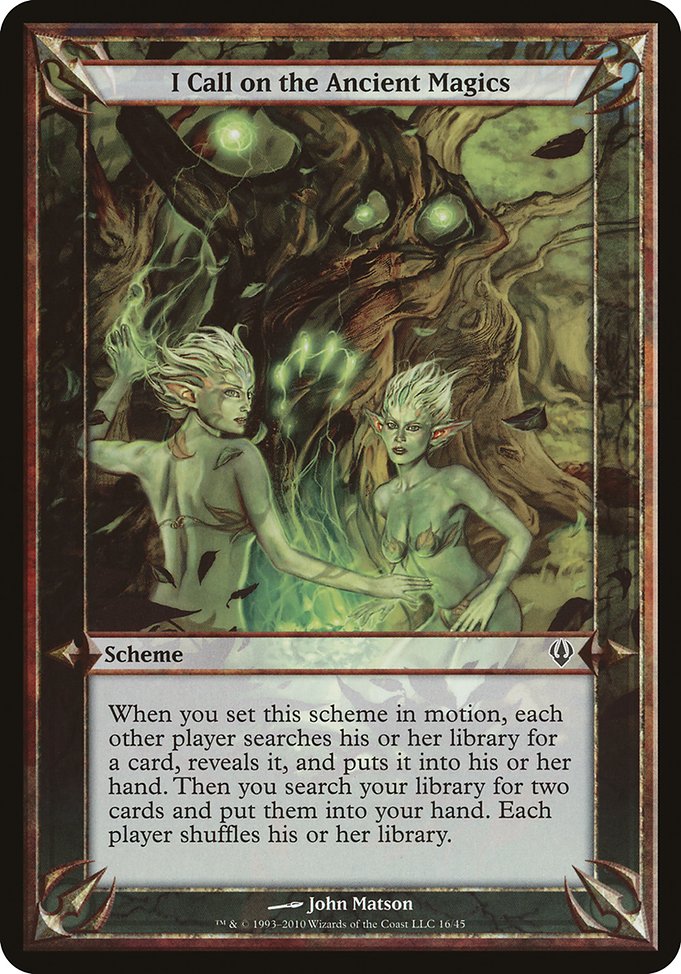
Image courtesy of Scryfall.com
Performance Across Rotating MTG Sets
Magic: The Gathering has always thrived on the clash between grand design and player agency. When you glimpse a card like I Call on the Ancient Magics, you’re reminded of how a single, ingenious effect can ripple across formats and playstyles, long after a set rotates out of standard. This colorless scheme from the Archenemy Schemes block—released in 2010—reads like a manifesto for multiplayer power dynamics: a moment of collective action that reshapes hands, libraries, and tempo all at once. 🧙♂️🔥💎
A quick read on the card’s core power
Staffed with a zero mana cost and a zero color identity, the scheme’s text is deceptively simple: when you set this scheme in motion, each other player searches their library for a card, reveals it, and puts it into their hand. Then you search your library for two cards and put them into your hand. Each player shuffles. The net effect is a mutual exchange of resources, but the balance tilts toward you in one critical way: you get two cards for every opponent’s single card. In a roundtable of three or more, that translates into a substantial draw advantage for the caster, at the literal cost of everyone else’s options being nudged into view. It’s a masterclass in political, non-dueling play. ⚔️🎨
The card’s rarity is listed as common, yet its impact sits squarely in the realm of high leverage—especially in casual or Commander-style games where the social contract and number of players can swing the outcome. The law of large numbers helps you recoup more value the more participants there are. And because the text doesn’t require colored mana, the scheme can slot into any color combination or mana base without complicating your early turns. This makes it a perennial talking point whenever people discuss longitudinal performance across sets and formats. 🧙♂️
Across formats: where this card shines and where it treads carefully
In Standard or most competitive environments, a scheme like this is not a typical fit due to its multiplayer-centric, non-interactive rhythm and card-drawing tilt. However, in Commander, Oathbreaker, or casual multi-player arenas, I Call on the Ancient Magics can catalyze dramatic turns, shaky alliances, and memorable moments. Its influence persists across rotating sets because the underlying mechanic—schemes in motion—remains a thematic anchor for multiplayer design. As newer sets come and go, the card’s effectiveness is less about raw numbers and more about the social architecture of the table: who holds the most leverage, who’s willing to cooperate, who’s prepared to pivot when an opponent suddenly profits from two fresh draws. 🧙♂️💎
From a design perspective, the arc of this card across sets highlights a fascinating balance: a zero-cost scheme that creates asymmetrical advantage without requiring color investment. That’s a thread modern designers tug at when evaluating how to support multi-player formats within rotating sets. It’s also a reminder that the most lasting MTG innovations aren’t always the flashiest; sometimes they’re the quietest, a rule-dense concept expressed as a single, elegant line of text. The artistry—courtesy of John Matson—paints a world where ancient knowledge stirs in the margins of the table, ready to reshape the game with a whisper and a reveal. 🎲🎨
Market vibes and collectibility
For collectors and historians of the game, I Call on the Ancient Magics offers a snapshot of Archenemy’s experimental approach. The card appears in a 2010 printing with a star-coated collector number (16★), hinting at special or foil-seeded importance within the set. While the nonfoil version trades around a modest price point in the single-digit range on Scryfall’s market data, the card’s value as a discussion piece—about strategy, politics, and the evolution of multiplayer design—remains strong. The true treasure isn’t just the balance of power on the tabletop; it’s the memory of those games where a well-timed two-card grab shifted the table’s attention and sparked a cascade of reactions. 🔥💎
Practical play notes
- Table impact: Expect a flurry of reactions as players anticipate the two cards you’ll grab and what it means for their own topdecks. The social contract matters as much as the actual card draw. 🧙♂️
- Deck construction: In a casual setting, you might pair this with other draw engines or rummaging effects to ensure your own library thinning aligns with the two-card grab. In Commander, it’s often about creating a favorable negotiation environment while preserving a winning line.
- Counterplay considerations: Opponents may try to disrupt your plan by counter-snapping draw-enabled answers or by baiting you into overreaching. The scheme’s merit lies in how you navigate those conversations and align allocations with the table’s mood.
- Rotation realities: As newer sets rotate in, the relevance of any single card shifts with the formats you play most. The core idea—managing shared knowledge while enriching your own hand—stays evergreen, making this a talking point for long-term strategy discussions. 🧭
Final thoughts: flavor, design, and the long arc
What makes I Call on the Ancient Magics resonate across sets isn’t just the mechanical effect—it’s the narrative moment when the entire table pivots on a single reveal. It embodies the sense that ancient wisdom can tip the scales in a modern game, reminding players that sometimes the smartest move is to look beyond your own hand and read the room. That blend of strategy, lore, and social play is what gives Archenemy Schemes its lasting charm, and what ensures this card isn’t merely a historical curiosity but a living, breathing part of MTG’s collaborative storytelling. 🧙♂️💬
Slim Glossy Phone Case Lexan PolycarbonateMore from our network
- https://blog.crypto-articles.xyz/blog/post/from-confederate-statues-to-art-how-protests-shaped-monuments/
- https://wiki.digital-vault.xyz/wiki/post/pokemon-tcg-stats-magmortar-card-id-a2-024/
- https://transparent-paper.shop/blog/post/dark-academia-aesthetic-with-digital-paper-textures/
- https://articles.zero-static.xyz/blog/post/using-waxed-oxidized-cut-copper-stairs-in-trails-and-tales-maps/
- https://crypto-acolytes.xyz/blog/post/parallax-vs-photometric-distances-for-39000-k-hot-giant-at-185-kpc/
I Call on the Ancient Magics
When you set this scheme in motion, each other player searches their library for a card, reveals it, and puts it into their hand. Then you search your library for two cards and put them into your hand. Each player shuffles.
ID: d5e0c5aa-af7f-4a6c-a04d-8c890c0c5d75
Oracle ID: f76d3e08-1697-4f64-937f-d90fe0fdb056
Multiverse IDs: 212619
TCGPlayer ID: 37151
Cardmarket ID: 240592
Colors:
Color Identity:
Keywords:
Rarity: Common
Released: 2010-06-18
Artist: John Matson
Frame: 2003
Border: black
Set: Archenemy Schemes (oarc)
Collector #: 16★
Legalities
- Standard — not_legal
- Future — not_legal
- Historic — not_legal
- Timeless — not_legal
- Gladiator — not_legal
- Pioneer — not_legal
- Modern — not_legal
- Legacy — not_legal
- Pauper — not_legal
- Vintage — not_legal
- Penny — not_legal
- Commander — not_legal
- Oathbreaker — not_legal
- Standardbrawl — not_legal
- Brawl — not_legal
- Alchemy — not_legal
- Paupercommander — not_legal
- Duel — not_legal
- Oldschool — not_legal
- Premodern — not_legal
- Predh — not_legal
Prices
- USD: 8.77
- EUR: 4.34
More from our network
- https://blog.zero-static.xyz/blog/post/cultural-symbolism-in-the-trickster-gods-heist/
- https://crypto-acolytes.xyz/blog/post/nft-stats-angel-2820-from-angels-collection/
- https://articles.digital-vault.xyz/blog/post/ico-first-impressions-on-the-ps3-hd-remaster-experience/
- https://blog.crypto-articles.xyz/blog/post/nft-data-trollio-380-from-trollios-collection-on-magiceden/
- https://wiki.digital-vault.xyz/wiki/post/pokemon-tcg-stats-drednaw-card-id-swsh1-61/