

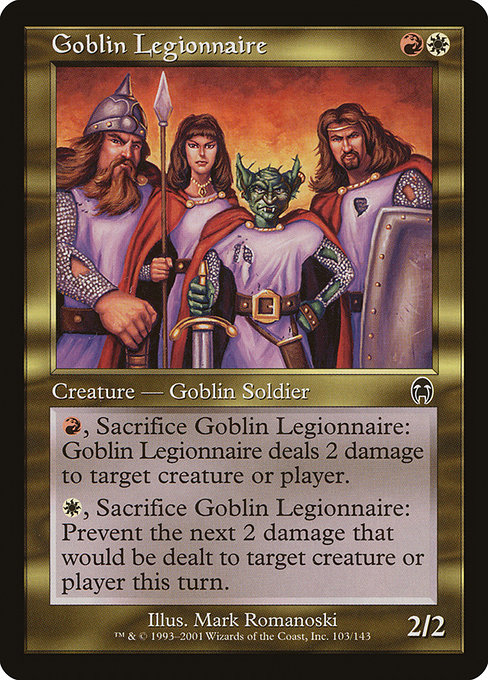
Image courtesy of Scryfall.com
Goblin Legionnaire crashes onto the battlefield with a blunt, dependable punch: a lean, two-mana creature that doubles as a weather vane for how quickly a match can swing in either direction. This red-white Goblin Soldier from Apocalypse is a classic example of how MTG balance can hinge on tempo and choice. At first glance, a 2/2 for {R}{W} seems modest, but the card’s two separate, sac-for-effect abilities give it unusual upside—and equally unusual decisions for both players. 🧙♂️🔥
Understanding the card’s core: what it really asks you to do
Goblin Legionnaire is a color-colored, two-edged tool. It’s a 2/2 creature for two mana, which already places it squarely in the “you probably want to answer it” camp in most early-game scenarios. But the card’s real strategic flavor comes from its activated abilities, both of which require sacrificing the Legionnaire itself:
- R}, Sacrifice this creature: It deals 2 damage to any target. This is a no-nonsense reach tool. On turn two, you can point 2 damage anywhere—face, a blocker, or a planeswalker—often turning a stalled board into a decisive moment.
- {W}, Sacrifice this creature: Prevent the next 2 damage that would be dealt to any target this turn. Think of this as a one-turn shield. It buys you breathing room, protects a critical attacker, or buys your life total a little extra cushion when facing a flood of aggressive noise.
That duality is the heartbeat of the card. It’s typical for Apocalypse to flank aggressive red-white strategies with nimble, value-forward creatures, and Legionnaire embodies that approach: it can push damage or prevent it, depending on what the board needs in the moment. Because it’s a common in a highly color-split squad, it’s also a frequent fixture in budget or casual metagames, where players rely on quick decisions and reliable bodies. Balance is the keyword here—use its abilities when they shift the outcome, not just as a reflex.
“In tempo games, a small two-mana misdirection can be worth a whole card.”
Counterplay: how to stop Goblin Legionnaire in its tracks
Strategy starts with recognizing the threat curves and the value of the two sac-abilities. Here are practical avenues you can lean on, depending on your deck’s color identity and style. 🧙♂️
- Answer it early with efficient removal. If you’re playing red or white removal, strike while it’s small. A quick Shock, Lightning Bolt, or other cheap removal spell can erase the body before those sac-for-damage tricks can pay off. White options like Condemn, Swords to Plowshares, or Path to Exile achieve the same result in different flavors, often leaving you with a happier board state after the dust settles. The key is to prevent the 2-damage payoffs from stacking up over multiple turns.
- Trade efficiently when it arrives. A single 2/2 can be traded with a variety of creatures. If you can block with a creature that’s close on value, you’ll force your opponent to commit to their two sac lines, potentially past the point of optimal value. If you’re playing Blue or Green, consider a tempo-friendly bounce or a bigger body that can safely hold off while you assemble a longer game plan.
- Chip away with value engines and reach creatures. Even if you don’t remove it immediately, ensure you’re applying pressure elsewhere on the board. A well-timed extra threat can force your opponent into awkward sac decisions, where they have to choose between keeping the Legionnaire alive and preventing damage to their own life total or board state.
- Plan for the white protection on crucial turns. The white prevention ability is the true tempo swayer. If your opponent can protect a fragile blocker or stabilize long enough to fire off that shield, you’ll need an additional removal or a bigger threat to press through. Don’t overcommit; keep a secondary answer ready for that “save the next two” moment.
- Adapt with your sideboard and game plan. In more controlled or midrange builds, this card can be answered by broad removal or by skewing the matchup so that your deck’s larger strategy dominates even if the Legionnaire sticks around for a turn. The common rarity and its set placement mean you’ll see it in lower- to mid-pressure games, so your plan should reflect a mindset of “tempo into a safe swing.”
In the end, Goblin Legionnaire rewards good angles: use your removal to erase the immediate threat, trade the body when you can, and keep pressing with diverse threats that outpace its two-for-one potential. It’s a card that teaches the art of tradeoffs in real time—sacrifice a creature, but outpace your opponent with superior card timing. ⚔️
How to incorporate it into your own deckbuilding philosophy
Decks that splash red and white often lean on fast, decisive play. The Legionnaire fits neatly into an aggressive or tempo-oriented shell that wants to punch early and force mistakes. If you’re building a budget or casual deck, this card can anchor a two-drop window where you’re applying pressure on multiple angles. The dual ability provides a built-in “two-for-one” dynamic; it’s not just about getting in for two points—it's about forcing your opponent into bad sac decisions or desperate answers. Know when to pull the trigger on its red ability vs. when to reserve the white shield for a future threat. The discipline to pick the right moment is where the real mastery lies. 🎨
And if you’re curious about where this card sits in the broader MTG ecosystem, note that Apocalypse brought a mix of fast, aggressive creatures and explosive, budget-friendly options. Goblin Legionnaire’s commonplace status makes it a reliable barometer for how players value tempo in the early turns. It’s not a game-ending bomb, but it’s a reliable accelerant that can tilt a match in a blink if left unchecked. 💎
As you refine your approach to Goblin Legionnaire, remember that tactics evolve with the metagame. The opposite table you sit at might be tanking on removal-heavy decks or flood into big finishers. Either way, staying proactive, keeping pressure, and reserving your own defensive assets for the right moments will keep you in control of the game’s tempo. And if you ever need a little desk-side inspiration while you ladder, grab a round or rectangular Neoprene Mouse Pad (Round or Rectangular One-Sided Print) to keep your strategies visually sharp and your wrists comfy while you plan your next turn. 🧙♂️🔥💎
Neoprene Mouse Pad Round or Rectangular One-Sided PrintMore from our network
- https://crypto-acolytes.xyz/blog/post/dynamic-terrain-redefining-immersion-in-open-world-games/
- https://blog.crypto-articles.xyz/blog/post/nft-data-solidskulls-1052-from-solidskulls-collection-on-magiceden/
- https://crypto-acolytes.xyz/blog/post/in-minutes-women-allege-rushed-hysterectomies-without-proper-exams/
- https://donation.digital-vault.xyz/donation/post/support-open-access-for-the-next-generation/
- https://blog.crypto-articles.xyz/blog/post/nft-data-pumpixels-704-from-pumpixels-collection-on-magiceden/
Goblin Legionnaire
{R}, Sacrifice this creature: It deals 2 damage to any target.
{W}, Sacrifice this creature: Prevent the next 2 damage that would be dealt to any target this turn.
ID: c684407e-277a-4e32-a978-cdac9548acce
Oracle ID: 582fdfbe-c5fe-45d0-b3ff-e66db5183725
Multiverse IDs: 26760
TCGPlayer ID: 7961
Cardmarket ID: 3215
Colors: R, W
Color Identity: R, W
Keywords:
Rarity: Common
Released: 2001-06-04
Artist: Mark Romanoski
Frame: 1997
Border: black
EDHRec Rank: 26830
Penny Rank: 9527
Set: Apocalypse (apc)
Collector #: 103
Legalities
- Standard — not_legal
- Future — not_legal
- Historic — not_legal
- Timeless — not_legal
- Gladiator — not_legal
- Pioneer — not_legal
- Modern — not_legal
- Legacy — legal
- Pauper — legal
- Vintage — legal
- Penny — not_legal
- Commander — legal
- Oathbreaker — legal
- Standardbrawl — not_legal
- Brawl — not_legal
- Alchemy — not_legal
- Paupercommander — legal
- Duel — legal
- Oldschool — not_legal
- Premodern — legal
- Predh — legal
Prices
- USD: 0.16
- USD_FOIL: 0.87
- EUR: 0.18
- EUR_FOIL: 1.46
- TIX: 0.04
More from our network
- https://crypto-acolytes.xyz/blog/post/nft-stats-it-kids-04626-from-it-kids-collection/
- https://crypto-acolytes.xyz/blog/post/nft-stats-geek-513-from-geeks-collection/
- https://blog.rusty-articles.xyz/blog/post/how-xenoblade-chronicles-3-transformed-streaming-culture/
- https://blog.crypto-articles.xyz/blog/post/nft-data-alchemist-3715-from-e-lander-alchemist-collection-on-magiceden/
- https://donation.digital-vault.xyz/donation/post/support-cyberspace-evolution-documentation-and-research/